
How to Use Minimum Night Settings to Maximize Your Airbnb Revenue
Your minimum stay setting is one of the most powerful levers in your listing — and most hosts set it once and never revisit it. Here's how to use it more strategically.
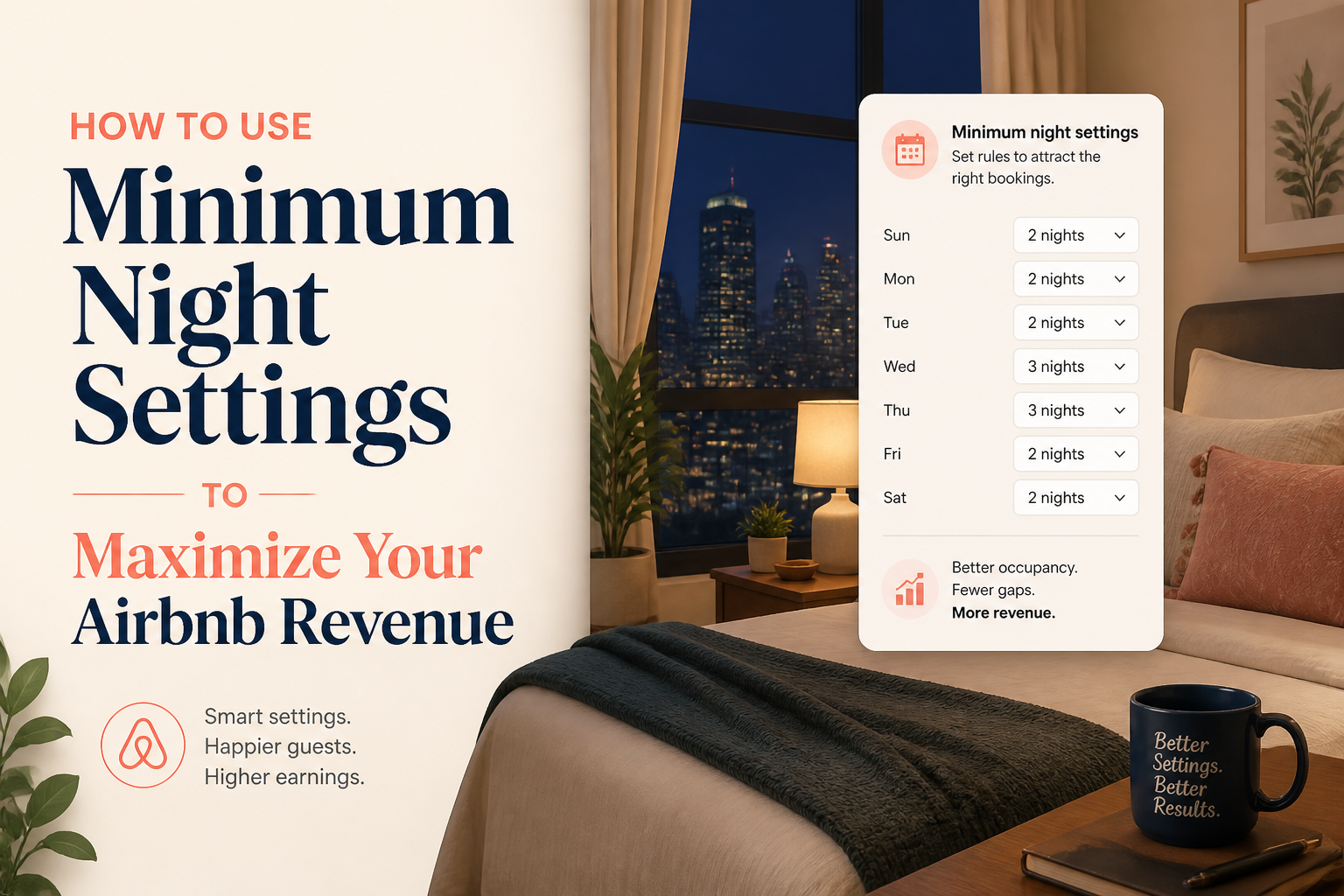
Most hosts set their minimum night requirement when they first list their property and never change it. They pick a number, two nights seems reasonable to most people starting out, and leave it there regardless of what their calendar is doing, what season it is, or what the gap between their bookings actually looks like.
That approach works well enough to avoid obvious mistakes. But it leaves a meaningful amount of revenue on the table, and it creates occupancy problems that a more deliberate approach would solve.
Your minimum stay setting is not a preference. It is a pricing tool. And like any pricing tool, it works best when you use it actively rather than set it and forget it.
Understand What Your Minimum Night Setting Actually Does
Your minimum night requirement does two things simultaneously, and understanding both helps you set it more intelligently.
First, it filters the type of guest your listing attracts. A two-night minimum screens out guests who want a single night for a specific, often lower-effort purpose. A five-night minimum screens out weekend guests entirely and attracts longer-stay travelers, often families or remote workers, who are planning a more substantial trip. Every minimum night setting is implicitly a statement about which guests you are and are not trying to reach.
Second, it shapes how your calendar fills. A high minimum stay fills your calendar with fewer, longer bookings and leaves fewer but larger gaps. A low minimum stay produces more frequent turnovers and smaller gaps but also more flexibility to fill the calendar continuously. Neither is inherently better. The right answer depends on your cleaning costs, your market, and how you want to operate.
The Tiered Approach That Most Experienced Hosts Settle Into
Hosts who have been listing for more than a couple of years tend to move away from a single fixed minimum and toward a tiered approach that adjusts based on season and demand.
The most common version looks something like this: a higher minimum during peak season, typically three to five nights, captures longer-stay bookings at higher rates during the period when demand is strongest and the calendar fills regardless of minimum. A standard minimum of two nights applies during the shoulder season when demand is moderate. And a lower minimum, sometimes one night, opens up during the off-season or in calendar gaps where the alternative to a short booking is an empty slot.
The logic behind the tiered approach is straightforward. During peak season, every night has high value and a longer booking captures more of that value per turnover. During the off-season, the marginal value of a one-night booking that would otherwise be empty is positive even if the margin is thin. The minimum night setting should reflect that difference rather than applying the same rule to fundamentally different market conditions.
Gap Nights Are Where the Strategy Gets Interesting
The most common complaint about minimum stay requirements is the calendar gap problem: a three-night minimum that leaves a single night between two longer bookings that cannot be extended in either direction. That night sits empty, earning nothing, because no one will book a three-night stay for a one-night gap.
This problem is real and it has a direct cost. Multiply a handful of these gaps across a month and the lost revenue becomes significant. The hosts who manage this most effectively tend to use one of two approaches.
The first is Airbnb's smart minimum stay setting, which automatically allows bookings shorter than your stated minimum when they would fill a gap that a longer booking cannot. You set your standard minimum and the platform handles the exceptions. Several hosts describe this as one of the most useful settings on the platform and the one most commonly overlooked by newer hosts.
The second approach is manual: periodically reviewing the calendar, identifying gaps, and temporarily lowering the minimum for the specific dates that need filling. This requires more attention but gives you more control over exactly when and how shorter stays are made available.
Pricing and Minimum Stays Work Together
One of the clearest mistakes hosts make is treating minimum stay and pricing as separate decisions. They are not. They are two levers that work together to determine the revenue and margin per booking.
A one-night booking at a standard nightly rate often produces a thinner margin than it appears to because the fixed cost of the turnover, cleaning, laundry, access coordination, is applied against a single night of revenue. A one-night booking priced at a premium produces a different result entirely.
Several hosts who accept one-night bookings price them specifically to reflect their higher per-night cost. One charges one and a half times her standard nightly rate for single nights. Another builds the premium into a short-stay surcharge that applies automatically below a certain booking length. The effect is that one-night guests pay more per night, which is accurate: serving them costs more per night than serving a longer-stay guest.
When you think about minimum stay and pricing together, the question shifts from should I allow one-night bookings to what price makes a one-night booking worth accepting. That is a much more useful question, and it tends to produce a more profitable answer.
When to Revisit Your Current Setting
If you have not looked at your minimum stay setting in the last six months, it is worth revisiting now with a few specific questions in mind.
How many gap nights did you have in your calendar last month? If the answer is more than two or three, your minimum stay may be creating occupancy problems that a smarter gap-night policy would solve.
What does a one-night turnover actually cost you? If you have never calculated this number specifically, your intuition about whether one-night bookings are worth it may be wrong in either direction.
Is your minimum stay the same across all seasons? If yes, you are almost certainly leaving revenue on the table during peak periods and possibly creating unnecessary gaps during slower ones.
The minimum night setting is one of the most powerful levers in your listing. It shapes who books, how often, at what margin, and how full your calendar stays. Using it deliberately rather than as a default is one of the simplest improvements most hosts can make without changing anything else about how they operate.
Airbnb optimization specialist, Superhost, and founder of one of the largest Airbnb host communities.
Continue Reading
Chosen for you from The Optimization Journal.
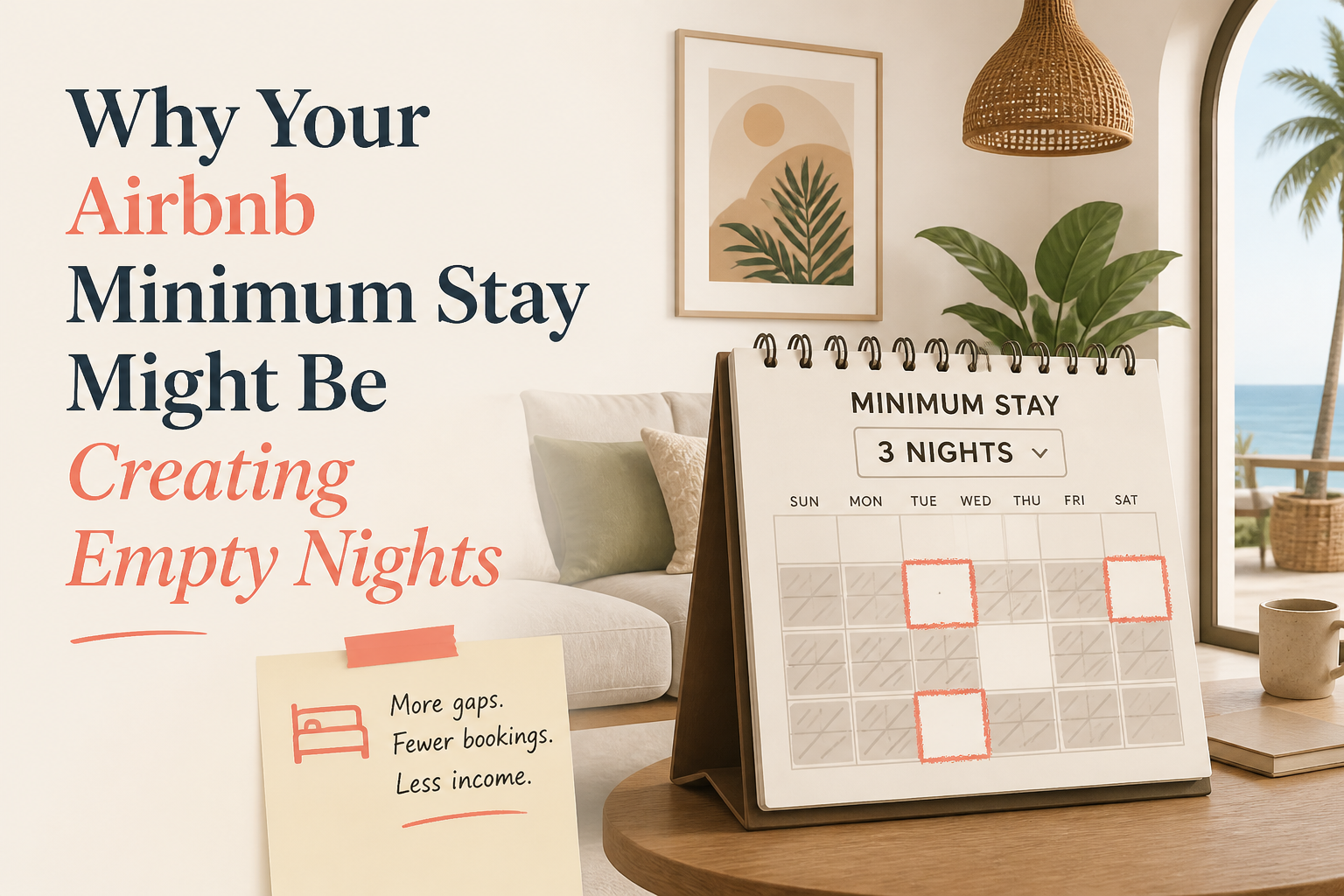 Why Your Airbnb Minimum Stay Might Be Creating Empty Nights
Minimum-stay rules can protect your calendar, reduce turnovers, and help you avoid low-value reservations. But the same rule can also create gaps that become nearly impossible to book. The trick is knowing when to hold your minimum and when the calendar is telling you to adjust it.
5 min read One-Night Airbnb Bookings: Are They Worth It?
The nightly rate looks fine. The cleaning fee is included. Then you run the actual numbers — and everything changes. Here's what experienced hosts have figured out about one-night stays.
6 min read What Are Orphan Nights on Airbnb and How Do You Fill Them?
Orphan nights are small gaps in your Airbnb calendar that become difficult or impossible to book because of the reservations around them. They are easy to miss, but over time they can quietly reduce occupancy. Here is how to identify them and decide what to do.
6 min read How Check-In Flexibility Becomes One of Your Best Hospitality Tools
The gesture that costs you nothing can be worth more than any amenity you add to your listing. Here's how to make check-in flexibility work in your favor.
5 min read Same-Day Airbnb Bookings: The Risk and Reward Hosts Need to Understand
Two hosts. Same situation. Completely opposite experiences. The difference between them was not luck — it was systems.
6 min read