
How Check-In Flexibility Becomes One of Your Best Hospitality Tools
The gesture that costs you nothing can be worth more than any amenity you add to your listing. Here's how to make check-in flexibility work in your favor.

There is a moment that happens at the beginning of almost every vacation rental stay that most hosts never think about deliberately. The guest arrives. They have been traveling. They are carrying things. They are tired or excited or both. And in the first five minutes of walking into your property, they form an impression that will shape how they experience everything that follows.
What that moment feels like is largely within your control. And one of the simplest ways to make it feel genuinely good rather than merely adequate is to let them arrive when it works for them rather than when it works for you.
Early check-in and late checkout are not just operational decisions. They are hospitality decisions. And the hosts who use them deliberately tend to find that the goodwill they generate is disproportionate to what they actually cost.
Why the Offer Matters Even When the Answer Is No
One of the more counterintuitive findings among hosts who offer flexible check-in times is that the offer generates goodwill even when it cannot be fulfilled.
One host who tells every guest at booking that early check-in may be available, subject to the cleaning schedule, and promises to confirm the day before, said that over fifteen months of hosting only a handful of guests were actually able to take advantage of it. Same-day turnovers, back-to-back bookings, and cleaner scheduling meant that most of the time early access was not possible.
But the guests who received that message at booking, and then received a follow-up saying that unfortunately it would not be possible this time, responded better than guests at properties that simply said check-in is at three and left it at that. The offer communicated that the host had thought about them. The follow-up communicated that the host had actually checked. Neither of those things costs anything. Both of them matter.
How to Structure the Offer So It Does Not Create Problems
The hosts who have the best experiences with check-in flexibility tend to have built a clear, consistent process around it rather than deciding on the fly for each guest.
The process looks something like this. At booking, let the guest know that you try to accommodate early check-in and late checkout when your schedule allows, and that you will confirm availability the day before their arrival. This sets an accurate expectation: flexibility is something you offer when you can, not something that is guaranteed.
The day before arrival, check with your cleaner about the schedule and whether early access is feasible. If it is, message the guest with a specific time they can arrive. If it is not, let them know the standard time stands. The guest has been kept informed, their expectation was set correctly from the start, and there is no gap between what was promised and what is delivered.
The key is that the cleaner conversation happens before the guest conversation. Hosts who promise flexibility and then discover they cannot deliver it create a worse experience than hosts who never offered it. The sequence matters: check first, then confirm.
The Competitive Advantage Hotels Cannot Match
Several hosts described their flexibility policy explicitly as a way of differentiating themselves from hotels, and the comparison is worth taking seriously.
Hotels charge for early check-in and late checkout because those services have a real cost in their operating model. Rooms need to be serviced on a schedule. Front desk staff need to manage inventory across hundreds of guests simultaneously. The pricing reflects genuine operational constraints.
Vacation rental hosts often do not have those constraints in the same way. When a property is already clean and ready, granting early access costs the host almost nothing. When a guest departs and the next booking does not arrive for another day, a late checkout costs nothing at all. In those situations, charging for flexibility is not recovering a real cost. It is applying a hotel logic to a situation that does not require it.
The guests who notice this most are the ones who travel frequently and have experienced both models. They have been charged forty dollars to check into a hotel room two hours early. They have been charged sixty-five dollars to leave an hour late. When they encounter a vacation rental host who offers those same accommodations freely, the contrast is immediate and it tends to show up in exactly the kind of review language that brings in the next booking.
When Charging Makes Sense and How to Do It Well
There are genuine situations where charging for early check-in or late checkout is reasonable, and presenting it clearly tends to go over better than most hosts expect.
When accommodating a request requires real coordination, a same-day turnover that needs to be rushed, a cleaner who needs to come in earlier than scheduled, an access arrangement that requires the host to be physically present, charging a fee that reflects that cost is accurate and honest. Most guests understand this when it is explained clearly rather than imposed without context.
The framing matters more than the fee itself. Priority early check-in, available for a fee when it requires scheduling adjustments, lands differently than we charge extra for early arrivals. One is a service with a clear value. The other sounds like a penalty for having a flight that lands at noon.
One host who charges fifty dollars for priority early check-in, available when there is no same-day checkout, described the response from guests as consistently positive. Guests who want the option have a clear way to get it. Guests who do not can arrive at the standard time. The transparency removes the friction that undefined policies tend to create.
The Simple Version That Works for Most Hosts
If you want a check-in flexibility policy that is easy to communicate and consistently well-received, the simplest version is this: offer both early check-in and late checkout for free when your schedule allows, confirm availability the day before arrival, and communicate clearly when it is not possible.
That approach requires no fee structure, no tiered pricing, and no complex decision-making on a guest-by-guest basis. It requires only that you check with your cleaner before you commit and that you follow through on what you say.
The guests who benefit from it will mention it in their reviews. The guests who did not get it this time will appreciate being kept informed. And the ones who come back a second time will often be partly coming back because of how that first arrival felt, which is the kind of outcome no amenity list ever produces on its own.
Airbnb optimization specialist, Superhost, and founder of one of the largest Airbnb host communities.
Continue Reading
Chosen for you from The Optimization Journal.
 Early Check-In and Late Checkout: Should You Charge or Offer It Free?
A hotel in Las Vegas charged one host $40 to check in early and $65 to check out late. She went home and changed her listing policy immediately. Here's the debate that followed.
5 min read The Small Hosting Details That Guests Remember Long After Checkout
It's rarely the big amenities that guests talk about in their reviews. It's the small, personal moments that a hotel would never think to create.
5 min read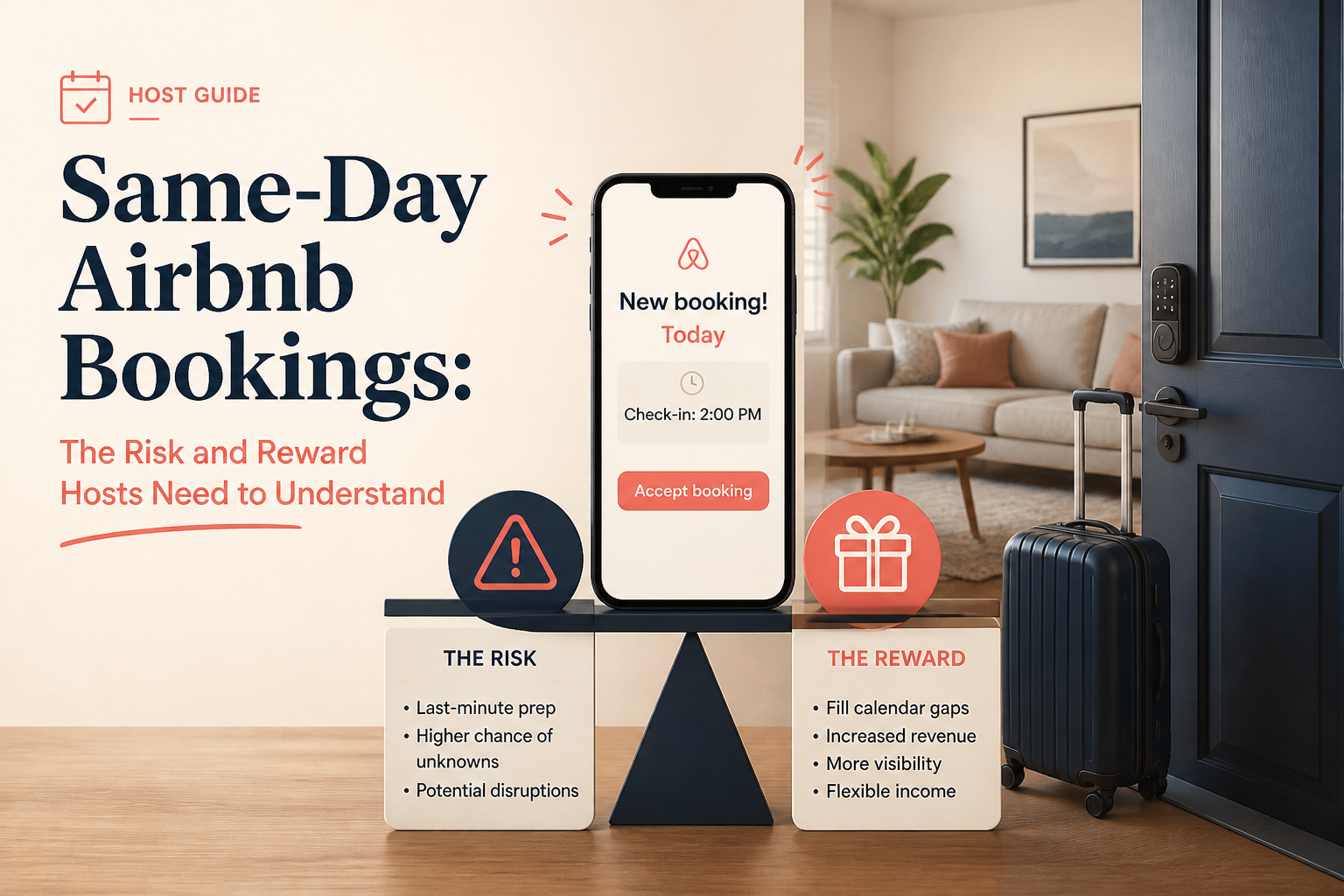 Same-Day Airbnb Bookings: The Risk and Reward Hosts Need to Understand
Two hosts. Same situation. Completely opposite experiences. The difference between them was not luck — it was systems.
6 min read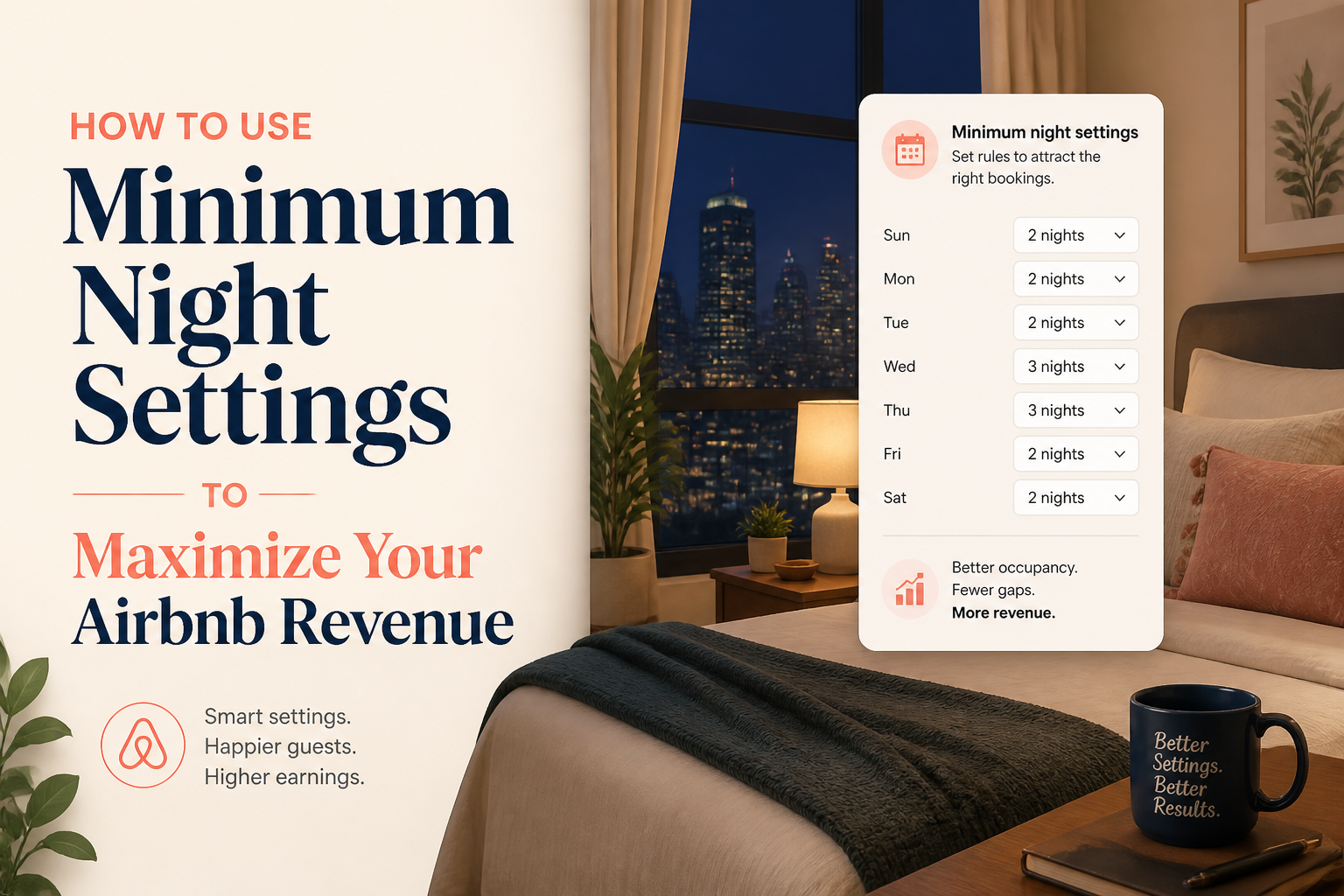 How to Use Minimum Night Settings to Maximize Your Airbnb Revenue
Your minimum stay setting is one of the most powerful levers in your listing — and most hosts set it once and never revisit it. Here's how to use it more strategically.
5 min read What Guests Are Really Looking for When They Book a Vacation Rental
Guests don't choose vacation rentals because they're cheaper than hotels. They choose them because they offer something a hotel genuinely cannot. Here's what that actually looks like in practice.
5 min read