
Why Your Airbnb Minimum Stay Might Be Creating Empty Nights
Minimum-stay rules can protect your calendar, reduce turnovers, and help you avoid low-value reservations. But the same rule can also create gaps that become nearly impossible to book. The trick is knowing when to hold your minimum and when the calendar is telling you to adjust it.
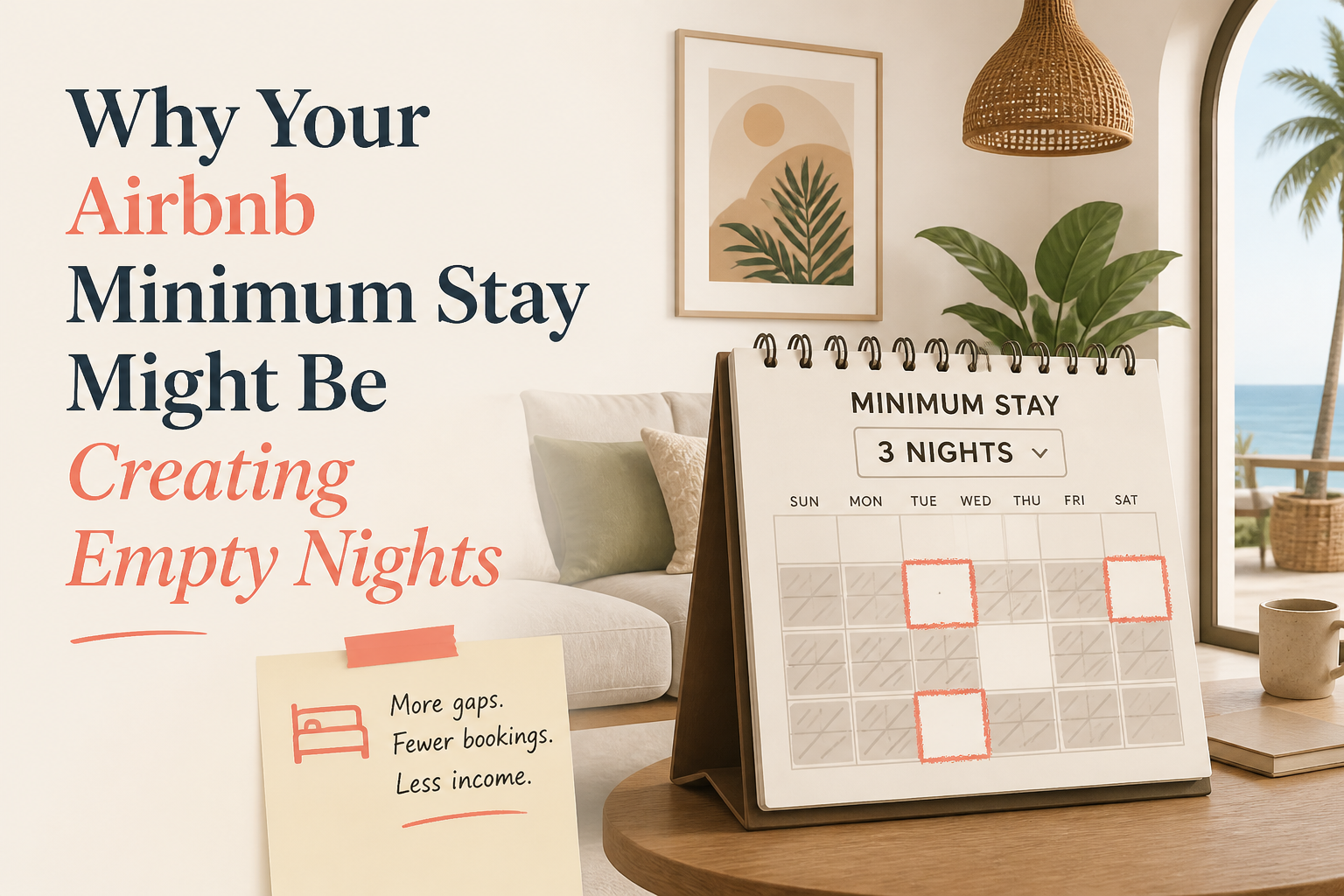
A three-night minimum sounds simple.
You decide that stays shorter than three nights are not worth the cleaning, turnover, or effort, so you apply the rule to your calendar.
Then two reservations come in.
One guest checks out on Thursday. The next arrives Saturday.
Now you have Thursday and Friday available, but your three-night minimum makes those two nights impossible to book.
Your calendar says they are open.
Your rules say nobody can have them.
This is where a perfectly reasonable minimum-stay strategy can start working against you.
The Minimum Stay Was Not Necessarily Wrong
I would not look at that two-night gap and immediately conclude that the three-night minimum was a mistake.
It may have been exactly the right rule when the calendar was wide open.
A longer minimum can reduce cleaning costs, create better reservations, protect weekends, and prevent your calendar from being broken into lots of short stays.
The problem is that the calendar changes as bookings come in.
A rule that made sense when you had 30 consecutive nights available may not make sense when only two nights remain between reservations.
That is why I think minimum stays need to be managed with the calendar rather than treated as one permanent number.
Ask What the Rule Is Protecting
Before changing a minimum stay, I would ask why it exists in the first place.
If you require three nights because your cleaning cost makes one-night stays unprofitable, that is a real operational reason.
If you require four nights over a holiday because you expect strong demand, that is a revenue decision.
If you have a seven-night minimum simply because you set it two years ago and never revisited it, that is different.
A rule should have a purpose.
Once you know what you are protecting, it becomes much easier to decide when an exception makes sense.
Scenario 1: The Gap Is Far Away
Suppose you have a two-night opening between reservations, but those dates are still three months away.
I probably would not rush to change anything.
There is still time. Reservations around the gap may change. Someone could cancel. Your market may book those dates much closer to arrival. You may even decide later that the two-night stay is worth accepting.
There is usually no reason to solve a distant calendar problem with an aggressive decision today.
I would notice the gap and keep watching it.
Scenario 2: The Gap Is Next Week
Now take the same two-night opening and move it to next week.
The decision changes.
You have much less time for another reservation to reshape the calendar. If your normal minimum is three nights, maintaining that rule effectively guarantees the two nights will remain empty.
At that point I would ask whether a two-night stay is better than no stay.
For many properties, the answer will be yes.
For others, cleaning cost, turnover workload, or operational complexity may still make it unattractive.
The important part is making the choice consciously rather than letting the original rule make it for you.
Scenario 3: It Is a Valuable Weekend
This is where I would be more careful.
Imagine you have Saturday night sitting between two reservations, and Saturday is normally one of your most valuable nights.
Opening it to a one-night stay could recover some revenue.
But it also creates another turnover, and a single Saturday may attract a different type of booking than you normally want.
You have to weigh the value of the night against the cost and risk of the turnover.
There is no rule that says every orphan night must be filled.
Sometimes leaving it empty is the better business decision.
Scenario 4: Your Competitors Allow Shorter Stays
Now imagine your calendar is unusually open and several comparable properties nearby are allowing two-night stays while you still require four.
That does not mean you should copy them.
But it should make you ask a question.
If a guest is searching for a two-night trip, those competitors may qualify for the search while your property does not.
You may think you have a ranking problem when the real problem is that your minimum stay removes you before ranking even becomes relevant.
This is where I like looking at minimum-stay patterns alongside competitor availability rather than evaluating your rule in isolation.
Do Not Fix Every Gap With a Discount
Another mistake is assuming that every empty gap needs both a shorter minimum and a large price reduction.
I would separate those decisions.
First ask whether the dates can actually be booked under your current stay rules.
If not, adjusting the minimum may be enough.
Only then ask whether the price also needs to move.
If you change the minimum from three nights to two and demand is strong, there may be no reason to discount heavily.
The calendar problem and the pricing problem are not always the same problem.
Watch What Happens Around Existing Reservations
I think hosts naturally focus on the large open sections of the calendar.
Those are easy to see.
The smaller gaps are easier to miss.
A one-night opening here. Two nights between reservations there. A weekend split by a Sunday arrival. A four-night opening that cannot accept your normal five-night minimum.
None of them looks dramatic.
But if enough of them accumulate, they can quietly reduce occupancy and revenue.
This is why the shape of the calendar matters as much as the number of open nights.
Use the Calendar Gap Analyzer for the Exceptions
This is exactly the kind of problem the Calendar Gap Analyzer is meant to find.
Instead of forcing you to scan months of reservations looking for awkward openings, it looks for orphan nights, short stretches, and other gaps created by the bookings around them.
The tool is not there to tell you that every gap should be filled.
It is there to make sure you actually see the gap and can decide whether your normal minimum-stay rule still makes sense for those specific dates.
That difference is important.
Then Look at the Market Around the Gap
Once you find a difficult opening, I would not make the decision in a vacuum.
Competitor Intelligence can help you see whether similar properties are using shorter minimum stays or are also sitting open.
Local Events & Demand can help explain whether those dates may become more valuable because something is happening nearby.
And if the stay is approaching quickly, your pricing strategy becomes more relevant as well.
You are building context around the gap instead of reacting to one empty square on the calendar.
My Rule Is Simple
I would use a minimum stay to shape the calendar while I still have plenty of availability.
Then I would become more flexible as bookings create smaller openings and the arrival date gets closer.
Not automatically.
Not at any price.
But deliberately.
A minimum stay should help you build a better calendar.
Once the minimum itself becomes the reason a perfectly usable night cannot be booked, it is worth asking whether the rule is still doing its job.
Airbnb optimization specialist, Superhost, and founder of one of the largest Airbnb host communities.
Continue Reading
Chosen for you from The Optimization Journal.
 What Are Orphan Nights on Airbnb and How Do You Fill Them?
Orphan nights are small gaps in your Airbnb calendar that become difficult or impossible to book because of the reservations around them. They are easy to miss, but over time they can quietly reduce occupancy. Here is how to identify them and decide what to do.
6 min read How to Compare Your Airbnb Calendar With Competitors
Looking at competitor calendars can help you understand whether a slow period is specific to your property or happening across your market. But availability does not automatically mean a property is struggling, and blocked dates do not necessarily mean bookings. Here is how I would use competitor calendar data without reading too much into it.
5 min read Why Airbnb Hosts Should Track Local Events Months in Advance
By the time a major local event is obviously driving Airbnb demand, some of the best booking opportunities may already be gone. Concerts, festivals, graduations, tournaments, and conferences are much more useful when you know about them early enough to adjust your calendar before guests start booking.
6 min read Why I Create Airbnb Discounts Inside Airbnb, Not PriceLabs
A host asked a question in our Facebook group yesterday about discounts and PriceLabs, and it got me thinking. I use dynamic pricing, but when I want to offer an additional discount to Airbnb guests, I prefer creating it inside Airbnb. The underlying rate can continue to fluctuate, while Airbnb gets the opportunity to actually merchandise the discount.
7 min read How to Build an Airbnb Cleaning Schedule From Your Calendar
Cleaning schedules sound simple until you have back-to-back stays, date changes, cancellations, and multiple properties. A good system should make turnovers obvious without forcing cleaners to constantly ask what is happening. Here is how I would organize an Airbnb cleaning schedule directly from the booking calendar.
5 min read