
How to Choose and Implement a Guest-Count Pricing Strategy for Your Rental
The right pricing structure for your vacation rental depends on your property size, your market, and how much verification overhead you are willing to manage. Here is how to find the right fit.

Your pricing structure is not just a number. It signals something to every guest who looks at your listing, shapes the verification overhead you take on, and determines how much of your cost structure is visible versus absorbed. Here is how to choose the approach that fits your situation and make it work cleanly.
Start by calculating what additional guests actually cost you
Before you decide whether to price per person, you need to know whether additional guests create meaningful additional costs for your specific property. For some properties, the answer is yes in ways that add up. For others, the costs are so similar across occupancy levels that a flat rate is genuinely appropriate.
Estimate what changes when you go from two guests to six. More loads of laundry. Higher utility bills. Longer cleaning time if you pay your cleaner hourly. Additional wear on high-traffic surfaces. If these incremental costs are substantial at your nightly rate, per-person pricing has a real economic rationale. If the incremental costs are small relative to the nightly rate, a flat rate absorbs them without the overhead of managing guest count declarations.
Think about your property's natural occupancy point
Most properties have a natural occupancy level at which the space functions comfortably and the hosting economics work without strain. A three-bedroom house with two bathrooms might host four guests comfortably without meaningful additional effort compared to two. Adding a fifth and sixth guest might introduce additional laundry, additional bathroom pressure, and more complex cleaning.
That natural occupancy point, the level at which your costs are covered and your property functions well, is often the right threshold for a hybrid pricing structure. Set a flat rate for guests up to that level, and add a per-night fee for any guests beyond it. Smaller parties get a clear, accessible price. Larger parties pay the additional cost their stay creates. Neither group feels penalized relative to the other.
Decide how much verification you are willing to manage
Per-person pricing requires that you know how many guests are actually staying. Flat rate pricing does not. This is not a trivial operational difference, and you should factor it honestly into your decision.
If you charge per person and a guest declares two and arrives with five, you need a process for catching and addressing that. That might be a pre-check-in message confirming the guest count. It might be a security camera at the entrance that lets you see who arrives. It might be a monitoring system that notices additional activity. Whatever the process is, it takes time and attention.
If you are not prepared to maintain that process consistently, per-person pricing creates a rate structure that undercharges guests who misrepresent their count and overcharges guests who declare accurately, which is the worst of both worlds. Flat rate pricing is often more honest about what you can actually enforce.
Communicate the structure before, not during
Whatever pricing structure you choose, explain it clearly in your listing so guests can calculate their total cost before they inquire. A guest who reaches checkout expecting one price and discovers another has not been given the chance to make an informed decision. That experience generates friction regardless of whether your pricing structure is technically justified.
If you use a hybrid structure, make the base occupancy and the per-person fee explicit in the listing description, not buried in the fine print. Something like: rate covers up to four guests; additional guests twenty-five dollars per night per person, maximum eight guests. A guest reading that has everything they need to calculate their cost before they book.
How to handle the guest who arrives with more people than declared
If you charge per person or have a hybrid structure, you will eventually have a guest who arrives with more people than the reservation reflects. How you handle this matters both for the specific stay and for the precedent it sets.
The most practical approach is to address it before check-in rather than at check-in. A confirmation message sent a day or two before arrival that references the guest count on the reservation, and notes that the rate and cleaning plan are based on that number, gives guests the opportunity to correct a mistake or acknowledge a change before they arrive.
If additional guests arrive without notice, a calm, factual message through the platform noting the discrepancy and the applicable additional charge is the appropriate response. Keep the tone professional. The guest may have made an honest mistake. Document the communication on platform regardless of the outcome.
What the platform shows and when it matters
Platform search results can display your listing differently depending on the party size the guest enters in their search. A property priced for full capacity on a flat rate will show the same price to a party of two as to a party of eight. A property with per-person pricing may show lower rates to smaller parties.
This visibility effect can matter significantly in markets where smaller groups make up a meaningful share of the bookings. If you want your listing to be competitive for couples and small families as well as large groups, per-person pricing with a base occupancy rate tends to present a more attractive headline number to those smaller searches. In markets dominated by large-group bookings, this consideration matters less.
Know who your primary guest profile is. Set your pricing structure to be maximally visible and accessible to the guests you most want to attract, while recovering the costs of serving the guests who use the space most fully.
Airbnb optimization specialist, Superhost, and founder of one of the largest Airbnb host communities.
Continue Reading
Chosen for you from The Optimization Journal.
 CornerstoneShould You Lower Airbnb Prices When Bookings Slow Down? What Hosts Actually Say
When Airbnb bookings slow down, should you lower your nightly rate or hold firm? Discover what experienced hosts reported, why some regret discounting, and how to make smarter pricing decisions.
15 min read The Flat Rate Versus Per-Person Pricing Debate in Short-Term Rentals
When one person pays the same nightly rate as eight, is that fair? When a solo guest cannot afford a space that costs as much as it does for a full group, is that fair? The pricing question is more interesting than it first appears.
5 min read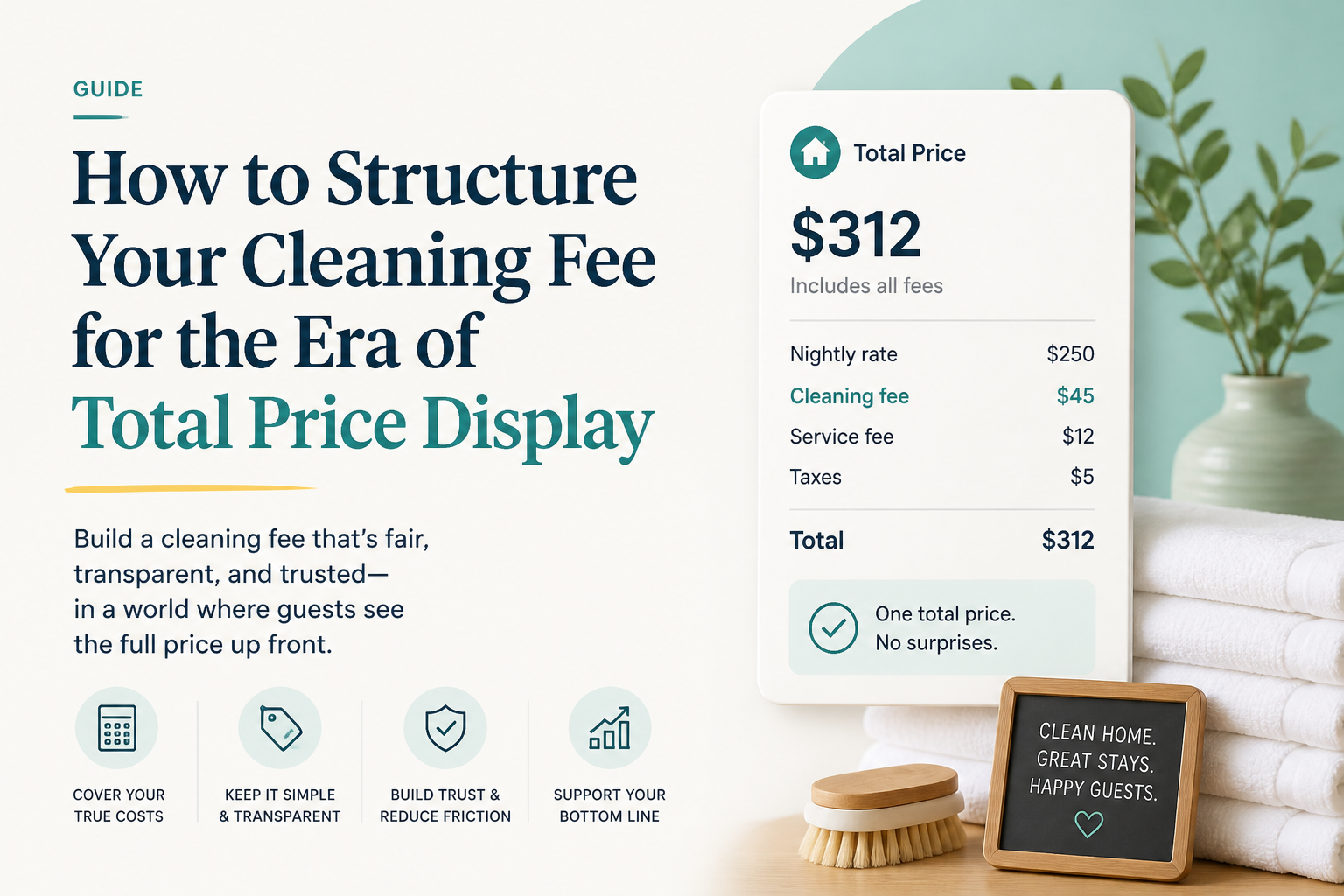 How to Structure Your Cleaning Fee for the Era of Total Price Display
Guests now see your total cost including cleaning fees from the first search result. Here is how to set your cleaning fee structure in a way that works with that reality rather than against it.
4 min read How Check-In Flexibility Becomes One of Your Best Hospitality Tools
The gesture that costs you nothing can be worth more than any amenity you add to your listing. Here's how to make check-in flexibility work in your favor.
5 min read How to Write an Event Policy That Actually Protects Your Vacation Rental
A no-party rule is only as good as how clearly it's communicated. Here's how experienced hosts define, enforce, and occasionally profit from their event policies.
5 min read