
Airbnb Listing Optimization: 8 Before-and-After Examples That Show What Actually Changes
What does Airbnb listing optimization actually look like? Explore eight before-and-after examples covering titles, descriptions, photo order, captions, amenities, and guest expectations, plus a real SuperhostSEO listing audit.
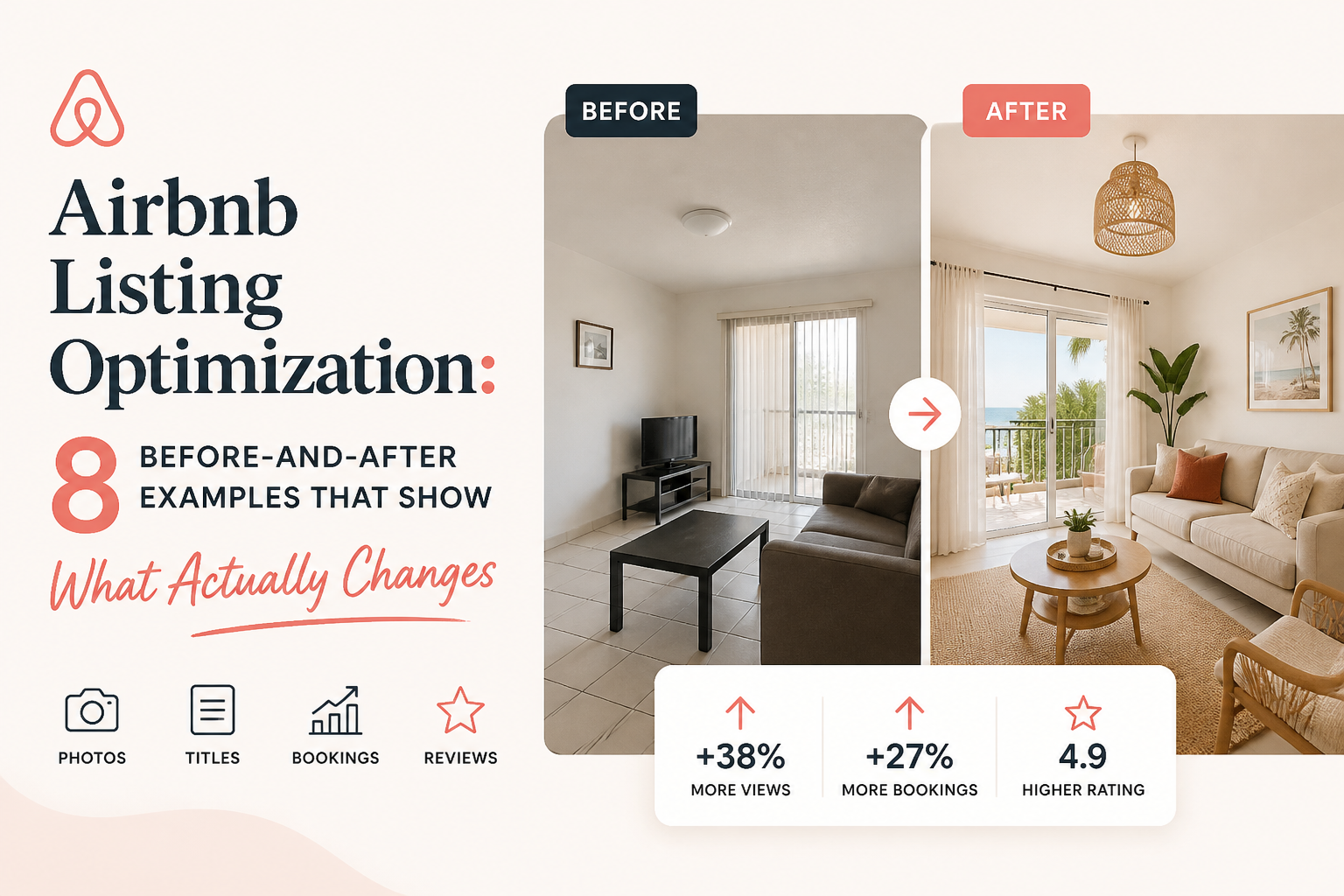
What does Airbnb listing optimization actually look like before and after the work is done?
Usually, it isn't about inventing an entirely new property description or filling every sentence with marketing language.
It's about making the property's real strengths easier to recognize, organizing information so guests can find what matters, and correcting the details that create unnecessary uncertainty.
An unoptimized listing might describe a property as a "beautiful home in a great location."
An optimized version explains that the home has a private pool, three bedrooms, outdoor dining for six, and off-street parking.
The property hasn't changed.
The difference is that the second version gives guests useful information they can actually evaluate.
In The Airbnb Optimization Playbook, I explain why a good listing needs more than attractive wording. Its title, summary, photographs, main description, amenities, and guest access information should work together.
And in The Airbnb Tools Playbook, I describe why an existing listing often needs to be reviewed section by section instead of rewritten blindly.
To demonstrate the difference, I'll walk through eight before-and-after examples.
I'll also show findings from a real Airbnb listing audit published on SuperhostSEO.
An important distinction: The illustrative rewrites in this article are teaching examples, not claims that specific properties achieved higher rankings or more bookings. The real audit findings are identified separately, and no post-optimization score is invented.
- Airbnb Title Optimization: Replace Generic Words With Real Benefits
Let's start with one of the most visible parts of your Airbnb listing.
The title.
Imagine a fictional three-bedroom vacation home with:
- A private swimming pool
- A covered outdoor dining area
- Three bedrooms
- Parking for two vehicles
- A fenced backyard
The host has already written a title.
It sounds friendly.
But it doesn't explain why the property deserves attention.
Before: The Generic Airbnb Title
"Beautiful Cozy Home in Great Location"
The problem isn't that the words are necessarily false.
The problem is that they could describe thousands of properties.
The title doesn't tell guests about the swimming pool.
It doesn't explain the outdoor space.
And it doesn't identify an advantage that may matter to the property's ideal audience.
After: The Benefit-Led Title
"Private Pool | Family Getaway | Fenced Yard"
This version changes the first impression.
It communicates three specific features or benefits.
A family comparing vacation rentals can understand something meaningful about the property without opening the complete description.
The title is also easier to connect with the opening photographs.
What Actually Changed?
The property's features remained exactly the same.
The improvement was in the order and specificity of the information.
Instead of relying on adjectives, the title leads with tangible selling points.
In Chapter 4 of The Airbnb Optimization Playbook, I recommend starting with the strongest benefits and considering how the title may appear when shortened on smaller screens.
The exact title should fit the property's real positioning.
A city apartment might emphasize a private terrace and dedicated workspace.
A mountain cabin might emphasize its view and hot tub.
A family vacation home might emphasize the pool and sleeping capacity.
The right wording depends on what makes the property valuable to its target guests.
When Not to Rewrite the Title
If your current title already communicates several strong, accurate benefits, rewriting it may not be your highest priority.
A good optimization process preserves what already works.
This becomes especially clear in the real audit example later in this article.
- Airbnb Summary Optimization: Use the Opening to Explain the Stay
Your Airbnb short summary provides a limited amount of space to introduce the accommodation.
That space should communicate something useful.
Yet many summaries begin with generic greetings, administrative details, or statements that could appear on almost any listing.
Before: The Generic Summary
"Welcome to our beautiful vacation home! We are excited to host you and hope you have a wonderful stay. Our home has everything you need for a memorable vacation."
There is nothing particularly offensive about this writing.
It's polite.
But it doesn't answer the questions guests actually have.
What kind of property is it?
Who is it suitable for?
What makes it different?
What features justify choosing it?
After: A Guest-Focused Summary
"Spend your days by the private pool and evenings dining outdoors at this three-bedroom family getaway. The fenced backyard offers room to unwind, while the open-plan living space gives everyone a place to gather. With two parking spaces and a full kitchen, the home is set up for an easy, comfortable stay."
This example assumes all the described features are accurate for our fictional property.
The summary now communicates an experience supported by real amenities.
It mentions the likely audience.
And it provides practical information.
What Actually Changed?
The revised summary does four things differently.
First, it gives guests a reason to care.
The private pool and outdoor dining area are presented as part of the stay.
Second, it identifies the audience.
A family can recognize that the accommodation may suit its needs.
Third, it connects features to benefits.
The living area isn't simply mentioned. Its purpose is explained.
Fourth, it uses the opening space efficiently.
There is less generic welcoming language and more information about the accommodation.
The Two-Layer Principle
In The Airbnb Optimization Playbook, I recommend making the short summary an introduction rather than a miniature copy of the entire property description.
The summary should make the property appealing and understandable.
The main description should provide the detailed information needed to evaluate it.
The two sections have different jobs.
Repeating the exact same sentences in both wastes valuable space.
- The Space Description: Turn a Wall of Text Into a Property Walkthrough
Now let's look at the main property description.
This is where I often find some of the biggest opportunities.
Many hosts write the description gradually.
They start with a short paragraph.
Then they add information about the kitchen.
Later, they add parking details.
A guest asks about a bedroom, so they add another sentence.
Eventually, the description becomes one long collection of facts.
Most of the information may be correct.
But it isn't organized around how guests evaluate a place to stay.
Before: An Unstructured Property Description
"Our house has three bedrooms, two bathrooms, a pool, a kitchen, Wi-Fi and parking. We have a nice living room with a TV and plenty of seating. The pool area is very relaxing. There are restaurants nearby and many activities in the area. The bedrooms are comfortable and the kitchen has what you need. Please read all the rules before booking."
This description contains information.
But it creates several questions.
What beds are in the bedrooms?
Are the bedrooms on the same floor?
Is the pool private?
How many people can sit at the dining table?
Is the parking covered or uncovered?
Where are the bathrooms?
After: A Structured Airbnb Description
Here's how I would organize the same fictional property after confirming its details.
THE SPACE
- Three bedrooms and two full bathrooms
- Single-level layout
- Private swimming pool and fenced backyard
- Open-plan living and dining area
- Full kitchen
- Two off-street parking spaces
- Wi-Fi throughout the home
LIVING AND DINING
The living room has comfortable seating, a television, and an open connection to the kitchen and dining area.
Sliding doors lead to the backyard, making it easy to move between indoor and outdoor spaces.
The dining table seats six guests.
BEDROOMS
Bedroom 1: King bed and ensuite bathroom.
Bedroom 2: Queen bed.
Bedroom 3: Two twin beds.
The second bathroom is accessible from the main hallway.
All bedrooms are on the same level.
KITCHEN
The kitchen includes a full-size refrigerator, stove, oven, microwave, dishwasher, coffee maker, cookware, and basic dining essentials.
The kitchen opens toward the dining area and living room.
OUTDOOR SPACE
The private backyard includes a swimming pool, outdoor seating, and a covered dining area.
Guests can use the pool during the property's advertised operating hours.
Any heating arrangements, safety information, or seasonal restrictions should be explained accurately in the relevant listing fields.
PARKING AND ACCESS
Two off-street parking spaces are available.
Check-in details are provided through Airbnb before arrival.
Important access limitations and property rules are explained in the appropriate sections.
What Actually Changed?
The information became easier to scan.
The sleeping arrangements are clear.
The layout is understandable.
The outdoor features are explained.
And the description no longer forces guests to search through one long paragraph for essential details.
This is the two-layer approach I teach in Chapter 6 of The Airbnb Optimization Playbook.
Layer One: A quick overview organized by category.
Layer Two: A detailed walkthrough that helps guests picture the accommodation.
The structure is flexible.
A studio apartment doesn't need the same description as a five-bedroom vacation home.
But every property benefits from clear, accurate information arranged in a logical order.
The objective is not a longer description for its own sake.
It's a more useful description.
- Airbnb Photo Optimization: Change the Story, Not Just the Pictures
Now imagine that our fictional vacation home has 35 photographs.
All the important rooms are represented.
The images are reasonably well lit.
But the photo order doesn't emphasize the property's strongest features.
Before: A Weak Opening Gallery
The first five photographs appear in this order:
- Hallway
- Kitchen countertop
- Decorative artwork
- Second bathroom
- Living room television
None of these images is necessarily useless.
But the gallery fails to introduce the private pool, fenced backyard, outdoor dining space, or bedrooms.
The property's strongest advantages are buried farther down.
After: A More Useful Opening Gallery
I might recommend this sequence:
- Private pool and outdoor dining area
- Main living space
- Open kitchen and dining area
- Primary bedroom
- Fenced backyard with seating
The rest of the photographs would follow a logical room-by-room sequence.
This helps guests understand both the distinctive benefits and the accommodation's practical layout.
What Actually Changed?
No new amenity was created.
The host didn't necessarily need a new photography session.
The improvement came from selecting and sequencing existing photographs to communicate a clearer story.
Of course, if the current photographs are dark, outdated, or misleading, a new shoot may be appropriate.
But poor photo order and poor photo quality are different problems.
One can often be fixed without the other.
A Simple Photo Test
Read your title.
Then look at your first five photographs.
Do the images support the promises made in the title?
If the title highlights a private pool, is that feature visible?
If the property is designed for families, does the opening gallery help guests understand the shared living space and sleeping arrangements?
If a view justifies the price, is that view clearly represented?
The goal isn't to show everything immediately.
It's to make the strongest and most relevant features recognizable.
For more detail, see "What Should Your First Five Airbnb Photos Show?" (https://www.superhostseo.com/blog/first-five-airbnb-photos).
- Airbnb Photo Captions: Replace Decorative Language With Useful Facts
Photo captions are another place where a small change can improve clarity.
A photograph shows the physical space.
A caption can explain something that isn't obvious from the image alone.
Before: Generic Captions
"Beautiful bedroom"
"Lovely backyard"
"Amazing kitchen"
These captions express an opinion.
They provide little additional information.
After: Informative Captions
Primary bedroom:
"King bed with ensuite bathroom. All bedrooms are located on the main floor."
Backyard:
"Private fenced backyard with pool, outdoor seating, and a covered dining table for six."
Kitchen:
"Full kitchen with dishwasher, oven, microwave, coffee maker, and cookware."
These captions assume the details are accurate for the hypothetical property.
They tell guests something useful.
A guest concerned about stairs learns that the bedrooms are on one level.
A family traveling with children can better understand the outdoor arrangement.
And someone planning to prepare meals can see which kitchen equipment is available.
What Actually Changed?
The captions moved from general praise to practical information.
They help answer questions rather than simply restating what the photo looks like.
Don't Invent Information
A caption generator or AI writing tool should never be trusted blindly.
If the photograph shows a bedroom but the bed size isn't verified, don't label it a king bed.
If the outdoor area is shared, don't describe it as private.
And if a pool is not heated, don't imply that it is.
Accurate details are more useful than impressive-sounding ones.
- Guest Access: Fix the Section Hosts Often Leave Incomplete
Guest Access is one of the most overlooked parts of an Airbnb listing.
Hosts know which areas are included in the reservation.
Guests don't necessarily know.
This is particularly important when a property includes shared outdoor areas, detached buildings, garages, or other spaces with limited access.
Before: An Empty Guest Access Section
No information is provided.
The listing may display attractive photographs of an outdoor area and a garage.
But the guest isn't sure which parts of the property are included.
Is the backyard private?
Can guests park in the garage?
Is the laundry room shared?
Is an additional building accessible?
After: A Clear Guest Access Section
For our fictional home, assuming these details have been verified:
"Guests have access to the entire home, private backyard, swimming pool, and two off-street parking spaces. The locked owner's storage closet is not accessible during the stay. There are no shared indoor living areas."
This tells the guest exactly what to expect.
It also identifies a limitation without making it sound alarming.
What Actually Changed?
The host moved knowledge that previously existed only in their own mind into the listing.
That is a form of optimization.
It doesn't require clever marketing.
It requires accurate communication.
Why This Matters
An incomplete Guest Access section doesn't automatically mean a guest will decline to book.
But when a listing includes spaces that could reasonably be private or shared, clarity can prevent uncertainty.
This principle applies beyond Guest Access.
Important information about parking, stairs, entrance arrangements, accessibility, and amenities should be available where guests need it.
And necessary safety disclosures should always be completed correctly.
- Guest Reviews: Make the Listing Match the Experience Guests Describe
Sometimes the main issue isn't missing content.
It's a mismatch between the advertised experience and the one previous guests describe.
This is central to the Guest Intent Optimization methodology I developed for SuperhostSEO.
Consider a hypothetical downtown apartment.
The listing presents it as a quiet retreat.
But several reviews mention street noise.
Before: A Promise That May Create the Wrong Expectations
"Enjoy complete peace and quiet in this beautiful downtown escape."
This may sound attractive.
But if road noise is noticeable, the wording could create expectations the property can't consistently meet.
After: More Accurate Positioning
"Stay in the center of downtown, within easy reach of restaurants, shops, and local attractions. The apartment is well suited to travelers who want a convenient urban base. As with many central locations, some street noise may be noticeable."
This version communicates the location's genuine advantage while setting more realistic expectations.
It doesn't pretend that everyone will value the same experience.
A guest wanting complete silence may prefer another location.
Someone prioritizing walkability may find this accommodation ideal.
What Actually Changed?
The host didn't solve a noise problem through copywriting.
Instead, the description became more consistent with what guests could reasonably expect.
If noise mitigation is possible, operational improvements may also be appropriate.
But a listing rewrite should never substitute for correcting a real problem.
Use Reviews as Evidence
Look for repeated themes.
Do guests frequently praise the balcony, kitchen, outdoor space, or convenient parking?
Are those strengths visible in the current listing?
Do they repeatedly mention difficult check-in, noise, unclear instructions, or uncomfortable sleeping arrangements?
Have you addressed those concerns?
A recurring review pattern can reveal information that deserves attention.
But it cannot prove why individual prospective guests choose not to book.
This is why a structured guest-intent analysis can complement a standard listing audit.
"Run a free Guest Intent Optimization analysis" (https://www.superhostseo.com/guest-intent) to examine how your content, photographs, and guest reviews work together.
- Complete Listing Alignment: A Real Airbnb Audit Example
Now let's look at a real example rather than an invented property.
SuperhostSEO publishes a "sample Airbnb Listing Audit of a two-bedroom townhouse in Jacksonville Beach, Florida" (https://www.superhostseo.com/audit/sample).
The property accommodates five guests.
Its published listing highlights several genuine benefits:
- Fenced yard
- Pet-friendly accommodation
- Approximately four blocks to Jacksonville Beach
- Outdoor firepit
- Beach wagon and gear
- Fast Wi-Fi
- Workspace
The SuperhostSEO audit gave the listing an overall score of 55 out of 100, labeled "Needs Work."
But the most useful information came from the individual categories.
Before: What the Real Audit Found
Title: 100/100
The title already communicated several important benefits.
It highlighted the fenced yard, pets, distance to the beach, and firepit.
This was an example of something the host had done well.
A rewrite of the title was not the top priority.
Short Summary: 0/100
The summary focused on an administrative notice about collecting guest contact information rather than describing the accommodation.
As a result, the introduction did very little to communicate the property's benefits.
The Space: 45/100
The property description contained useful details, including the beach wagon, outdoor shower, firepit, and gigabit Wi-Fi.
But those details were buried among restaurant recommendations, fees, notices, and other information.
The issue was organization rather than a complete absence of useful content.
Photo Order: 40/100
The opening gallery didn't clearly support several of the features advertised in the title.
The fenced yard, firepit, and beach equipment deserved closer consideration in the opening sequence.
Guest Access: Incomplete
The section was empty.
That left relevant information about property access unexplained.
After: What I Would Recommend Changing
The public report identifies three main priorities.
First, rewrite the short summary.
Second, organize The Space into a clearer walkthrough.
Third, reconsider the opening photograph sequence.
Here is what those improvements could look like.
Important: The following text is an illustrative proposed rewrite based on the published audit findings. It is not presented as a verified revision that the host subsequently published.
Illustrative After: Short Summary
"Bring your dog and enjoy easy beach days from this two-bedroom Jacksonville Beach townhouse, approximately four blocks from the shore. Relax by the firepit after exploring the coast, use the available beach wagon and gear for outings, and stay connected with fast Wi-Fi and a dedicated workspace."
The wording focuses on verified features from the published audit.
It gives prospective guests useful reasons to consider the stay.
Before publishing, the host should verify every detail and ensure the description reflects current property conditions.
Illustrative After: The Space Structure
Rather than mixing everything into one long block of text, I would organize the property description under headings such as:
The Home
A short overview of the townhouse layout and sleeping capacity.
Bedrooms and Bathrooms
The actual bed types, bedroom locations, and bathroom arrangements.
Living and Kitchen Areas
The available seating, kitchen equipment, and relevant practical details.
Outdoor Features
The fenced yard, firepit, and outdoor shower, with their availability and use conditions clearly explained.
Beach Equipment
The available beach wagon and other verified items.
Work and Connectivity
Gigabit Wi-Fi and the workspace.
Guest Access and Important Notes
Specific access arrangements, restrictions, and necessary disclosures in the appropriate Airbnb fields.
The host would still need to confirm details not established by the public audit.
The point is to make existing information easier to find.
Illustrative After: Opening Photo Sequence
The audit recommended better alignment between the gallery and the title.
Depending on the quality and availability of the actual photographs, a potential opening sequence could be:
- Fenced yard
- Firepit area
- Beach wagon and gear
- Main living area
- Bedroom
This sequence is an example of the report's recommendation, not confirmation that these changes were made.
What Would Happen to the Audit Score?
We don't know.
The published report documents the original 55/100 assessment and recommends improvements.
It does not establish a verified after-score or a measured booking increase from these particular proposed changes.
So it would be misleading to claim the listing increased to 90/100 or doubled its bookings.
What the example demonstrates is more practical.
A real property can have an excellent title and complete amenities while still losing significant points because its summary, description structure, and photo order need attention.
That's precisely why I recommend diagnosing each section before deciding what to change.
See the original findings: "Real SuperhostSEO Airbnb Listing Audit — 55/100" (https://www.superhostseo.com/audit/sample).
- What Does a Real Before-and-After Performance Result Tell Us?
So far, we've examined before-and-after content.
But hosts also want to know whether optimization makes a measurable difference.
SuperhostSEO has published a separate client case study reporting that monthly listing views increased from 154 to 715 after a guest-intent-focused optimization project.
That is an increase of approximately 364%.
The project reportedly included:
- Improved listing positioning
- Title and description changes
- More organized property information
- Photo sequencing improvements
- Clearer communication of the property's strongest features
The host also reported receiving more bookings.
You can read the published account here: "154 Views to 715 Views in 30 Days — SuperhostSEO Case Study" (https://www.superhostseo.com/case-study).
How I Interpret That Result
The reported increase is encouraging.
But it is an individual client outcome, not a controlled experiment.
Other factors may have changed during the period.
Travel demand, availability, pricing, competition, and seasonality can all influence listing views and bookings.
Without isolating those variables, it would be inaccurate to claim that one title change or rewritten paragraph independently produced the entire result.
What the case study does illustrate is the kind of comprehensive work involved in a guest-focused optimization project.
The aim wasn't simply to add more adjectives.
It was to make the property easier for relevant guests to understand.
Individual results will vary.
- Why Before-and-After Airbnb Optimization Isn't Just About Better Writing
There is a broader principle behind all eight examples.
Airbnb guests are trying to answer practical questions.
Does this property suit the trip?
Is the sleeping arrangement appropriate?
Are the important amenities available?
Can I understand the location and access?
Does the total price make sense?
Do the reviews support what the host is promising?
A listing that answers those questions clearly may be easier to evaluate than one that relies heavily on vague promotional language.
That doesn't mean every detailed description automatically converts better.
Some guests prefer short, skimmable content.
Others want to investigate every important detail before booking.
A good listing accommodates both.
What Airbnb Officially Confirms
Airbnb explains that listing quality, popularity, pricing, and location play important roles in search results.
Listing content, photographs, amenities, ratings, reviews, and other factors can influence how properties appear.
Airbnb also encourages hosts to provide comprehensive descriptions and accurate information that help guests evaluate listings.
You can review those principles in "Airbnb's official guide to how search results work" (https://www.airbnb.com/help/article/39).
However, Airbnb does not promise that rewriting a summary, reorganizing photographs, or improving an independent audit score will guarantee a particular ranking.
A before-and-after content improvement and a measured ranking improvement are not the same thing.
That's why I recommend combining a structured listing review with actual performance monitoring.
- How to Optimize Your Airbnb Listing Without Rewriting Everything
After looking at these examples, you may feel tempted to rebuild your listing immediately.
I wouldn't necessarily recommend that.
Start with diagnosis.
Step 1: Identify What Is Already Working
If your title communicates strong benefits, keep it.
If the opening photographs accurately represent your property's biggest advantages, preserve them.
If guests repeatedly praise a feature you've highlighted well, don't bury it during a rewrite.
Optimization should protect strengths as well as address weaknesses.
Step 2: Find the Most Important Problem
Run a structured audit to identify weak or incomplete sections.
Look at the report's prioritized recommendations.
Do not automatically fix the lowest percentage score without considering the issue and its importance.
If critical information is inaccurate, correct it regardless of the audit's numeric weighting.
Step 3: Decide Whether You Need a Small Refresh or a Complete Rebuild
Some properties need only a few targeted changes.
A stronger summary.
A clearer photo caption.
An updated Guest Access section.
Others have become inconsistent after years of edits.
The title emphasizes one experience.
The summary promotes another.
The photographs tell a different story.
And the description has become a collection of unrelated additions.
That is a stronger reason to consider a full listing rebuild.
Step 4: Make the Changes Using Verified Property Facts
Don't invent amenities.
Don't exaggerate the location.
Don't describe shared facilities as private.
Don't omit important restrictions.
Make the listing clearer and more persuasive by presenting the truth more effectively.
Step 5: Monitor the Results
Record the changes you've made.
Review listing views and conversion trends in Airbnb Insights.
Consider seasonality, pricing, availability, and broader demand.
Give the data enough time to become meaningful.
Avoid changing several unrelated elements at once unless necessary to correct inaccuracies.
A higher audit score may indicate better performance against the audit framework.
Actual booking and revenue outcomes still need to be evaluated separately.
- How SuperhostSEO Turns an Airbnb Audit Into a Listing Rebuild
This is the workflow I designed SuperhostSEO around.
First, identify what needs improvement.
Then, work through the appropriate changes.
Finally, monitor the listing over time.
Start With the Free Airbnb Listing Audit
The "SuperhostSEO Listing Audit" (https://www.superhostseo.com/audit/) evaluates a live Airbnb property across nine weighted categories.
It provides:
- An overall score out of 100
- Individual section assessments
- Identified strengths
- Prioritized improvements
- A roadmap for what to review first
The first audit is free.
You create a free account and provide your public Airbnb listing URL.
No credit card is required for that first audit.
The audit doesn't automatically rewrite or publish your listing.
Its purpose is to help you understand where your attention should go.
Use Guest Intent Optimization for a Deeper Perspective
If your listing is structurally complete but you still suspect mismatched guest expectations, "Guest Intent Optimization" (https://www.superhostseo.com/guest-intent) provides another perspective.
It examines how your content, photographs, and reviews work together.
The analysis identifies possible sources of hesitation and areas where the property's real strengths could be communicated more effectively.
It does not prove why individual visitors failed to book.
Use the Listing Workshop for a Full Rebuild
The "SuperhostSEO Listing Workshop" (https://www.superhostseo.com/tools) is designed for hosts who already have a live Airbnb listing and want to improve it section by section.
The process starts with the existing property information.
Rather than creating generic content from a single prompt, it helps work through areas such as:
- Listing title
- Short summary
- Main property description
- Photo order
- Photo captions
- Guest access
- Important property notes
- Other relevant listing content
The objective is to make the listing's sections work together.
Your opening photographs should support the title.
Your summary should introduce the strongest relevant benefits.
Your main description should answer practical questions.
And the rest of the listing should support the expectations being created.
Free Diagnosis, Optional Paid Implementation
The audit and Guest Intent Optimization are available as free starting points.
The Listing Workshop is part of the paid SuperhostSEO Pro workspace, which offers a trial for eligible new properties.
You can review the current features and terms on the "SuperhostSEO Tools page" (https://www.superhostseo.com/tools).
The tools provide recommendations and draft content.
You review the results and decide what to publish.
SuperhostSEO does not automatically modify your Airbnb listing on your behalf.
- A Before-and-After Checklist You Can Use Today
Before you begin changing your listing, compare the current version against the improvements shown in this article.
Your Airbnb Title
Before: Generic description of the property.
After: Specific, accurate benefits that help guests recognize what makes it different.
Your Short Summary
Before: A greeting, filler language, or administrative text.
After: A clear introduction to the property, audience, and strongest features.
Your Main Description
Before: Long paragraphs with unrelated details mixed together.
After: A skimmable overview followed by an organized room-by-room explanation.
Your Photo Gallery
Before: Images displayed in an order that doesn't highlight the property's strengths.
After: A coordinated opening sequence followed by a logical walkthrough.
Your Photo Captions
Before: Generic labels such as "beautiful room."
After: Verified details that answer practical questions.
Your Amenities
Before: Features mentioned in text but not selected in the relevant Airbnb fields.
After: Accurate amenity selections that match the actual property.
Your Guest Access
Before: Empty or unclear information about usable spaces.
After: Specific explanations of private, shared, and restricted areas.
Your Guest Expectations
Before: Promotional claims that may conflict with the guest experience.
After: Honest positioning supported by photographs, descriptions, and recurring guest feedback.
You don't need to make every possible change.
Start with the weaknesses that actually apply to your property.
Frequently Asked Questions
What does Airbnb listing optimization look like before and after?
Before optimization, a listing may use generic titles, unclear descriptions, disorganized photographs, incomplete amenities, and missing guest access details. After optimization, its genuine strengths are easier to recognize, its information is more organized, and guests can better understand the accommodation before booking.
Does rewriting an Airbnb description increase bookings?
A clearer description may help guests evaluate a property and reduce unnecessary uncertainty. However, rewriting alone does not guarantee more bookings. Price, demand, availability, reviews, and other factors also influence reservations.
What should I change first in my Airbnb listing?
Start by identifying the largest relevant weakness. This may be the title, short summary, main description, photographs, or missing information. A structured listing audit can help prioritize improvements instead of rewriting sections randomly.
What is the best Airbnb title before-and-after example?
A generic title such as "Beautiful Home in Great Location" can be improved by highlighting verified benefits, such as "Private Pool | Family Getaway | Fenced Yard." The strongest title depends on the property's actual features and ideal guests.
Can I use AI to rewrite my Airbnb listing?
Yes. AI can help organize property information and draft clearer titles and descriptions. But every claim should be verified, and the host should review the final content before publishing. An AI rewrite does not guarantee better search rankings.
Should I change all my Airbnb photographs during optimization?
Not necessarily. Sometimes the problem is the sequence rather than the quality of the photographs. Review whether your opening images support the title and show the property's strongest features. Replace images when they are outdated, inaccurate, or genuinely poor quality.
Can I see a real Airbnb listing audit example?
Yes. SuperhostSEO publishes a "real sample audit of a Jacksonville Beach townhouse" (https://www.superhostseo.com/audit/sample). The original report scores the listing 55/100 and explains which areas deserve attention first.
What is the difference between an Airbnb listing refresh and a full rewrite?
A refresh improves selected sections while preserving an already sound foundation. A full rewrite or rebuild is more appropriate when the title, summary, description, photographs, and other information have become inconsistent or poorly organized.
How do I know whether my Airbnb listing needs optimization?
Review whether the property's strongest benefits are clear, the description answers practical guest questions, amenities are correct, and the opening photographs support the listing's promises. A free audit can provide an additional structured assessment.
Is SuperhostSEO's Airbnb Listing Audit free?
Yes. SuperhostSEO offers a free first listing audit with a category score breakdown and prioritized recommendations. A free account is required, but no credit card is needed for the first audit.
Does a higher Airbnb audit score mean a higher Airbnb ranking?
No. A SuperhostSEO audit score reflects the platform's independent evaluation criteria. It is not an official Airbnb ranking score, and an improved result does not guarantee a particular search position.
What is the SuperhostSEO Listing Workshop?
The Listing Workshop is a guided optimization tool for existing Airbnb listings. It helps hosts work through titles, summaries, property descriptions, photo strategy, and other sections using information from their actual listing.
Final Thoughts: The Property Doesn't Have to Change for the Listing to Become Clearer
Some of the most useful Airbnb optimizations are surprisingly simple.
You move a valuable photograph closer to the beginning.
You replace generic adjectives with real amenities.
You explain the sleeping arrangements.
You clarify which areas are private.
You make your summary more useful.
Or you correct an expectation that wasn't fully supported by the guest experience.
None of those changes requires inventing a new feature.
And none guarantees that Airbnb will suddenly rank your property first.
What they can do is make the property easier to understand and evaluate.
That's the principle behind the before-and-after examples in this article.
Effective Airbnb optimization is not about making an ordinary property sound extraordinary. It's about communicating the property's actual value clearly, accurately, and consistently.
If your listing is already doing that well, preserve what works.
If it isn't, find the biggest weaknesses and fix those first.
You can begin with the same diagnostic approach used in the real audit example.
"Run Your Free Airbnb Listing Audit at SuperhostSEO" (https://www.superhostseo.com/audit/)
See your listing score, review the section-by-section findings, and identify your top improvement priorities.
And if your listing needs more than a few small corrections, explore the "SuperhostSEO Listing Workshop" (https://www.superhostseo.com/tools) to rebuild the relevant sections using your real property information.
Start with a clear diagnosis.
Make the right changes.
Then monitor what happens.
Written by Elie Parienti, founder of SuperhostSEO and author of The Airbnb Optimization Playbook and The Airbnb Tools Playbook. The before-and-after framework draws on Chapters 4–6 and the Master Airbnb Listing Checklist in The Airbnb Optimization Playbook, together with the audit and Listing Workshop methodology in The Airbnb Tools Playbook. Illustrative rewrites are examples, not verified client results.
Further Reading
- "Airbnb: How Search Results Work" (https://www.airbnb.com/help/article/39)
- "Real Airbnb Listing Audit — 55/100" (https://www.superhostseo.com/audit/sample)
- "SuperhostSEO Client Case Study — 154 to 715 Monthly Views" (https://www.superhostseo.com/case-study)
- "What Should Your First Five Airbnb Photos Show?" (https://www.superhostseo.com/blog/first-five-airbnb-photos)
- "Airbnb Listing Refresh vs. Rewrite: Which Do You Need?" (https://www.superhostseo.com/blog/airbnb-listing-refresh-vs-rewrite)
- "SuperhostSEO Free Listing Audit" (https://www.superhostseo.com/audit/)
- "SuperhostSEO Listing Workshop and Pro Tools" (https://www.superhostseo.com/tools)
Airbnb optimization specialist, Superhost, and founder of one of the largest Airbnb host communities.
Continue Reading
Chosen for you from The Optimization Journal.
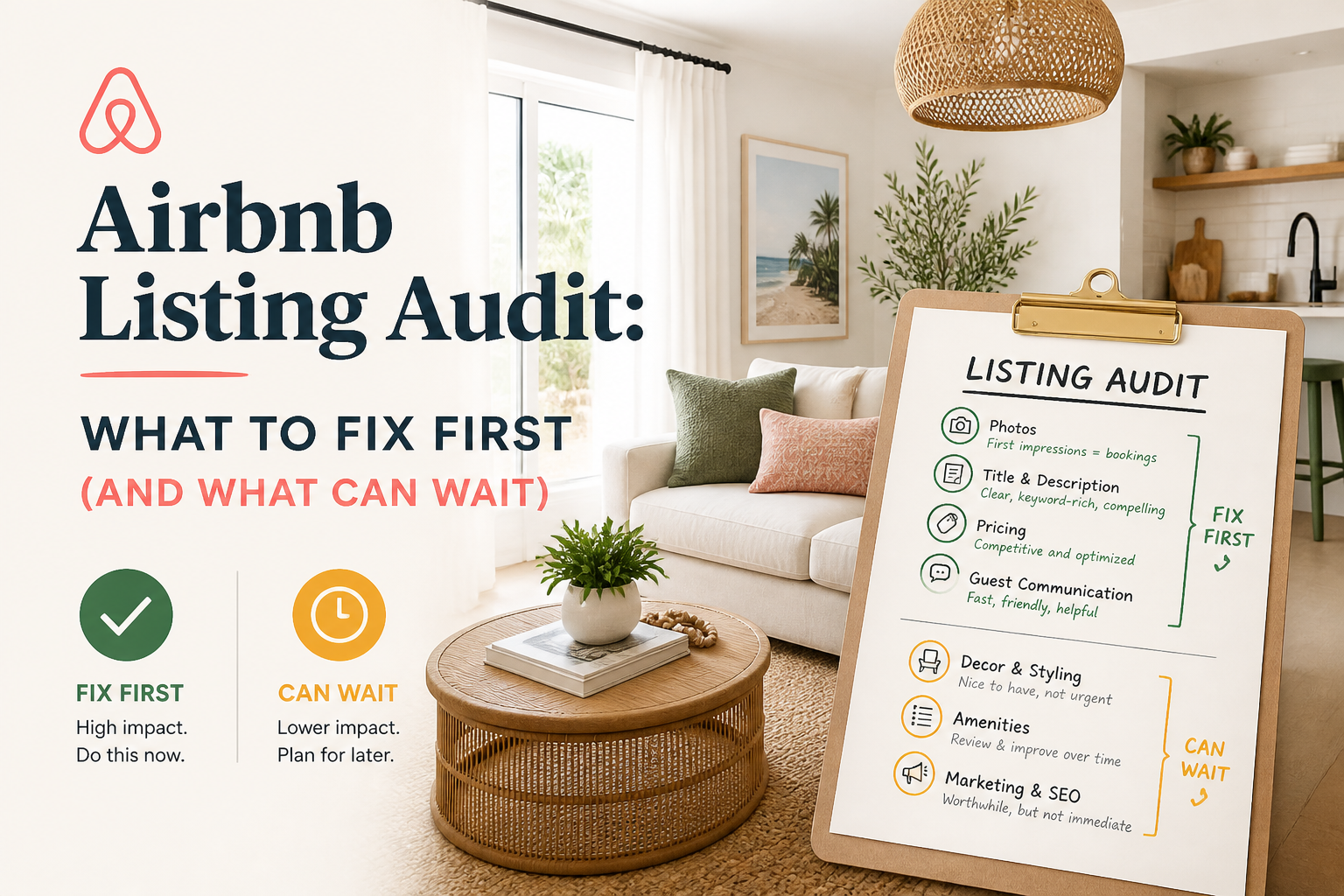 CornerstoneAirbnb Listing Audit: What to Fix First (And What Can Wait)
Not every weakness in your Airbnb listing deserves the same attention. Learn how to read an Airbnb listing audit, identify high-impact problems, and prioritize improvements that actually matter to guests.
14 min read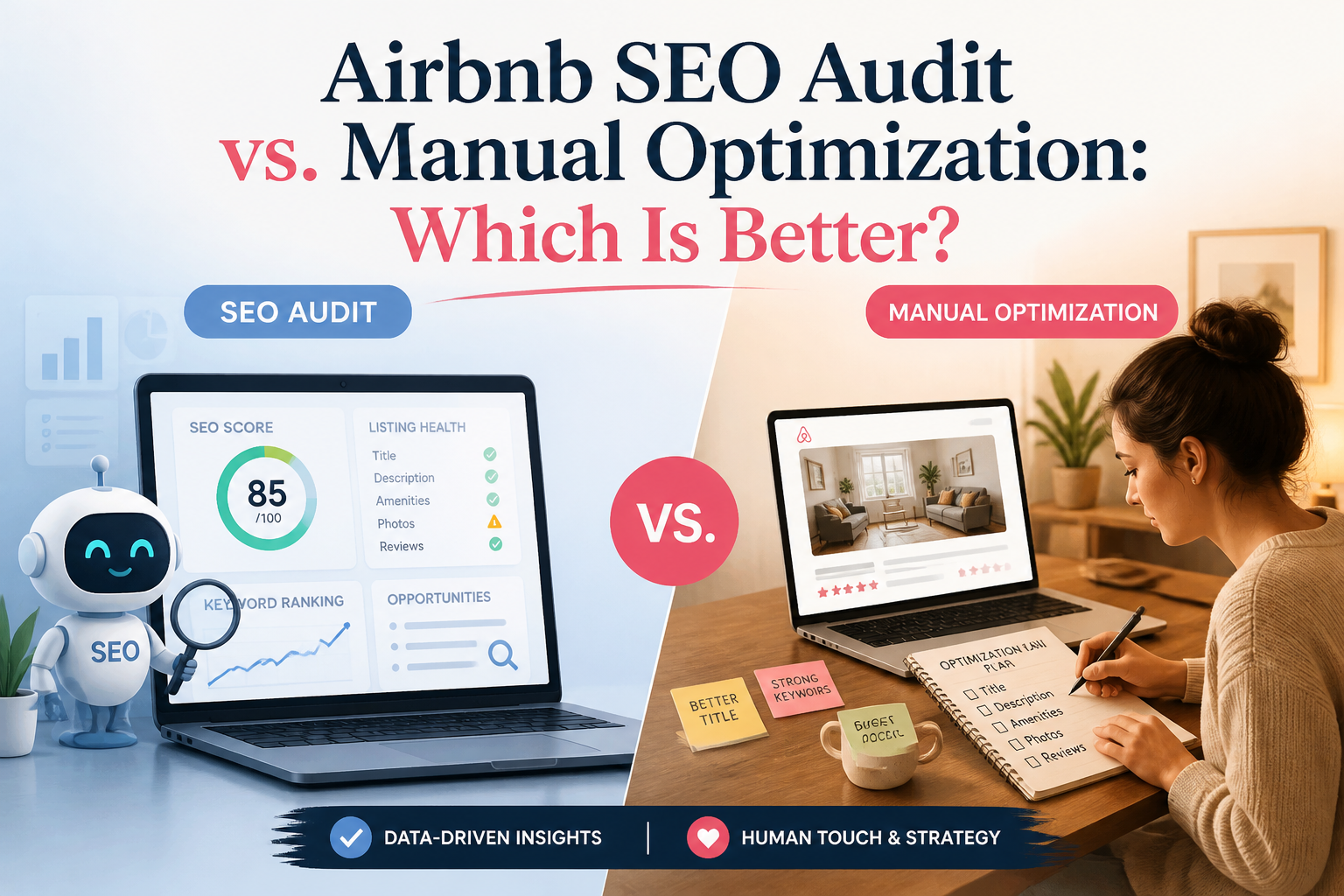 CornerstoneAirbnb SEO Audit vs. Manual Optimization: Which Is Better?
Should you optimize your Airbnb listing yourself, use an AI-powered audit, or hire a professional? Compare the benefits, limitations, costs, and practical results of each approach. Learn when a free audit is enough and when personalized help makes more sense.
23 min read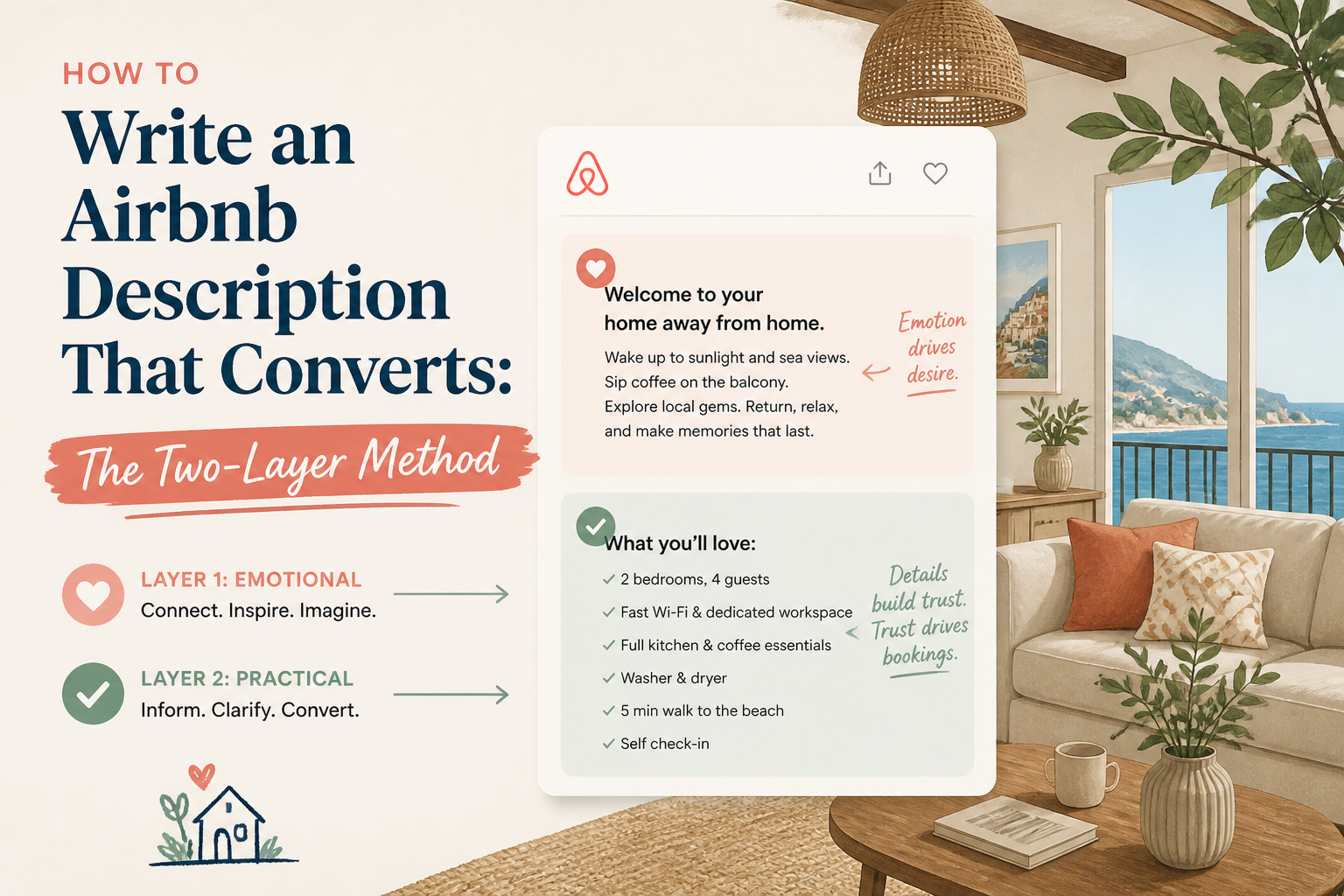 CornerstoneHow to Write an Airbnb Description That Converts: The Two-Layer Method
Most Airbnb descriptions are either too short or too difficult to scan. Learn the two-layer method for writing a clear, detailed, guest-focused listing description, with examples and a copy-ready template.
17 min read CornerstoneCan AI Improve Your Airbnb Listing? What Works and What Doesn't in 2026
Can ChatGPT or an AI Airbnb listing optimizer really improve your property description, title, and booking potential? Learn which tasks AI handles well, where it makes mistakes, and how to use it safely with real listing data and a structured optimization framework.
24 min read CornerstoneHow to Organize Your Airbnb Photo Tour: The Room-by-Room Guide
Your Airbnb photos might be beautiful, but is your Photo Tour helping guests understand the property? Learn how to organize every room, correct misplaced photos, improve room details, and build a gallery that creates booking confidence.
18 min read