
Booking Confidence: The Hidden Metric Behind More Airbnb Bookings
Discover how booking confidence shapes every Airbnb decision—and how your photos, descriptions, amenities, and reviews can either strengthen trust or quietly create hesitation.
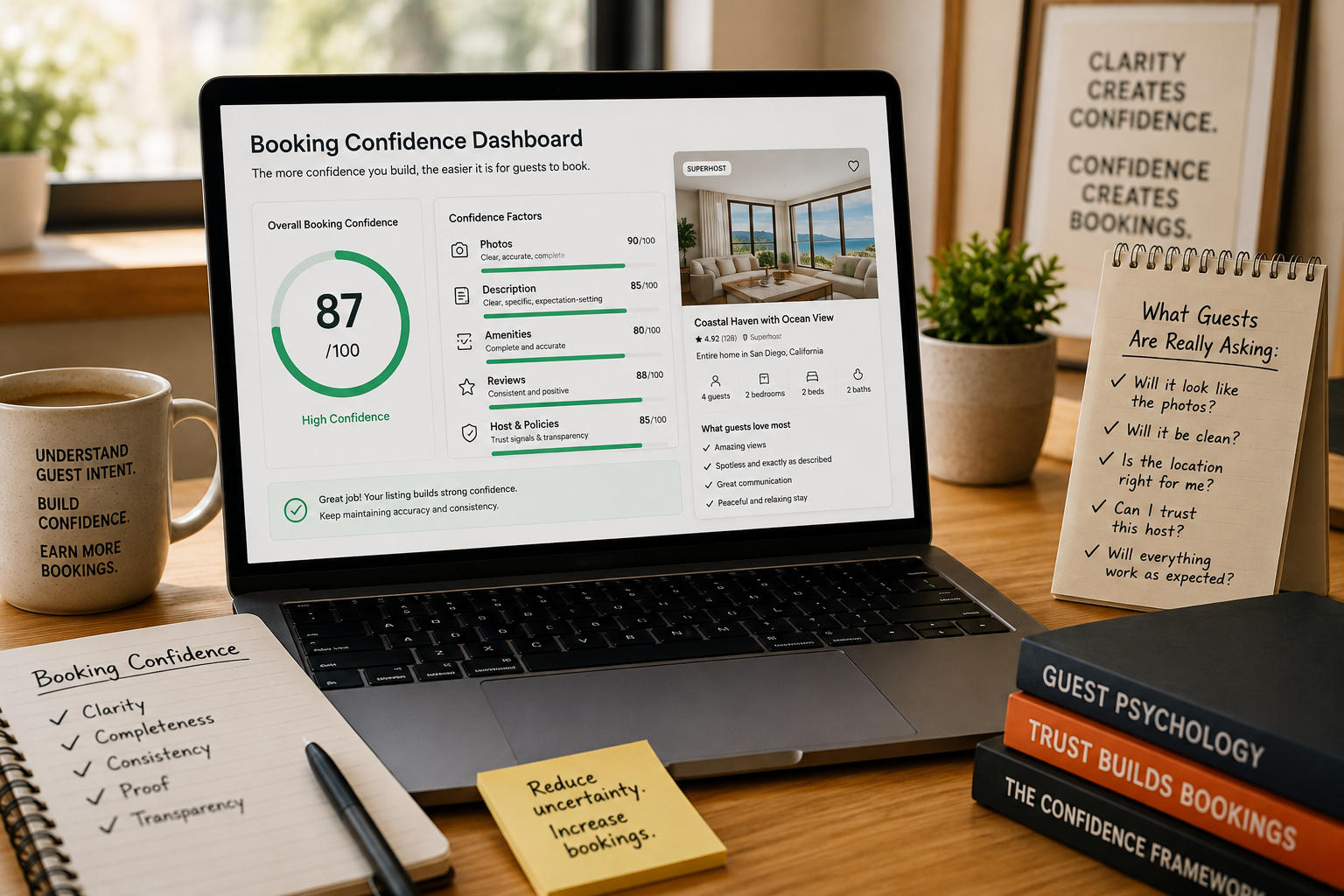
Booking Confidence: The Hidden Metric Behind More Airbnb Bookings
Guests do not always book the most impressive property. They book the one that feels safest to choose.
Most Airbnb hosts measure performance through familiar numbers:
- Views
- Clicks
- Bookings
- Occupancy
- Average nightly rate
Those metrics tell you what happened.
But they do not always explain why a guest booked—or why they continued scrolling.
Behind almost every booking decision is another metric that Airbnb does not display in your dashboard:
Booking confidence is the level of certainty a guest feels that your property is right for their trip, accurately represented, professionally managed, and unlikely to create unpleasant surprises.
The greater that confidence becomes, the easier it is for the guest to book.
The more uncertainty your listing creates, the more likely they are to hesitate, compare alternatives, or leave.
What Is Booking Confidence?
Booking confidence is the guest's answer to one underlying question:
“Can I trust this place to deliver the stay I am expecting?”
Guests may never consciously phrase the question that way.
But they are looking for the answer throughout your listing.
They search for it in your photos.
They look for it in your description.
They check your amenities, reviews, house rules, host profile, and cancellation policy.
Every element either increases confidence or introduces another unanswered question.
This is why an ordinary property with a clear, complete listing can outperform a more impressive home that feels vague or inconsistent.
The guest is not only evaluating quality.
They are evaluating risk.
Travel Is an Emotional Purchase
Booking accommodation involves uncertainty.
The guest cannot walk through the property before paying.
They cannot test the mattress, inspect the neighborhood, confirm the noise level, or see whether the photographs accurately represent the space.
They must make the decision using the information you provide.
That creates emotional risk.
Guests worry about questions such as:
- Will the property look like the photographs?
- Will it be clean?
- Is the neighborhood suitable for my trip?
- Is the host dependable?
- Will the Wi-Fi, parking, heating, or air conditioning work as described?
- Are there any important details being hidden?
A strong listing does not eliminate every possible concern.
It answers the important ones before they become reasons not to book.
The Four Foundations of Booking Confidence
1. Clarity
Guests should quickly understand what the property is, who it suits, and what makes it worth considering.
Clarity begins with your first impression:
- A cover photo that communicates the property's strongest advantage
- A title that provides useful information
- An opening description that identifies the experience and ideal guest
- A gallery that helps guests understand the layout
Vague language reduces clarity.
Words such as beautiful, cozy, amazing, and luxurious may sound positive, but they rarely answer practical questions.
Specific information gives guests something they can evaluate.
Instead of:
Beautiful home in a great location.
Write something more concrete:
Quiet three-bedroom home with a fenced garden, dedicated workspace, and easy access to the city center.
The second version creates a clearer picture and helps the right guest recognize a match.
2. Completeness
Missing information forces guests to make assumptions.
And guests rarely make optimistic assumptions when spending money on an unfamiliar property.
An incomplete listing may leave them wondering:
- Is parking really available?
- Is the outdoor space private or shared?
- Which bedroom contains each bed?
- Does the kitchen include the equipment I need?
- Are there stairs?
- Is the beach genuinely walkable?
Every unanswered question creates friction.
Some guests will message the host.
Many will simply choose a listing that already provides the answer.
Completeness does not mean filling the page with unnecessary text.
It means providing the information required to make a confident decision.
3. Consistency
Your listing should tell one coherent story.
The title, photographs, description, amenities, and reviews should reinforce the same expectations.
Problems begin when different parts of the listing contradict one another.
For example:
- The description promises fast Wi-Fi, but reviews mention frequent disconnections.
- The title promotes walkability, but guests describe needing a car.
- The photographs suggest privacy, but the outdoor area is shared.
- The listing advertises a fully equipped kitchen, but reviews mention missing basics.
- The sleeping capacity is six, but the bed configuration is unclear.
One inconsistency can raise a larger question:
“If this detail is inaccurate, what else might be different from what I expect?”
Guests do not need perfection.
They need the listing to be believable.
4. Proof
Claims become more persuasive when guests can verify them.
Proof can come from:
- Clear photographs
- Specific photo captions
- Accurate measurements or travel times
- Detailed amenity information
- Consistent guest reviews
- A complete host profile
- A strong response history
Compare these two statements:
Close to the beach.
The nearest beach is approximately an eight-minute walk from the property.
The first makes a claim.
The second provides a basis for comparison.
Verifiable information lowers perceived risk.
How Photos Build—or Damage—Confidence
Guests form an impression before reading most of your description.
Your photographs establish the emotional reference point for everything that follows.
Bright, well-composed images can communicate cleanliness, care, space, and professionalism.
Dark, inconsistent, poorly ordered, or incomplete galleries create doubt.
Guests become less confident when:
- Important rooms are missing
- The same area is photographed repeatedly from similar angles
- Images are heavily edited
- The layout is difficult to understand
- Photographs show furniture or amenities that are no longer available
Your gallery should function as a visual walkthrough.
By the time a guest reaches the final image, they should understand the property well enough to imagine arriving, moving through the space, and using its main features.
How Descriptions Affect Booking Confidence
A description should not merely make the property sound attractive.
It should make the stay understandable.
Strong descriptions answer questions such as:
- What kind of property is this?
- Who is it best suited for?
- How is the space arranged?
- What are the most important amenities?
- What should guests know before booking?
- What does staying here actually feel like?
Weak descriptions often fall into one of two extremes.
Some are too thin and provide almost no practical information.
Others are long but filled with generic language, repeated amenities, and details that do not help the guest decide.
The goal is not maximum length.
The goal is maximum usefulness.
Reviews Are the Reality Check
Your listing tells guests what you promise.
Your reviews tell them what previous guests experienced.
That makes reviews one of the most powerful sources of booking confidence.
When reviews confirm the claims in your listing, trust compounds.
If the description promises a peaceful stay and reviews repeatedly mention quiet nights, the message becomes stronger.
If the listing emphasizes cleanliness and guests consistently praise how spotless the property was, the promise feels credible.
But when reviews contradict the listing, confidence falls quickly.
This is why hosts should regularly compare their description and amenities against recent feedback.
Your reviews may reveal:
- Promises that are no longer accurate
- Guest concerns that should be addressed
- Features guests value more than you realized
- Recurring questions caused by missing information
- Strengths that deserve greater visibility in the listing
Reviews should not be treated only as ratings.
They are optimization data.
Transparency Usually Converts Better Than Perfection
Many hosts hesitate to mention limitations because they fear discouraging bookings.
But undisclosed limitations create a much greater risk.
Guests are often comfortable booking a property with stairs, shared outdoor space, limited parking, rural Wi-Fi, or a compact bedroom.
What they dislike is discovering those details after arrival.
Clear disclosure helps unsuitable guests self-select out and gives suitable guests confidence that there will be no surprises.
For example:
The second bedroom is compact and contains one single bed. It also serves as the property's designated safe room.
That statement may reduce interest from some travelers.
But it increases confidence among the guests who remain.
Those are the guests most likely to arrive with accurate expectations and leave satisfied.
Booking Confidence and Guest Intent Optimization™
Guest Intent Optimization™ begins with understanding what the guest is trying to achieve.
Booking confidence determines whether they believe your property can deliver it.
A family may want space, convenience, and an easy routine.
A couple may want privacy, atmosphere, and relaxation.
A remote worker may need reliable internet, a practical workspace, and quiet surroundings.
Your listing should provide enough evidence for that guest to think:
“This property fits my trip, and I trust what I am being shown.”
That is the point where interest becomes intent.
And intent becomes a booking.
A Booking Confidence Audit You Can Do Today
Open your listing and review it from the perspective of someone who has never seen the property.
Ask:
- Can I understand the property's main advantage within seconds?
- Do the first five photos communicate the most important features?
- Is every room and sleeping arrangement clear?
- Are privacy, parking, access, and shared spaces explained?
- Do the amenities match what is described in the text?
- Do recent reviews support the promises being made?
- Could anything surprise a guest after arrival?
Every unclear answer identifies a possible confidence gap.
You do not need to exaggerate the property to close those gaps.
You need to communicate it more accurately.
The Listing That Creates the Most Certainty Often Wins
Guests are not only comparing price, size, and amenities.
They are comparing how each listing makes them feel about the decision.
One property may be more luxurious.
Another may be cheaper.
But the listing that feels clearest, most consistent, and least risky often earns the booking.
The goal is not to make your property look perfect.
The goal is to make the decision feel safe.
Every photo, sentence, amenity, and review should move the guest toward greater certainty.
That is booking confidence.
And it may be the most important Airbnb metric you are not currently measuring.
Airbnb optimization specialist, Superhost, and founder of one of the largest Airbnb host communities.
Continue Reading
Chosen for you from The Optimization Journal.
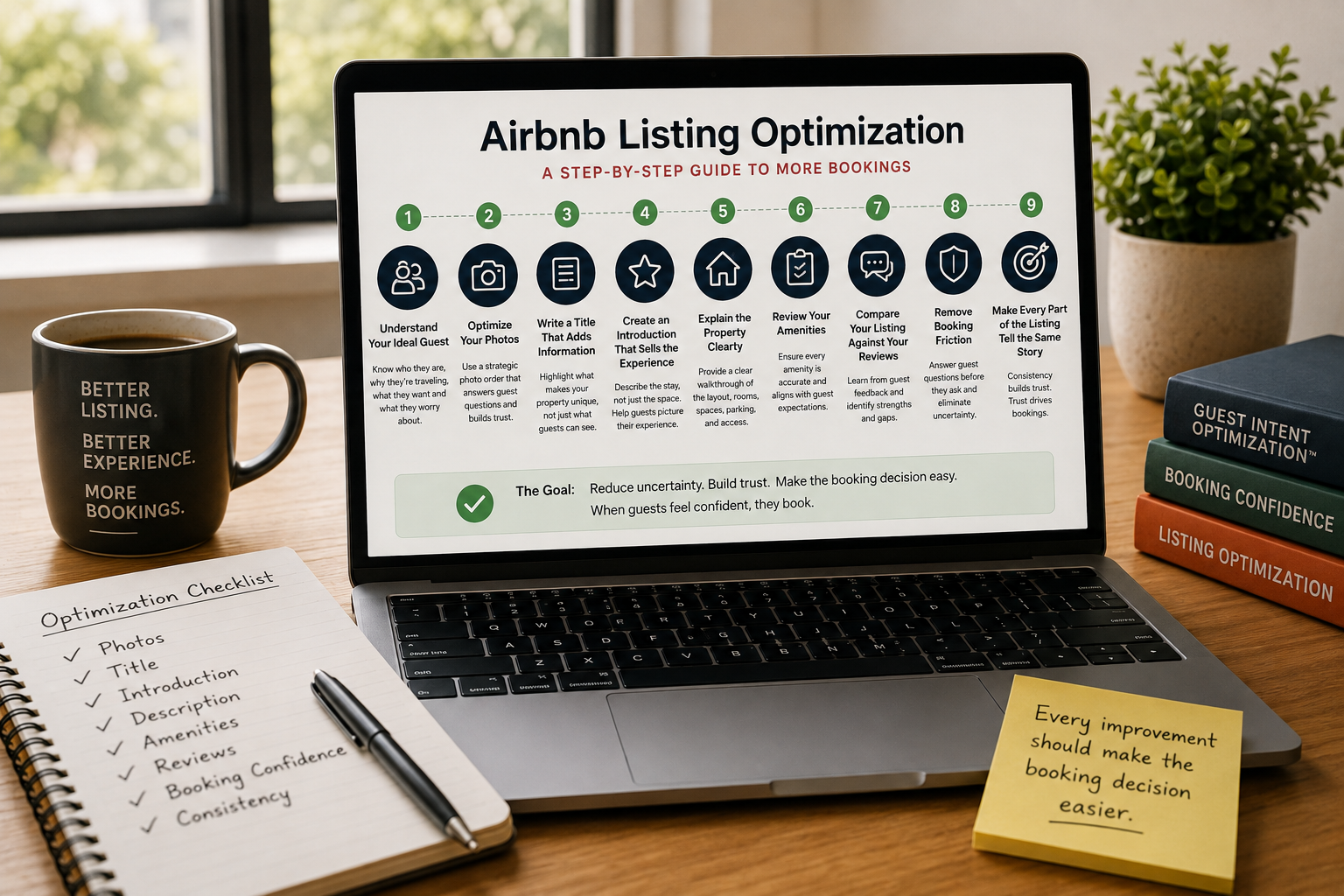 CornerstoneHow to Optimize an Airbnb Listing: A Complete Step-by-Step Guide
Most Airbnb hosts optimize their listing randomly. This guide explains the exact process professionals use to improve booking confidence, reduce booking friction, and increase conversions. ---
3 min read The Hidden Trust Killer in Your Airbnb Listing
What happens when your listing promises one thing—but your reviews say another?
3 min read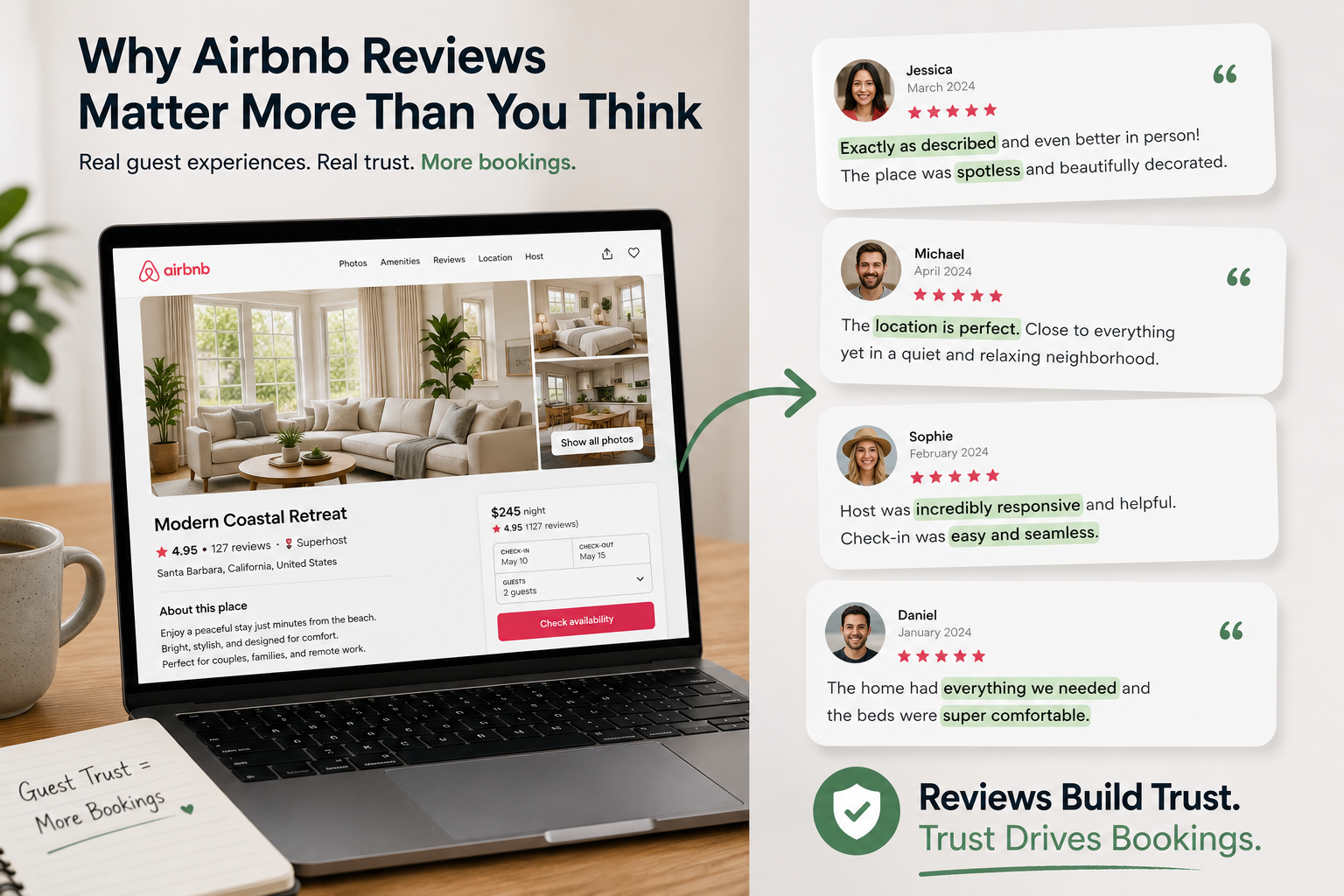 CornerstoneWhy Airbnb Reviews Matter More Than You Think
Most hosts think reviews are proof of a great stay. They're much more than that—they're one of the biggest influences on whether future guests book your property. ---
2 min read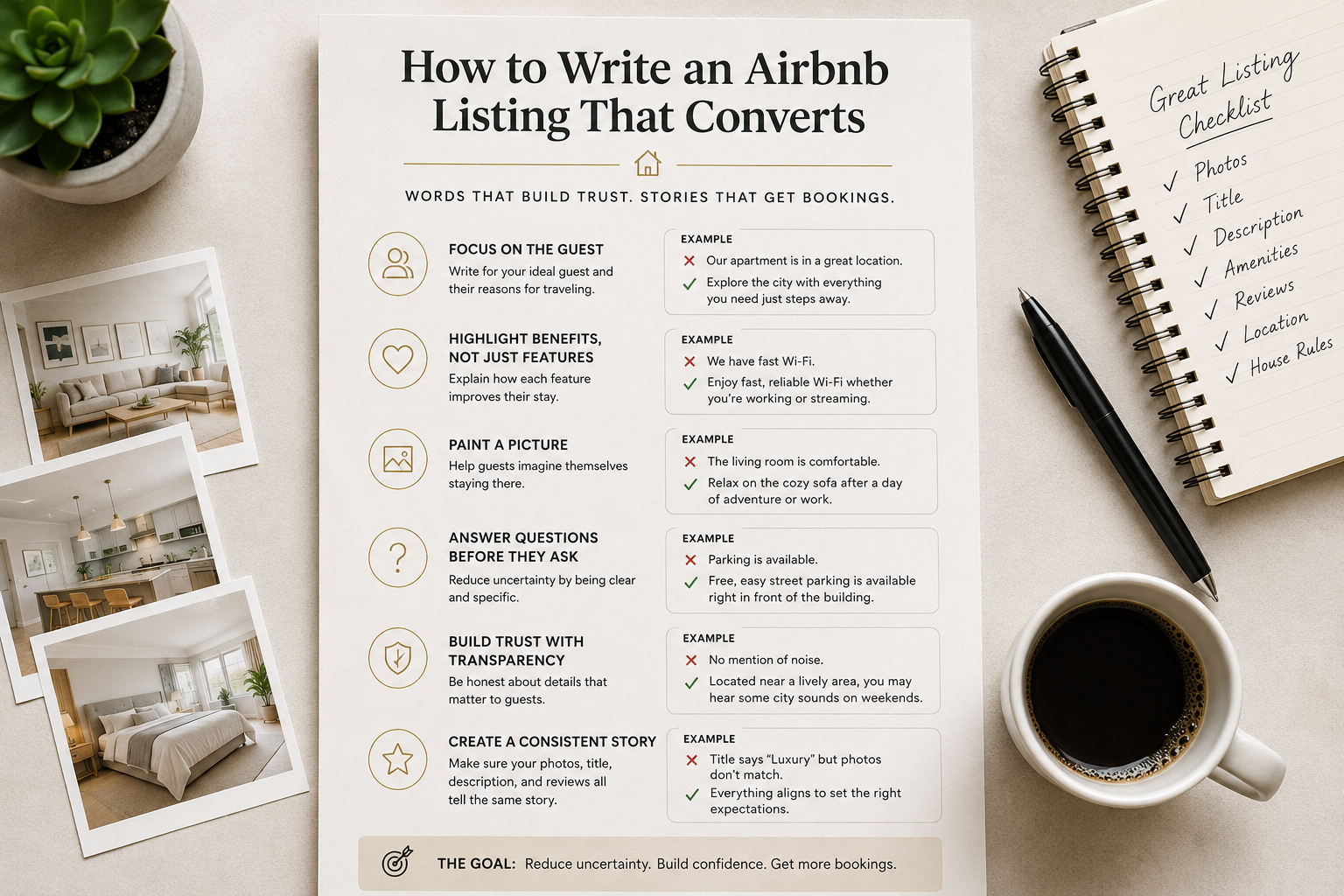 CornerstoneHow to Write an Airbnb Listing That Actually Converts
Most Airbnb listings describe a property. The best listings help guests picture their stay. Here's how to write descriptions that build trust, answer questions, and increase bookings. ---
2 min read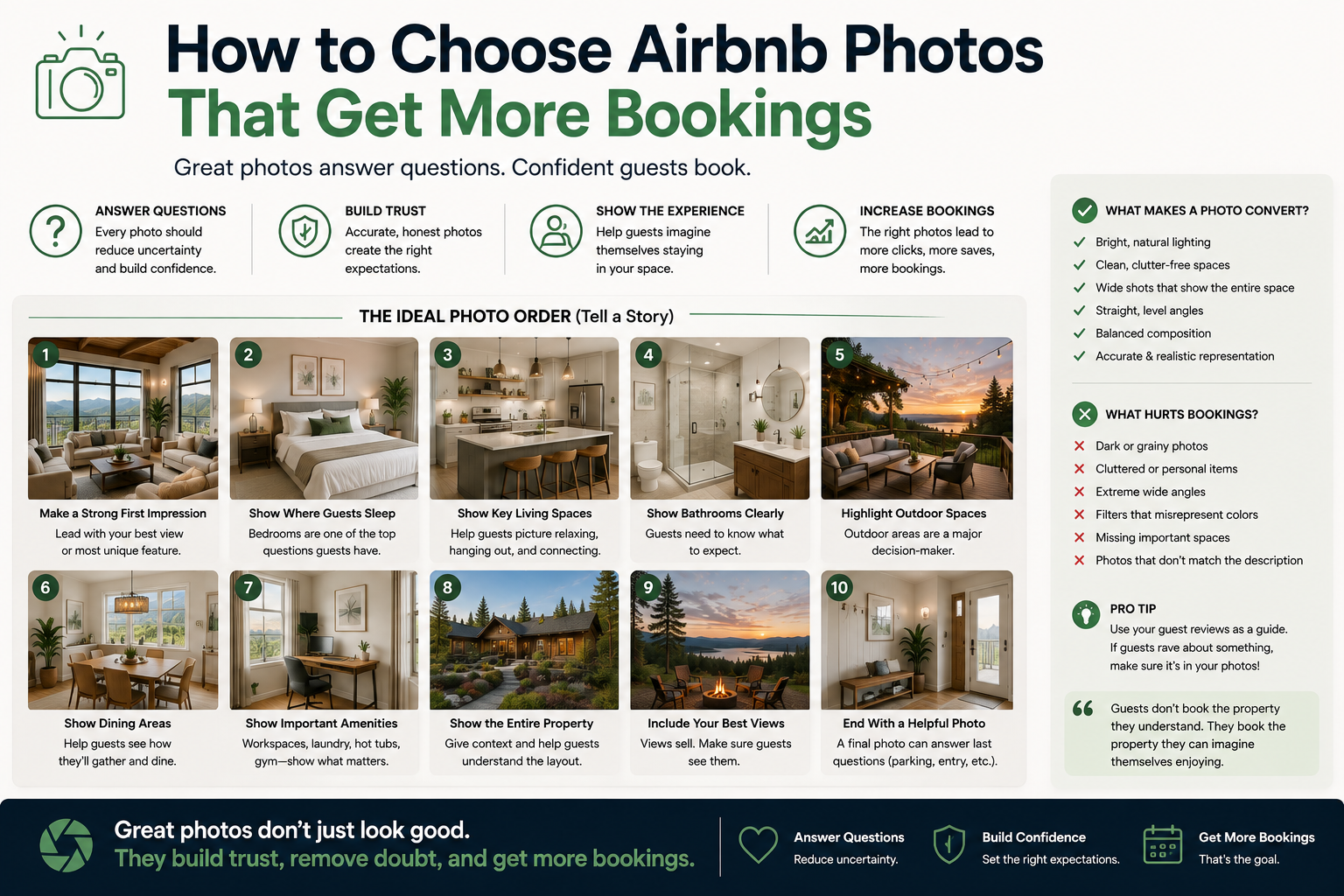 CornerstoneHow to Choose Airbnb Photos That Get More Bookings
Great Airbnb photos don't just look beautiful—they answer guest questions. Learn how to choose photos that build trust, reduce hesitation, and increase bookings.
2 min read