
Airbnb Listing Views Dropped Suddenly? How to Tell Whether It's Seasonality, Search Visibility, or Your Cover Photo
Your Airbnb listing views suddenly fell, but why? Learn how to separate a seasonal slowdown from reduced search visibility or weaker click-through, compare Airbnb Insights correctly, and decide what to fix before changing your listing.
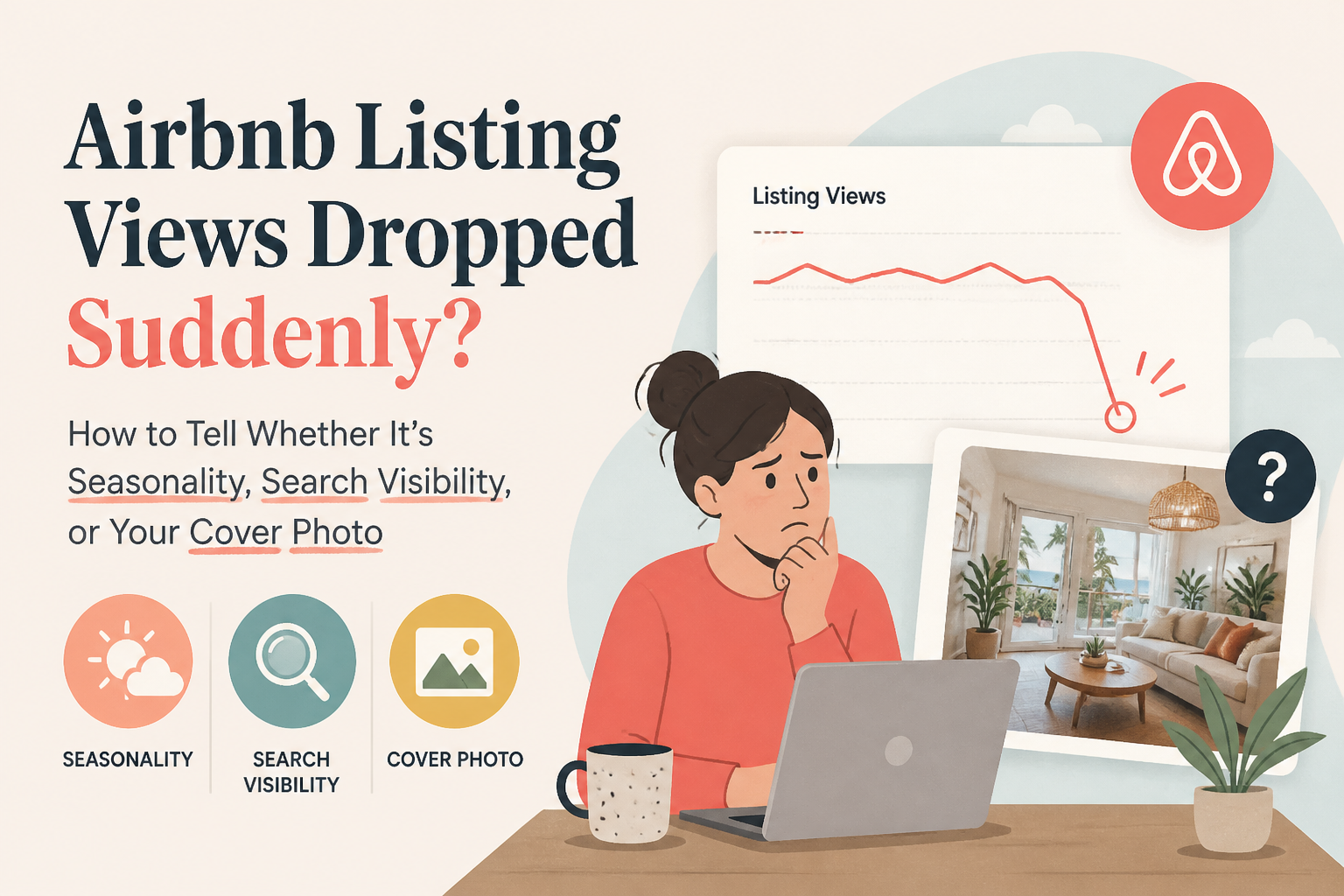
Your Airbnb listing was receiving a steady stream of views. Then, almost overnight, the numbers dropped. Last week, guests were opening your listing regularly. This week, hardly anyone seems to be looking.
You haven't necessarily received a bad review. Your property is still available, and you may not have changed anything at all.
So what happened?
When Airbnb listing views suddenly drop, the first thing to determine is whether fewer guests are seeing your property in search or fewer guests are choosing to click on it. Those are two different problems, and they can require completely different solutions. If fewer people are searching your destination, rewriting your title won't create demand. If your property is appearing in search but attracting fewer clicks, the cover photograph, title, price, or surrounding competition may deserve attention.
And if your listing is no longer eligible for common guest searches because of calendar restrictions, neither a new photograph nor a rewritten description will resolve that particular issue. I'm Elie Parienti, founder of SuperhostSEO and author of The Airbnb Optimization Playbook. One of the ideas I emphasize in the book is that a host shouldn't treat every performance decline as the same problem. Listing views, search exposure, guest interest, and booking conversion represent different stages of the guest journey.
In this guide, I'll show you nine checks to investigate a sudden decline in Airbnb listing views, including the numbers I would compare, the mistakes I would avoid, and the point at which an actual listing optimization becomes useful.
1. Confirm That Your Airbnb Views Really Dropped
Before looking for an explanation, make sure the decline is meaningful. A host might receive 15 listing views on Monday and only six on Tuesday. That feels like a major change, especially when bookings are slow.
But a one-day comparison tells you very little without context. Guest searches fluctuate throughout the week, and a small number of visits can make percentage changes look more dramatic than they are.
Compare More Than One Time Window
I recommend beginning with three perspectives:
- Last seven days: Useful for noticing sudden changes, but often too short for reliable conclusions.
- Last 30 days: A stronger starting point for identifying a sustained performance trend.
- Comparable seasonal periods: Useful for evaluating whether the slowdown is typical for the time of year.
These comparisons serve different purposes. A seven-day decline can tell you when something may have changed. A 30-day view helps you decide whether the change is persistent.
A year-over-year comparison can help identify seasonality, although differences in pricing, supply, events, and available dates still matter.
Example: A Drop That Looks Worse Than It Is
Imagine your listing normally receives between 10 and 20 views per day.
On Monday, it receives 18.
On Tuesday, it receives seven.
That's a substantial one-day decline, but the next five days might return to the normal range. Now consider a different pattern: your listing averaged 450 views during recent 30-day periods, but the latest comparable period has only 190.
That deserves a closer investigation.
The question isn't whether today's number is lower than yesterday's. It's whether your property is receiving materially less attention than you would reasonably expect.
Where to Find Airbnb Listing Views
Airbnb provides listing-view reporting in its hosting Insights. According to Airbnb's official guide to checking listing views, hosts can open Insights and review Views to understand how often their property has been visited. Hosts using professional hosting tools may also have access to more detailed conversion information.
If a particular report isn't visible, check whether those tools are enabled and what information your account makes available. My recommendation: Confirm the decline using a meaningful period before editing the listing.
2. Separate Search Impressions From Listing Views
This is the most important distinction in the entire diagnosis. Your Airbnb listing can lose visitors for at least two broad reasons. Reason one: Fewer guests encounter the listing in search results.
Reason two: Guests encounter the listing but choose not to open it as often. Both situations can produce the same decline in page views. But they point toward different things to investigate.
What Is an Airbnb Search Impression?
Airbnb's professional conversion reporting includes a stage called first-page search impressions. This concerns exposure of the listing in search results, under Airbnb's own reporting definitions. It is different from someone opening the property's full listing page.
What Is a Listing View?
A listing view represents a visit to your property page during the reporting period. When a guest opens the listing to examine the photographs, description, amenities, and other details, that activity contributes to listing-view reporting.
What Is Search-to-Listing Conversion?
Search-to-listing conversion describes the stage where a guest moves from seeing your property in search to opening the full listing. Airbnb also reports a further stage, listing-to-booking conversion, for guests who proceed to make a reservation. You can find the explanation in Airbnb's guide to conversion performance.
Why These Metrics Matter Together
Imagine your listing is receiving fewer visits. If search exposure has also declined, start by investigating demand, eligibility, availability, pricing, and visibility. If search exposure is relatively stable but listing visits are falling, look more closely at what guests see while comparing search results.
That includes the opening photograph, title, total price, ratings, and competing properties. A guest cannot decide to book a property they never encounter. But appearing in search is only the beginning.
Visibility creates the opportunity for a click. Your first impression has to earn it.
3. Use the Numbers to Identify the Type of Decline
Here's an example of how similar-looking declines can point toward different problems. These are hypothetical figures used to demonstrate the logic. They are not client results, and the simplified ratios are not a substitute for Airbnb's official conversion calculations.
Scenario A: Search Exposure and Views Both Fall
Previous period:
- Search impressions: 12,000
- Listing views: 600
- Illustrative views-to-impressions ratio: 5%
Current period:
- Search impressions: 6,000
- Listing views: 300
- Illustrative views-to-impressions ratio: 5%
Listing views declined by 50%.
But in this simplified example, search exposure also fell by 50%, while the ratio between the two remained unchanged. That gives us a useful starting hypothesis: the principal issue may be reduced search exposure rather than a sudden deterioration in how compelling the listing looks.
Possible explanations include:
- Fewer searches for the destination
- Reduced eligibility because of calendar settings
- Different pricing or competition
- Changes in search visibility
- A different mix of guest searches
This doesn't prove which explanation is correct. It tells you where to investigate first.
Scenario B: Search Exposure Holds Steady but Views Fall
Previous period:
- Search impressions: 12,000
- Listing views: 600
- Illustrative views-to-impressions ratio: 5%
Current period:
- Search impressions: 12,000
- Listing views: 300
- Illustrative views-to-impressions ratio: 2.5%
Here, search exposure is unchanged.
But fewer people are opening the listing. That suggests investigating the guest's decision at the search-results stage. Potential contributors include the cover photograph, title, displayed price, ratings, and what competitors are offering.
The problem may involve the first impression rather than the property's ability to appear in search.
Scenario C: Views Stay Steady but Bookings Fall
Previous period:
- Listing views: 600
- Bookings: 12
Current period:
- Listing views: 600
- Bookings: Four
Now we have a different question.
Guests are still opening the property, but reservations are weaker. That shifts the investigation toward booking conversion: value, total price, reviews, the complete photo gallery, descriptions, and booking conditions. For that situation, see my guide to Why Your Airbnb Listing Gets Views but Not Bookings.
The Critical Limitation
The examples above simplify the relationship between exposure and visits to show how to reason about the data. Airbnb's actual reporting uses its own definitions and calculations. First-page search impressions should not automatically be treated as an exhaustive count of every possible search appearance, and separate metrics may not correspond to a simple one-to-one visitor journey.
Use the platform's reported conversion stages when available, and compare equivalent periods consistently. The objective is not to create a perfect mathematical model. It's to identify where the biggest change appears to have occurred.
4. Check Whether the Decline Is Seasonal or Market-Wide
Suppose your listing views have dropped by 40%.
That sounds concerning.
But what if comparable listings in your destination are also experiencing a slowdown?
The explanation may be different from what you'd conclude by looking only at your own property.
Compare Your Listing With Similar Properties
Airbnb's professional performance tools allow hosts to compare certain metrics with similar listings, where those comparisons are available. This is particularly useful because an isolated view count doesn't tell you whether your property is outperforming or underperforming the surrounding market. See Airbnb's conversion performance guidance.
Example: A Seasonal Beach House
Imagine a four-bedroom beach house that attracts summer family vacations.
During July, listing views are strong.
In October, they decline sharply.
The host worries that Airbnb has reduced the property's ranking. But family vacation demand may naturally be lower for the upcoming travel periods. Competitors may also be receiving fewer visits.
Now compare that with a second situation. The beach house's views decline sharply, while similar nearby properties continue attracting substantial interest. That pattern gives you more reason to investigate property-specific factors.
Neither comparison identifies the cause automatically, but it changes the direction of the diagnosis.
Compare Comparable Travel Demand
Be careful when interpreting seasonal data. A summer vacation home and a year-round business-travel apartment can have very different demand patterns. Even properties in the same destination may attract different types of guests.
Try to compare listings with similar:
- Location and property type
- Guest capacity
- Amenities
- Price positioning
- Typical booking patterns
Also consider local events, school holidays, weather, and any unusual circumstances affecting the destination.
Don't Confuse Future Demand With Past Performance
In Chapter 11 of The Airbnb Optimization Playbook, I distinguish performance data from future demand information. Historical views tell you how the listing has performed. Forward-looking search and demand information can help inform future pricing and availability decisions.
These are related but different questions. If the latest 30 days show lower listing views, don't assume a forward-looking demand measure represents those same historical visits. Use each metric for what it actually measures.
My Rule for Seasonal Declines
If your property and comparable listings are experiencing similar weakness, investigate market conditions before making substantial listing changes. If your listing is performing materially worse than comparable properties, investigate your own search eligibility, price, presentation, and guest experience more closely. A market-wide slowdown and a property-specific visibility problem should not receive the same solution.
5. Make Sure Guests Can Still Find Your Listing for Common Dates
A sudden reduction in views can be caused by an unexpectedly restrictive calendar. This happens more often than some hosts realize. Your listing may still be published, but the number of trips it can accommodate may have changed.
Example: A Minimum-Stay Change
Imagine you manage a downtown apartment. You previously accepted two-night reservations. At the beginning of the month, you increased the minimum stay to four nights.
Guests searching for weekend trips may now be unable to book your property under that rule. The listing hasn't disappeared from Airbnb. It has become incompatible with more of the searches that matter to your guests.
Review Availability Before Rewriting Anything
Check:
- Open and blocked dates
- Minimum and maximum stays
- Date-specific rule-sets
- Check-in and checkout restrictions
- Advance notice
- Preparation time
- Booking window
- Imported calendar blocks
- Guest-capacity settings
Look for changes that coincide with the period when views began declining. An old seasonal rule-set or connected calendar can sometimes affect availability without being obvious from a quick glance.
Test Searches Like a Guest
Create a search for dates and a guest count your property should accommodate.
Then change only one factor at a time.
For example, compare a two-night weekend with a four-night stay using otherwise similar conditions. If the listing appears for the longer trip but not the shorter one, investigate minimum-night restrictions. Don't confuse a search-eligibility issue with poor ranking.
For the complete step-by-step method, read Airbnb Listing Not Showing for Certain Dates? How to Test Search Filters and Booking Restrictions.
Why This Check Comes Before Photo Optimization
A better cover photograph cannot overcome unavailable dates. If the calendar prevents your property from qualifying for relevant searches, correct or deliberately retain those restrictions based on your operating needs. Only then should you focus on improving how the listing performs when guests actually encounter it.
6. Investigate Whether Your Cover Photograph Is Losing Clicks
Now suppose your listing still qualifies for relevant searches. Your available data suggests that search exposure has not declined substantially, but listing views have weakened. This is the point where I would take a close look at the cover photograph.
In The Airbnb Optimization Playbook, I place considerable emphasis on the opening image because it helps determine whether a guest considers the property worth exploring. Airbnb also identifies high-quality media as part of listing quality and guest engagement in its official search-ranking guidance.
The Most Beautiful Photograph Isn't Always the Most Useful
Imagine two possible cover images for a vacation home. Photograph A: A carefully styled bedroom with neutral bedding and tasteful artwork. Photograph B: A private swimming pool surrounded by an outdoor lounge and dining area.
Both may be excellent photographs.
But if the property's strongest competitive advantage is its private pool, Photograph B may explain its appeal more immediately. A guest comparing several similar properties can recognize that benefit without opening the listing. This does not mean every pool property should use the pool as its cover image.
The right image depends on the property, the guest, and the competition.
Ask Whether Your Current Photo Still Communicates the Main Benefit
Review the cover photograph at the size guests are likely to encounter it in search results.
Does it show something distinctive?
Is the main subject visible?
Does it represent the property accurately?
Would a stranger understand why the accommodation deserves consideration?
Then compare it with several relevant competing listings. Your image may be technically excellent but visually similar to everything else in the results.
Review the First Five Photographs Together
The opening gallery should also support the cover photograph.
For example, a mountain cabin might introduce the property with:
- Mountain view or distinctive cabin exterior
- Private hot tub
- Main living area with fireplace
- Primary bedroom
- Outdoor seating or dining
Each photograph serves a different purpose. A guest can see the property's main attractions while beginning to understand the accommodation. Five images of the same view may be beautiful, but they leave questions about the interior.
For a complete gallery framework, read What Should Your First Five Airbnb Photos Show?.
A Cover Photo Is a Hypothesis, Not a Guaranteed Fix
Replacing a weak image with a stronger one may improve first impressions. But Airbnb does not publish a rule guaranteeing that a new photograph will increase views by a specific percentage. Likewise, a drop in views after changing photographs doesn't prove Airbnb imposed a penalty.
Treat the photograph as a plausible contributing factor and evaluate it alongside the rest of the evidence.
7. Examine the Title and Total Price Beside the Photograph
Your cover photograph doesn't work alone. Guests also compare visible information such as the title, price, ratings, and other listing characteristics. A strong photo may attract initial attention, while an unclear title or relatively high price changes the guest's decision.
Example: A Title That Hides the Selling Point
Imagine a cabin with a private hot tub, wooded surroundings, and a fireplace.
Generic title:
"Beautiful and Cozy Weekend Getaway"
More informative title:
"Private Hot Tub | Fireplace | Forest Cabin" The second version communicates concrete benefits. That can help a guest determine whether the property matches the experience they want. But I would not automatically rewrite a title that is already clear and specific.
The goal is to improve weak information, not keep changing the listing for the sake of activity.
Match Your Title to the Photograph
If your title emphasizes a private pool, your opening image should ideally help guests recognize that feature. If your title promises an exceptional view, the opening photographs should accurately demonstrate it. If the title promotes family-friendly sleeping arrangements, the gallery should eventually make those arrangements easy to understand.
When the title and images communicate different things, guests may struggle to identify the property's main value.
Use the Free Title Generator When the Title Is Actually Weak
I built the SuperhostSEO Airbnb Title Generator to help hosts explore stronger title options based on features in their actual listings. It can provide alternatives that emphasize a property's specific benefits rather than generic promotional language. However, generating new options doesn't establish that your existing title caused a traffic decline.
First identify the weakness. Then use the tool to address it.
Compare the Complete Guest-Facing Price
Pricing is another important factor.
Imagine your property is listed at $240 per night. Comparable homes are available for $195 to $215 on the same dates. Your accommodation may justify the premium through better amenities, more space, a superior location, or stronger reviews.
But if those advantages aren't obvious, guests may choose other listings to investigate. Airbnb explains that its search system considers total price and price competitiveness relative to comparable accommodation. See Airbnb's explanation of how search results work.
Don't compare nightly rates alone.
Check the relevant guest-facing total for the same dates and guest count, including applicable fees. A cover photograph may be compelling, but a significant total-price difference can still influence which property a guest opens.
8. Check Reviews, Competition, and Recent Listing Changes
If views have declined, create a timeline of meaningful events. Don't restrict your review to changes you intentionally made in the listing editor. Changes outside the listing may also affect guest decisions.
Look for New Reviews
Have you received a recent review mentioning a recurring concern?
Perhaps guests describe difficult parking, road noise, unreliable Wi-Fi, or an outdated bathroom. One review doesn't necessarily explain a traffic decline. But recent feedback may change how some prospective guests evaluate your property.
If several reviews identify the same issue, investigate whether it needs an operational solution or clearer expectations in the listing.
Look at What Competitors Changed
Your property may not have changed at all. But competing properties may have improved. For example, three similar vacation homes may have recently added professional photographs, highlighted amenities, or adjusted their prices.
Your previous first impression might now look less distinctive by comparison. Airbnb search is competitive and depends partly on the alternatives available for each guest's trip.
Check Your Own Change History
Write down whether you recently:
- Replaced or reordered photos
- Changed the title
- Rewrote the summary
- Adjusted nightly prices or fees
- Modified minimum stays
- Updated guest capacity
- Changed booking options
- Received significant new reviews
- Added or removed an important amenity
Then compare the timing with the view decline. If you recently made several changes, don't assume the last one caused the problem.
Use the history to develop hypotheses.
Don't Undo Every Change at Once
Suppose you replaced your cover photograph, increased weekend prices, and adjusted your minimum stay within three days.
Views declined the following week.
If you reverse all three changes immediately and views recover, you still won't know which adjustment mattered. Where practical, correct obvious mistakes first and evaluate other changes in a more deliberate sequence. For a more detailed approach, read Airbnb Ranking Dropped After You Edited Your Listing: What to Check Before Reverting Changes.
9. Choose the Right Fix Based on What the Data Suggests
After completing the first eight checks, you should have a clearer picture of the problem. You may not have definitive proof of causation. Airbnb does not disclose every factor or exact weight in its ranking system, and host performance data is not a controlled experiment.
But you can make a better decision than simply rewriting the listing at random.
If Search Exposure Declined Alongside Market Demand
Focus on understanding the demand change. Review seasonal patterns, comparable listings, open dates, and booking lead times. A general decline in local demand may call for pricing or availability decisions, but it doesn't automatically justify a full rewrite.
If Search Exposure Declined but the Market Appears Healthy
Investigate property-specific eligibility and competitiveness.
Check:
- Availability and restrictions
- Total price
- Relevant amenity selections
- Recent reviews
- Listing quality
- Search-position trends under comparable conditions
Avoid relying on a single personalized search as a universal ranking measurement.
If Search Exposure Is Steady but Fewer Guests Click
Give additional attention to the first impression. Review the cover photograph, title, price, ratings, and competing listings for the same dates. If the title is generic, test a clearer, benefit-led version.
If your best feature is buried in the gallery, consider whether a more informative opening photograph would help. Make changes based on identifiable weaknesses.
If Listing Views Are Healthy but Bookings Decline
Shift attention to booking conversion.
Investigate total guest cost, the full description, guest access information, reviews, house rules, and the clarity of your photo tour. A property can earn the click and still create hesitation afterward. That is a different diagnostic problem from losing listing views.
If the Evidence Is Too Limited
Keep monitoring.
A few days of lower traffic may not justify a major change, particularly for properties with low visitor volume or long booking lead times. Use enough data to make a reasonable judgment. The best next step is the one that addresses the weakness you can actually identify.
My 20-Minute Checklist for a Sudden Airbnb View Drop
If you want to investigate without spending the entire afternoon in your hosting dashboard, use this sequence.
Minutes 1–5: Confirm the Trend
Open Airbnb Insights.
Review the last seven and 30 days.
Compare listing views with relevant historical periods. If possible, examine first-page search impressions and search-to-listing conversion.
Write down exactly what changed.
Minutes 6–10: Compare Market Conditions
Check whether similar listings appear to be experiencing weaker demand. Consider seasonality, holidays, local events, and booking lead times. Don't use a peak-season month as the sole benchmark for an off-season period.
Minutes 11–15: Verify Search Eligibility
Choose representative dates and guest counts. Check that your property can accommodate those trips. Review minimum stays, blocked dates, advance notice, booking windows, and any relevant filters.
If the listing isn't eligible for the searches you're testing, address that question first.
Minutes 16–20: Review Your Search-Results Presentation
Compare your cover photograph, title, and total price with several relevant alternatives. Ask whether your strongest genuine features are easy to recognize. Identify one meaningful weakness to address.
Then record what you changed and when.
Write Down the Diagnosis
Finish with a sentence such as:
"My listing views declined mainly because search exposure appears to have fallen during a weaker demand period."
Or:
"My available search exposure is relatively stable, but fewer guests are opening the listing, so I'm investigating my first impression."
Or:
"My listing no longer qualifies for some common weekend searches because my minimum stay changed." You may need further evidence to confirm the conclusion.
But a specific hypothesis is far more useful than "Airbnb stopped showing my listing."
When a Free Airbnb Listing Audit Can Help
Once you've confirmed that the property is published and eligible for relevant searches, it makes sense to evaluate the listing itself. This is where the SuperhostSEO Free Airbnb Listing Audit becomes useful. I developed the audit to give hosts a structured way to identify weaknesses rather than guessing which section to rewrite.
What the Listing Audit Evaluates
The tool reviews a public Airbnb listing across nine categories, including:
- Title
- Short summary
- Main property description
- Photo order
- Photos
- Amenities
- Guest Access
- Other Things to Note
- Listing completeness
The report provides an optimization score out of 100, category-level feedback, and prioritized recommendations. It is an independent evaluation framework—not an official Airbnb ranking score.
What the Audit Cannot Tell You
A public listing audit cannot directly determine why Airbnb's search impressions changed on a particular date. It cannot see every private calendar restriction in your hosting account. And it cannot prove that your cover photo caused a specific decline in views.
Those questions require Airbnb performance data, calendar checks, market comparisons, and historical context. The value of an audit is different: it helps identify whether the public-facing listing has structural weaknesses you may be overlooking.
Start With the Free Audit
If your listing is receiving fewer visits and you aren't sure whether its presentation is strong enough, run a Free Airbnb Listing Audit. You'll receive a structured report that helps prioritize what deserves attention. If your title is the main weakness, you can use the Free Airbnb Title Generator to explore alternatives.
If your photographs need clearer explanations, the Free Photo Captions Tool can help you prepare captions based on the actual property. I recommend choosing the tool based on the problem rather than using every tool indiscriminately.
Prefer a Personal Review?
If you're dealing with a persistent decline and want a more comprehensive assessment of the listing itself, I also offer professional Airbnb optimization services. You can work with me directly through SuperhostSEO. My role is to help identify and improve the listing's presentation and guest-facing information. I won't promise a specific Airbnb search position or booking increase because those outcomes depend on factors beyond any one listing edit.
Frequently Asked Questions
Why did my Airbnb listing views suddenly drop?
Possible causes include reduced destination demand, fewer search appearances, restrictive availability, increased competition, pricing changes, or a less compelling first impression. Begin by comparing listing views with available search-exposure and conversion metrics.
Does a drop in Airbnb views mean my ranking dropped?
No. A decline in listing views doesn't establish a decline in search ranking. Guests may be searching less frequently, your property may qualify for fewer trips, or fewer people may be choosing to open it.
Can Airbnb views drop because of seasonality?
Yes. Search activity and booking demand can change by season, destination, guest type, and travel period. Compare your listing with relevant historical data and similar properties before assuming a property-specific problem.
Why are my Airbnb impressions down but my conversion looks normal?
If the reported relationship between search exposure and guest actions remains relatively stable while impressions decline, you may need to investigate demand, eligibility, and search visibility. The exact interpretation depends on which Airbnb metrics you're comparing.
Why are Airbnb impressions steady but listing views down?
That pattern suggests guests may be less likely to open the listing after encountering it in search. Review the cover photograph, title, total guest price, ratings, and competing accommodation, while keeping in mind the limitations of the available data.
Can changing an Airbnb cover photo reduce views?
A new cover photo may attract less attention if it communicates less of the property's value. But a decline after changing an image does not prove Airbnb penalized the listing. Compare the old and new photographs and evaluate performance over a meaningful period.
Does Airbnb rank listings lower when they get fewer clicks?
Airbnb identifies guest engagement and listing popularity among factors relevant to search ranking. However, it does not disclose a simple rule linking a particular click-through decline to a fixed ranking loss. Avoid assuming a specific penalty or recovery timeline.
Should I change my Airbnb title if views drop?
Only if the title has an identifiable weakness. A generic or unclear title may deserve improvement, but changing a strong title won't necessarily resolve declining demand or restrictive calendar settings.
Can minimum-night settings cause fewer listing views?
Yes. Minimum-stay restrictions can reduce the number of guest searches for which a listing qualifies. Check whether your settings still match the stay lengths your intended guests commonly request.
How many days should I wait before reacting to a view decline?
There is no universally reliable number of days. A seven-day period can reveal a potential change, while a 30-day comparison often provides more useful context. Low-volume properties and strongly seasonal destinations may require longer or more carefully matched comparisons.
Can a free Airbnb listing audit identify why my views dropped?
An audit can identify current listing weaknesses, such as a generic title or incomplete description. It cannot independently establish which change caused a historical decline in views. Use it alongside Airbnb Insights and market comparisons.
What if my Airbnb views recover without changing anything?
That may suggest the slowdown was temporary or influenced by demand fluctuations. It doesn't prove that no listing weakness exists, but it does show why making large changes based on a few quiet days can be premature.
Final Thoughts: Diagnose the Decline Before Changing the Listing
When Airbnb listing views suddenly fall, the temptation is to do something immediately.
Rewrite the title.
Replace the cover photo.
Lower the price.
Change the description.
But these actions solve different problems. If fewer guests are searching your destination, a better title won't create demand. If a restrictive calendar prevents common stays, a stronger photograph won't make those dates bookable.
If guests are seeing your listing but choosing other properties, then the first impression may genuinely deserve attention. And if guests continue opening the property but bookings have slowed, you need to investigate conversion rather than visibility alone. In The Airbnb Optimization Playbook, I encourage hosts to treat listing performance as a sequence of measurable decisions instead of a constant cycle of reactive changes.
Find out whether the decline happened before the click, at the click, or after the click. Then address the part of the guest journey that actually needs attention. If your data suggests the listing's public presentation may be holding it back, start with a Free Airbnb Listing Audit at SuperhostSEO.
Review the category scores and prioritized recommendations before deciding whether your photographs, title, description, or amenities need work. And if you would rather have me review your property personally, you can explore my professional Airbnb listing optimization services. The goal isn't to keep editing until the numbers move.
It's to understand why they moved—and make your next decision with better information.
Written by Elie Parienti, founder of SuperhostSEO and author of The Airbnb Optimization Playbook, The Airbnb Tools Playbook, The Airbnb Hosting Decisions Playbook, and The Airbnb Direct Booking Playbook. The diagnostic framework draws primarily from the Airbnb Insights, photography, platform settings, and troubleshooting sections of The Airbnb Optimization Playbook. All numerical examples are illustrative and are not presented as client audit findings.
Further Reading
- Airbnb: Understanding Performance Data for Conversion
- Airbnb: Confirm That Guests Can Find Your Listing
- Airbnb: How Search Results Work
- Airbnb: How to Take Great Photos for Your Listing
- Airbnb: All-New Insights to Help Your Listing Stand Out
- Airbnb Search Ranking Dropped Suddenly? How to Find Out What Changed
- How to Check Where Your Airbnb Listing Appears in Search
- Airbnb Listing Not Showing for Certain Dates?
- Free Airbnb Listing Audit
- Free Airbnb Title Generator
Airbnb optimization specialist, Superhost, and founder of one of the largest Airbnb host communities.
Continue Reading
Chosen for you from The Optimization Journal.
 CornerstoneAirbnb Ranking Dropped After You Edited Your Listing: What to Check Before Reverting Changes
Did your Airbnb search visibility decline after changing your title, photos, description, or settings? Learn how to identify which edit may have mattered, distinguish lower views from lower rankings, and decide when to revert a change.
22 min read CornerstoneAirbnb Views but No Bookings After a Price Increase? 9 Things to Check
Did your Airbnb bookings slow down after you raised your nightly rate? Learn how to compare listing views, conversion, total guest prices, and competing properties before deciding whether to lower your price.
17 min read CornerstoneAirbnb Listing Not Showing for Certain Dates? How to Test Search Filters and Booking Restrictions
Your Airbnb appears for one set of dates but disappears for another. Learn how to test search criteria, minimum stays, guest counts, advance notice, booking windows, and calendar restrictions without guessing about your ranking.
22 min read CornerstoneAirbnb Search Ranking Dropped Suddenly? How to Find Out What Changed
Did your Airbnb listing suddenly lose views or search visibility? Learn how to diagnose ranking changes, check availability and pricing, compare market conditions, and identify what to fix before rewriting your listing.
19 min read CornerstoneWhy Is My Airbnb Listing Not Getting Bookings in 2026? How to Find the Real Problem
When Airbnb bookings slow down, lowering your price is not always the solution. Learn how to identify whether your listing has a visibility problem, a conversion problem, or a market-demand problem—and what to fix first.
12 min read