
Should Airbnb Hosts Accept Local Guests? The Case for Both Sides
Few hosting decisions divide opinion more sharply than whether to accept guests who live nearby. Here is what hosts on both sides have learned from experience.
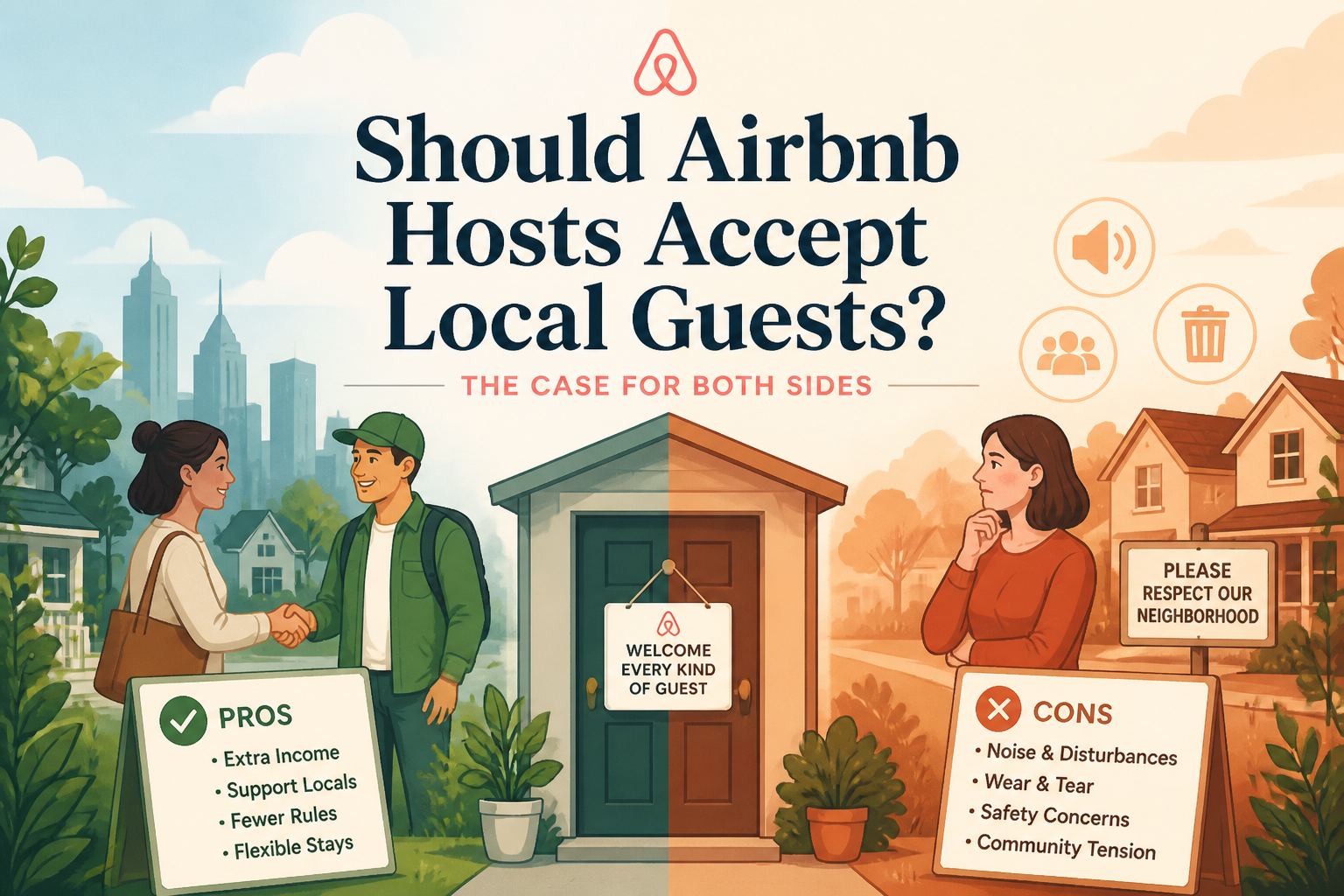
Someone ten minutes from your property wants to book for the weekend. Their profile looks fine. Their message is polite. But they live close enough to walk to your front door.
Do you accept the booking?
For some hosts, the answer is immediately yes. For others, it is immediately no. And the interesting thing is that both groups have experience to back them up. This is one of those hosting decisions where two people can reach opposite conclusions from equally real evidence, and both be right about their own situation.
Understanding why that is, and where you actually land, is more useful than picking a side.
The Case for Accepting Local Guests
Hosts who welcome local bookings tend to point to one consistent observation: the guests themselves are often among the easiest they host.
The reasons someone local books a vacation rental are usually legitimate and low-drama. They need overflow space for visiting family. They are hosting a small gathering and their own home is not large enough. They want a neutral space where extended family can stay together without anyone sleeping on a couch. They are going through a life transition, a divorce, a renovation, a temporary displacement, and need somewhere to land for a few nights.
One host in a small coastal town described locals as a good portion of her business specifically because her market draws weddings, college reunions, and bachelorette parties. Not everyone who attends those events owns a house big enough to host the whole group, or wants to. A vacation rental solves a real problem for a real reason. She has had zero issues with local guests across multiple years of hosting. Some of her most difficult guests, she noted, came from far away.
Another host made the point from a business continuity angle: locals kept many vacation rental businesses alive during the period when long-distance travel dropped significantly. Cutting them off entirely means removing a segment of demand that can be genuinely reliable when other sources dry up.
For hosts in tourist destinations, the logic extends further. A local who needs a place for a family event is as much a customer as someone who flew in from another country. The geography of where they sleep the other three hundred and sixty days of the year is not relevant to whether they will be a good guest for three nights.
The Case Against Accepting Local Guests
The hosts who block local bookings are equally clear about their reasoning, and they tend to have specific experiences that shaped the policy.
The most common concern is parties. A guest who lives nearby and books for one or two nights, especially on short notice, fits a recognizable pattern for someone looking for a space to host a gathering rather than genuinely needing accommodation. The closer they live, the less sense the booking makes as a straightforward lodging need, and the more it starts to look like something else.
One host described it plainly: a local books last minute for one night, and the next thing you know the front door camera has mysteriously stopped working because the wifi went down, and the evening takes a turn. The observation behind that story is pointed. Guests who plan a trip in advance and travel to get somewhere tend to behave differently from guests who booked an hour ago and could walk home if they wanted to.
The stories that inform the strictest no-local policies are usually specific. A guest who said their house was being worked on and needed somewhere to stay, but failed to mention they were treating for bed bugs and brought the infestation with them. A local booking that turned into a gathering nobody asked for. Repeated experiences with guests who gave vague explanations that felt plausible enough to accept but turned out not to be true.
For some hosts, the geographic filtering is explicit. They block surrounding zip codes entirely and only accept bookings from guests whose home address is a certain number of hours away. It is a blunt instrument, but for hosts who have been burned enough times it removes the need to evaluate each request individually.
What Actually Matters Is the Context
The most useful thing the debate between these two positions reveals is that the question itself is slightly wrong. The question is not whether local guests are good or bad. It is what the local booking tells you in your specific market, given your specific property and your specific risk tolerance.
A vacation rental in a small coastal town with a busy events calendar attracts local bookings for entirely different reasons than a large suburban property near a city. What looks like a party risk in one context looks like a wedding overflow booking in another. The geography is the same. The meaning is different.
The hosts who navigate this most successfully tend to be the ones who have stopped asking whether the guest is local and started asking why the local guest needs their property. That question, asked directly before confirming a booking, tells you far more than the distance between their home address and yours.
Screening Local Bookings Without Blocking Them Entirely
If you are open to local guests but want to manage the risk more deliberately, a few practices make a real difference.
Ask the question before you confirm. A simple message asking what brings them to the area, who will be staying, and whether they have any questions about the house rules creates a natural opportunity for the guest to explain themselves. Guests with legitimate reasons answer easily. Guests with something to hide tend to give vague answers, push back on the question, or cancel.
Pay attention to the booking pattern. Last-minute local bookings for one night carry a different risk profile than a local booking made two weeks in advance for a long weekend. Timing is a signal worth reading.
Consider your minimum night requirement. A two-night minimum does not eliminate party risk, but it changes the economics of using your property as a venue. Someone planning a gathering for one night will often move on to a listing with no minimum rather than pay for two nights they do not need.
And if something feels off, it probably is. The hosts who have the worst experiences with local guests are often, on reflection, the ones who noticed something that did not quite add up and confirmed the booking anyway. Your instincts are part of your screening system too.
Airbnb optimization specialist, Superhost, and founder of one of the largest Airbnb host communities.
Continue Reading
Chosen for you from The Optimization Journal.
 How to Screen Local Airbnb Guests Without Blocking Them Completely
A blanket no-locals policy costs you real revenue. A blanket yes leaves you exposed. Here's how experienced hosts find the middle ground.
5 min read Same-Day Airbnb Bookings: The Risk and Reward Hosts Need to Understand
Two hosts. Same situation. Completely opposite experiences. The difference between them was not luck — it was systems.
6 min read Parties and Vacation Rentals: Where Hosts Draw the Line
Every host eventually gets a booking that makes them pause. How you respond to that moment — before it becomes a problem — is what separates a clear policy from a costly lesson.
5 min read How to Write an Event Policy That Actually Protects Your Vacation Rental
A no-party rule is only as good as how clearly it's communicated. Here's how experienced hosts define, enforce, and occasionally profit from their event policies.
5 min read One-Night Airbnb Bookings: Are They Worth It?
The nightly rate looks fine. The cleaning fee is included. Then you run the actual numbers — and everything changes. Here's what experienced hosts have figured out about one-night stays.
6 min read