
Airbnb SEO Tools in 2026: Which Ones Do You Actually Need?
Not every Airbnb optimization tool solves the same problem. Learn the difference between listing audits, guest intent analysis, search rank tracking, competitor intelligence, and AI listing tools—and when to use each one.
The best Airbnb SEO tool depends on what is actually wrong with your listing.
If your listing is missing important information, you need an audit. If guests are viewing the property but not booking, you may need an analysis of how the listing communicates its value. If you're trying to understand whether your property is becoming more visible in Airbnb search, you need a search visibility tracker.
And if you're launching a new property, none of those tools replaces the work of building a complete, accurate listing in the first place.
The mistake is assuming every Airbnb optimization tool does the same thing.
It doesn't.
After years of optimizing Airbnb listings, I built SuperhostSEO around a simple principle: diagnosis, implementation, and measurement are different jobs.
A tool that tells you what's wrong isn't necessarily the right tool to fix it. A tool that rewrites your description cannot automatically tell you whether your search visibility has improved.
Understanding those differences makes it much easier to choose the right tool, avoid unnecessary work, and make useful improvements to your listing.
Here is how I would approach it.
- What Are Airbnb SEO Tools?
Airbnb SEO tools are software applications designed to help hosts evaluate, optimize, and monitor their Airbnb listings.
Unlike traditional Google SEO software, which focuses on website search rankings, Airbnb optimization tools focus on how a property is presented and discovered inside Airbnb's marketplace.
Different tools solve different problems.
Some evaluate listing completeness.
Others analyze guest-facing content, produce better descriptions, compare competitors, or track search visibility.
The most useful way to think about them is in five categories:
Tool Category| Main Purpose Listing Audit| Identify structural weaknesses and missing information Guest Intent Analysis| Find possible sources of hesitation in the booking decision Listing Writing Tools| Create or improve titles and descriptions Search and Competitor Tools| Monitor visibility and relevant market patterns Maintenance Tools| Keep listing information and positioning current
These categories work together, but they should not be treated as interchangeable.
Airbnb considers multiple factors when generating search results, including price, quality, popularity, location, availability, and guest preferences.
No independent optimization tool has access to Airbnb's complete internal ranking algorithm.
You can learn more about the platform's published approach in "Airbnb's explanation of search results" (https://www.airbnb.com/help/article/39).
That is why I focus on tools that provide useful information and practical recommendations rather than claiming any software can guarantee a particular ranking position.
- Airbnb Listing Audit: Find Out What's Missing
When a host asks me where to start, I usually recommend reviewing the listing's foundation first.
There is little value in rewriting individual sentences if the property has important information missing from several sections.
An Airbnb listing audit helps answer one primary question:
Is my listing complete, clearly organized, and making good use of the information I can provide?
What the SuperhostSEO Listing Audit checks
The "SuperhostSEO Airbnb Listing Audit" (https://www.superhostseo.com/audit/) evaluates a live listing across nine weighted categories.
The assessment includes important areas such as:
- The listing title
- The short summary description
- The main property description
- Photos and photo order
- Amenity information
- Guest access
- Other listing sections and completeness signals
The tool produces an overall score out of 100, individual category assessments, and prioritized recommendations.
Three text-heavy areas carry particular importance in the SuperhostSEO methodology: the title, summary, and main property description.
That weighting reflects how the tool evaluates listing information. It is not a claim that Airbnb uses the same scoring formula.
What an audit can tell you
An audit can identify weaknesses such as a generic title, incomplete description, missing information, or opportunities to improve how a property's features are communicated.
It can also help you decide where to begin.
The SuperhostSEO report includes your top priorities and a roadmap rather than simply presenting a number.
That matters because a low score in one category does not automatically mean that category should be fixed first.
You need to consider what the weakness is and how important it may be.
What an audit cannot tell you
An audit cannot tell you exactly where Airbnb will rank your property.
It cannot guarantee more bookings.
It cannot determine how every potential guest will react to your listing.
And it cannot fully judge the visual appeal of your photographs in the same way a human guest would.
A property might score well on completeness while still having an unattractive opening photo or a price that is not competitive for the dates being searched.
The audit does not automatically make changes to your Airbnb account, either.
Its job is diagnosis, not automatic publication.
Best for: Hosts who haven't reviewed their listings systematically, hosts experiencing uncertain performance, and anyone who wants an organized starting point.
- Guest Intent Optimization: Understand Why Guests May Hesitate
A structurally complete Airbnb listing is not necessarily a convincing one.
Imagine a property with an accurate title, complete amenities, detailed room descriptions, and professional photographs.
Everything seems to be in place.
Yet the listing receives views without generating the expected reservations.
What could be wrong?
Sometimes the issue isn't missing information.
It's the relationship between what the listing promises and what guests expect.
This is the problem that "SuperhostSEO Guest Intent Optimization" (https://www.superhostseo.com/guest-intent) is designed to investigate.
What Guest Intent Optimization examines
Unlike the structural audit, Guest Intent Optimization examines the listing's photographs, written content, and real guest reviews together.
It looks for possible mismatches between the experience being promoted and the information available to prospective guests.
For example, imagine your description emphasizes a peaceful location.
But several reviews mention road noise.
That doesn't necessarily mean the property is unsuitable for guests.
It means the listing may be creating an expectation that deserves clarification.
Or perhaps the listing focuses heavily on a luxury kitchen while past guests repeatedly praise the private backyard.
You may be emphasizing the wrong selling point.
What the analysis provides
Guest Intent Optimization generates a written assessment of the listing, an overall score, and prioritized recommendations.
Some recommendations may involve changing the description or emphasizing a feature more clearly.
Others may concern aspects of the experience that cannot be fixed by rewriting text alone.
The goal is to identify potential sources of hesitation and opportunities to communicate the property's value more accurately.
What Guest Intent Optimization cannot do
The analysis cannot read a particular guest's mind.
It cannot prove why an individual visitor chose not to book.
And it cannot guarantee that addressing an identified issue will improve conversion.
Its recommendations are interpretations based on the information available in your listing and reviews.
They should be evaluated alongside actual performance data and your own knowledge of the property.
Best for: Hosts with reasonably complete listings who want to investigate guest confidence, unclear positioning, or potential booking friction.
I usually recommend starting with the structural audit, then using Guest Intent Optimization to investigate the less obvious issues.
Both tools are available to try for free on SuperhostSEO.
- Airbnb Search Rank Trackers: Measure Visibility Over Time
One of the most common questions hosts ask is:
"Where does my Airbnb listing rank?"
It sounds like there should be a simple answer.
But Airbnb search doesn't work like a fixed list where every guest sees properties in the same order.
Search results can change depending on:
- Travel dates
- Number of guests
- Length of stay
- Search location
- Selected filters
- Property availability
- Guest preferences and personalization
A listing that appears near the top for one search may be much lower—or not eligible to appear at all—for another.
That makes a single ranking number potentially misleading.
What an Airbnb search rank tracker does
The SuperhostSEO Search Visibility tool runs anonymous Airbnb searches and records where a listing appears under tested conditions.
Rather than giving you one supposedly permanent ranking, it helps monitor the average position and direction of visibility over time.
For example, consider a hypothetical property that appears at these average positions in comparable searches:
Month 1: Position 48
Month 2: Position 35
Month 3: Position 27
That could suggest improving visibility under those conditions.
But it doesn't prove that a particular title or description change caused the improvement.
Competitors, pricing, demand, and available inventory may all have changed.
What a rank tracker cannot tell you
A rank tracker cannot identify one universal Airbnb ranking for your property.
It cannot reproduce every personalized search result.
And it cannot tell you why a guest who opens your listing doesn't book.
The most useful information is usually the trend, not the exact position recorded on a particular day.
Best for: Hosts who want to monitor search visibility after optimization and understand whether their listing's position is generally improving or declining.
- Competitor Intelligence: Understand the Market Around You
Your Airbnb listing doesn't operate in isolation.
Guests are comparing it with other properties available for similar dates, locations, and group sizes.
That means your performance needs context.
Suppose your bookings have slowed.
Is your listing underperforming?
Or is the entire local market experiencing weaker demand?
Those are different situations.
What competitor tools can help you evaluate
Competitor Intelligence can help compare selected nearby listings and identify patterns in availability and minimum-stay requirements.
These observations may highlight differences worth investigating.
For example, your property may require a four-night minimum while several comparable properties accept two-night stays.
That could be excluding you from some guest searches.
Or you may notice that competitors have more restricted availability around particular dates.
That information can help you ask better questions about your own calendar.
The important limitation
A blocked date on another host's calendar is not proof that the property received a paid reservation.
It might represent:
- A confirmed reservation
- Owner use
- Maintenance
- A manually blocked date
- A restriction caused by booking settings
This is why I treat competitor availability as a signal rather than confirmed occupancy data.
The Airbnb Tools Playbook describes SuperhostSEO's Competitor Intelligence feature as comparing availability and minimum-stay patterns across up to three selected competitor listings.
The purpose is to provide market context, not to pretend you can see every competitor's actual financial results.
Best for: Hosts investigating market conditions, calendar competitiveness, and differences between their property and relevant nearby listings.
- Airbnb Listing Writing Tools: Turn Recommendations Into Changes
An audit might tell you that your title is generic.
Guest Intent Optimization might show that your description doesn't communicate one of the property's strongest features.
But knowing what needs improvement doesn't automatically give you the finished wording.
That is where listing writing tools become useful.
SuperhostSEO offers several options depending on whether you're launching, rebuilding, or refreshing a listing.
Airbnb Title Generator
A title generator can help produce alternatives based on the property's actual features.
For example:
Before:
"Beautiful Apartment in Great Location"
After:
"Private Terrace | Bright City Loft"
The second version communicates a specific property benefit, provided that feature genuinely exists.
The goal is not to stuff keywords into the title.
It is to help the right guest understand why the property deserves attention.
SuperhostSEO provides a free "Title Generator" (https://www.superhostseo.com/) through its free tools.
Listing Studio: For brand-new properties
Listing Studio is designed for hosts starting with a property that does not yet have a complete listing.
Instead of generating text from a single short prompt, it guides the host through a structured property profile.
That process covers the property's layout, room details, amenities, sleeping arrangements, neighborhood information, and other relevant facts.
The information then becomes the foundation for draft listing content.
The advantage is that the final writing can draw from a more complete picture of the property.
Airbnb Listing Workshop: For existing listings
The Listing Workshop serves a different purpose.
It starts with an existing live listing.
From there, it incorporates the audit and Guest Intent analysis before guiding the host through improvements section by section.
The Workshop covers areas such as:
- Main property description
- Short summary
- Listing title
- Photo strategy
- Guest access
- Additional notes
- Neighborhood information
The workflow allows hosts to review, edit, approve, and export the finished sections.
It is particularly useful when a listing has accumulated years of small edits and no longer feels consistent.
Listing Revamp: For smaller improvements
Not every listing needs to be rebuilt.
Sometimes the property is already well presented, but the wording needs to be updated or tightened.
Revamp is designed for those smaller changes.
It offers different levels of revision so a host can preserve the existing information while improving how it is communicated.
The proposed text appears for review rather than silently replacing the current draft.
Seasonal Refresh applies a similar approach to repositioning listing content for an upcoming season.
What these tools cannot do
They cannot make inaccurate property information true.
They should not invent amenities or exaggerate features.
And they do not automatically publish changes to Airbnb on your behalf.
The host reviews the generated text and decides what to copy into the actual listing.
That final human review is essential.
Best for: Hosts who have identified a specific content problem and want help producing a complete, accurate replacement.
- Calendar Tools: Find Booking Restrictions and Difficult Gaps
Sometimes a host is focused on photos, titles, and descriptions when the real issue is the calendar.
Imagine you have a two-night gap between existing reservations.
Your minimum stay is set to three nights.
Even if your listing is excellent, a guest looking for those two nights may not be able to book them.
This is not fundamentally a writing problem.
It is an availability problem.
The Calendar Gap Analyzer described in The Airbnb Tools Playbook uses the property's Airbnb iCal export to identify gaps that may be difficult to fill under current booking patterns.
Examples include short gaps between reservations, weekend openings, and stretches of availability that may deserve attention.
The Local Events and Demand Calendar takes another approach, helping hosts consider upcoming demand patterns and seasonal opportunities.
These tools are useful when calendar configuration or changing local conditions may be part of the problem.
They do not turn an empty date into a booking automatically.
A suggested calendar change still needs to make financial and operational sense for the property.
- Which Airbnb SEO Tool Should You Use First?
There is no reason to open every tool and make every possible change.
Start with the problem you are trying to solve.
Your Situation| Where I Would Start My listing hasn't been optimized| Free Listing Audit My listing looks complete but bookings are weak| Guest Intent Optimization I want to know whether my search visibility is improving| Search Visibility I need a completely new listing| Listing Studio My existing listing needs a full rebuild| Listing Workshop My title or descriptions need a small refresh| Title Generator or Listing Revamp I want to compare availability with nearby properties| Competitor Intelligence I have difficult gaps between bookings| Calendar Gap Analyzer I want to prepare my listing for a different season| Seasonal Refresh
The order matters.
I generally prefer to diagnose before rewriting.
And I prefer to make specific, intentional improvements rather than changing everything because a dashboard suggested several possibilities.
- A Realistic Example: A Listing Gets Views but Not Bookings
Let's put the different tools together.
Imagine a host manages a three-bedroom vacation home.
The property receives a reasonable number of listing views, but its conversion rate is disappointing.
The host has already considered lowering the nightly rate.
Before changing prices, I would take the following approach.
Step 1: Review Airbnb performance data
Confirm whether views are actually healthy relative to the property's historical performance and current market.
A listing with low visibility requires different attention from one receiving qualified visitors who don't book.
Step 2: Run the Listing Audit
Identify incomplete information, generic wording, or other structural weaknesses.
Perhaps the main description doesn't clearly explain the sleeping arrangements.
Fix the issues that matter most.
Step 3: Run Guest Intent Optimization
Now examine how the listing's photos, copy, and reviews fit together.
Maybe the host promotes a family-friendly vacation home, but past reviews repeatedly mention that the second bathroom is downstairs.
That detail may be important to guests traveling with young children or older family members.
The listing may need clearer expectations rather than more promotional language.
Step 4: Improve the relevant sections
If the changes are small, a targeted refresh may be enough.
If the entire listing feels inconsistent, the Listing Workshop may be more appropriate.
Step 5: Monitor the results
After implementing the improvements, track listing views, booking conversion, and other relevant performance measures over time.
If the problem persists, investigate pricing, availability, and competition.
The goal is not to force every problem through one tool.
It is to use the appropriate information to make a better decision.
- What Airbnb SEO Tools Cannot Guarantee
This is worth stating clearly because the optimization software market often creates unrealistic expectations.
No legitimate third-party tool should promise that a particular audit score automatically results in a particular Airbnb ranking.
Airbnb's search results depend on many factors, some of which are outside an individual host's control.
A well-written listing cannot create local travel demand that doesn't exist.
A strong audit score cannot make an unavailable date bookable.
And a high search position doesn't guarantee that the guest will choose your property.
Think of optimization tools as ways to reduce guesswork.
They can help identify weaknesses, organize information, improve presentation, and measure useful signals.
They cannot replace judgment or guarantee business outcomes.
In my experience, hosts benefit most when they use these tools to make deliberate improvements and then evaluate the results.
- The Best Way to Start Optimizing Your Airbnb Listing
If you're new to Airbnb optimization, I would keep the process simple.
First, review your listing's recent performance.
Second, run a structural audit.
Third, use the results to identify your most important weaknesses.
Fourth, investigate possible guest hesitation if the listing is complete but conversion remains disappointing.
Fifth, make the relevant improvements using either your own writing or a guided optimization tool.
Finally, monitor performance and repeat the process when the information suggests another change is needed.
You do not have to purchase multiple software subscriptions to begin.
Start with the free tools and understand what your listing actually needs.
The "SuperhostSEO free Airbnb Listing Audit" (https://www.superhostseo.com/audit/) gives you a scored assessment and prioritized recommendations.
If you want to investigate how your listing communicates its value to prospective guests, "Guest Intent Optimization is also available for free" (https://www.superhostseo.com/guest-intent).
And when you're ready to implement improvements across an existing property, the "SuperhostSEO Pro workspace" (https://www.superhostseo.com/tools) brings the guided writing, monitoring, and maintenance tools together.
Frequently Asked Questions
What are the best Airbnb SEO tools?
The right tool depends on the problem. A listing audit is useful for identifying structural weaknesses. Guest intent analysis examines possible booking friction. Rank tracking monitors visibility, while listing writing tools help implement content improvements. No single tool addresses every factor influencing bookings.
Is there a free Airbnb listing optimization tool?
Yes. SuperhostSEO offers a free Airbnb Listing Audit, Guest Intent Optimization analysis, and other focused listing tools. Some advanced workspace features require a paid subscription.
Can Airbnb SEO tools improve my search ranking?
They can help hosts identify and improve factors that may influence listing competitiveness, such as completeness, presentation, availability, and guest-facing information. However, using a tool does not guarantee higher Airbnb search rankings.
What is the difference between an Airbnb audit and a rank tracker?
An audit evaluates the listing's content and completeness. A rank tracker measures where a listing appears under particular Airbnb search conditions. The first helps investigate what might need improvement; the second helps monitor search visibility.
Can an Airbnb audit tell me why guests aren't booking?
An audit can reveal weaknesses that may contribute to hesitation, such as missing information or unclear descriptions. It cannot prove why individual guests decided against booking. Guest Intent Optimization and Airbnb performance data provide additional context.
Can AI write my entire Airbnb listing?
AI tools can help generate titles and descriptions when supplied with accurate property details. The host should still review the output, verify every claim, and publish the approved content manually.
Do I need a paid Airbnb SEO tool?
Not necessarily. Many hosts can begin with free audits and manual improvements. Paid tools become more useful when you want a guided rebuilding process, ongoing monitoring, or repeated optimization across several properties.
How often should I optimize my Airbnb listing?
Review the listing when property details change, seasonal demand shifts, or performance trends suggest a problem. A monthly maintenance check is a practical habit, but frequent rewrites without a clear reason can make results difficult to interpret.
Final Thoughts: The Right Tool Starts With the Right Question
Airbnb optimization isn't one task.
It is a combination of building a complete listing, communicating the property's value, understanding guest hesitation, monitoring visibility, and responding to changes over time.
That's why I don't believe every host needs the same tool at the same moment.
Some hosts need a simple audit.
Others need a full listing rebuild.
Others have excellent listings but need to understand visibility, market conditions, or guest expectations.
The important thing is to avoid confusing diagnosis with implementation or measurement.
A score tells you something about the listing.
A writing tool helps you change something.
A rank tracker gives you information about search visibility.
Your actual booking performance tells you whether the business is moving in the direction you want.
Use each one for the job it was designed to do.
And start with understanding your listing before assuming you need to change everything.
Not sure where to begin?
"Run your free Airbnb Listing Audit on SuperhostSEO" (https://www.superhostseo.com/audit/) to identify your listing's strengths, weaknesses, and priority improvements.
Written by Elie Parienti, founder of SuperhostSEO and author of The Airbnb Optimization Playbook and The Airbnb Tools Playbook. The tool-selection framework in this article is based on The Airbnb Tools Playbook: A SuperhostSEO Companion Guide.
Further Reading
- "Airbnb: How Search Results Work" (https://www.airbnb.com/help/article/39)
- "Airbnb Listing Audit vs. Guest Intent Analysis: What's the Difference?" (https://www.superhostseo.com/blog/airbnb-listing-audit-vs-guest-intent)
- "How to Measure Where Your Airbnb Listing Appears in Search" (https://www.superhostseo.com/blog/measure-airbnb-search-position)
- "SuperhostSEO Pro: The Airbnb Optimization Workspace" (https://www.superhostseo.com/tools)
Airbnb optimization specialist, Superhost, and founder of one of the largest Airbnb host communities.
Continue Reading
Chosen for you from The Optimization Journal.
 CornerstoneBest Free Airbnb Listing Optimization Tools in 2026: What Actually Helps?
Looking for free tools to improve your Airbnb listing? Compare listing audits, guest intent analysis, title generators, description checkers, photo tools, and Airbnb Insights. Learn what each tool does, what it cannot do, and where to start.
21 min read CornerstoneAirbnb Listing Audit: What to Fix First (And What Can Wait)
Not every weakness in your Airbnb listing deserves the same attention. Learn how to read an Airbnb listing audit, identify high-impact problems, and prioritize improvements that actually matter to guests.
14 min read Best AI Tools for Airbnb Descriptions and SEO
Compare SuperhostSEO, Rankbreeze, and Lodgify for Airbnb listing writing and optimization. Explore guided rewriting, rank tracking, host feedback, and pricing.
4 min read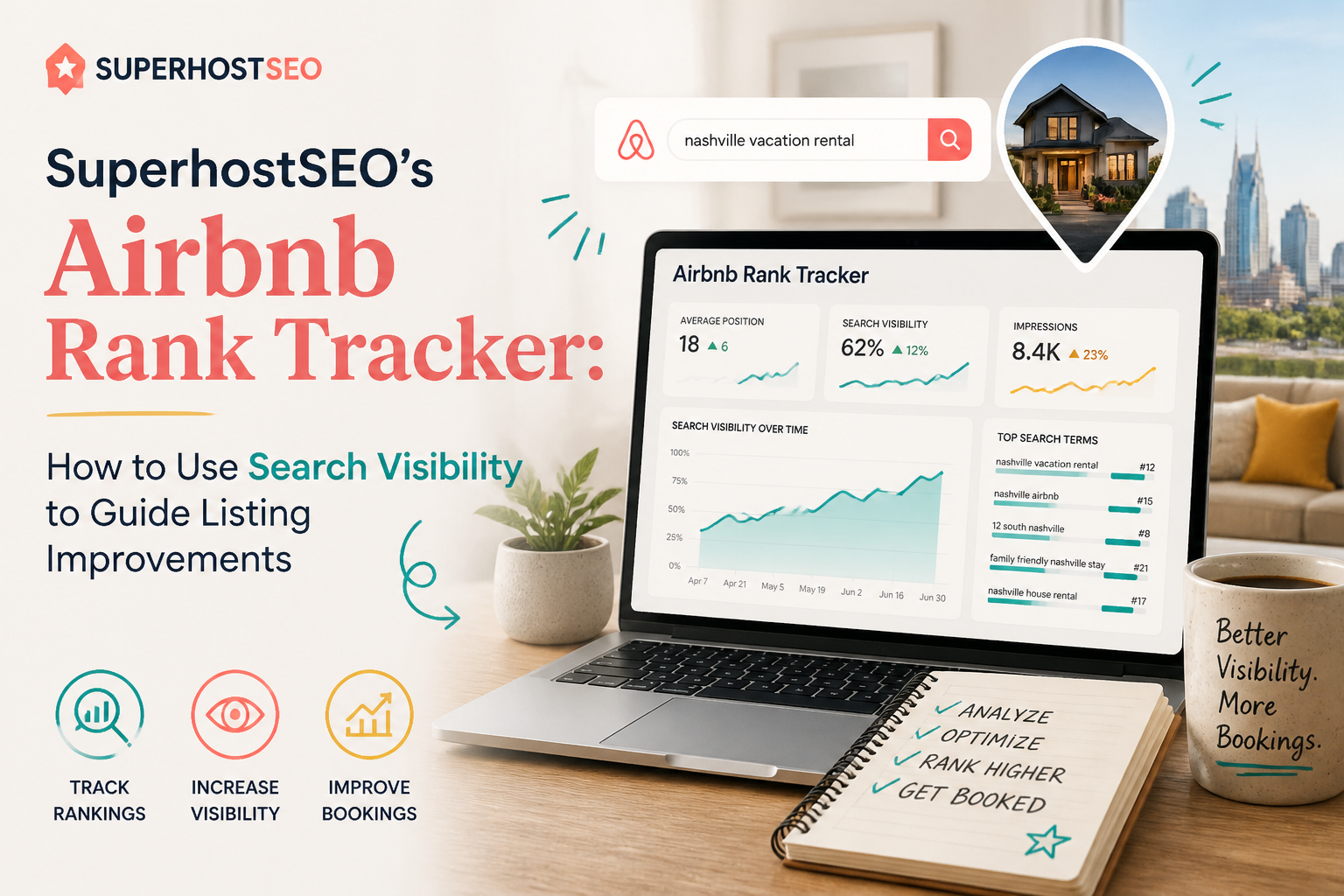 SuperhostSEO’s Airbnb Rank Tracker: How to Use Search Visibility to Guide Listing Improvements
Learn what Airbnb rank tracking can tell you, why search positions vary, and how to use SuperhostSEO’s visibility tracking alongside your listing improvements.
3 min read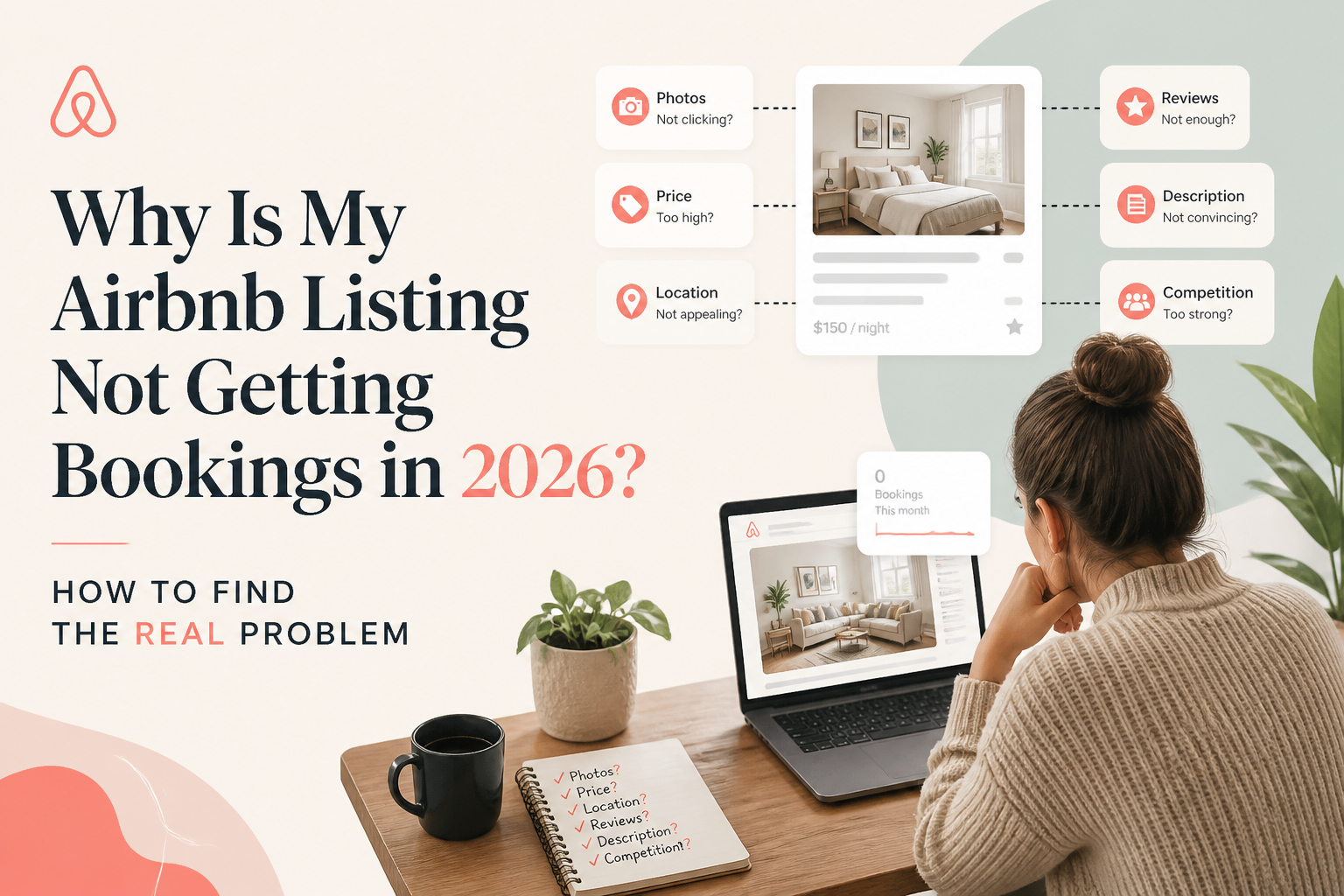 CornerstoneWhy Is My Airbnb Listing Not Getting Bookings in 2026? How to Find the Real Problem
When Airbnb bookings slow down, lowering your price is not always the solution. Learn how to identify whether your listing has a visibility problem, a conversion problem, or a market-demand problem—and what to fix first.
12 min read