
Airbnb Listing Audit vs. Guest Intent Analysis: What's the Difference?
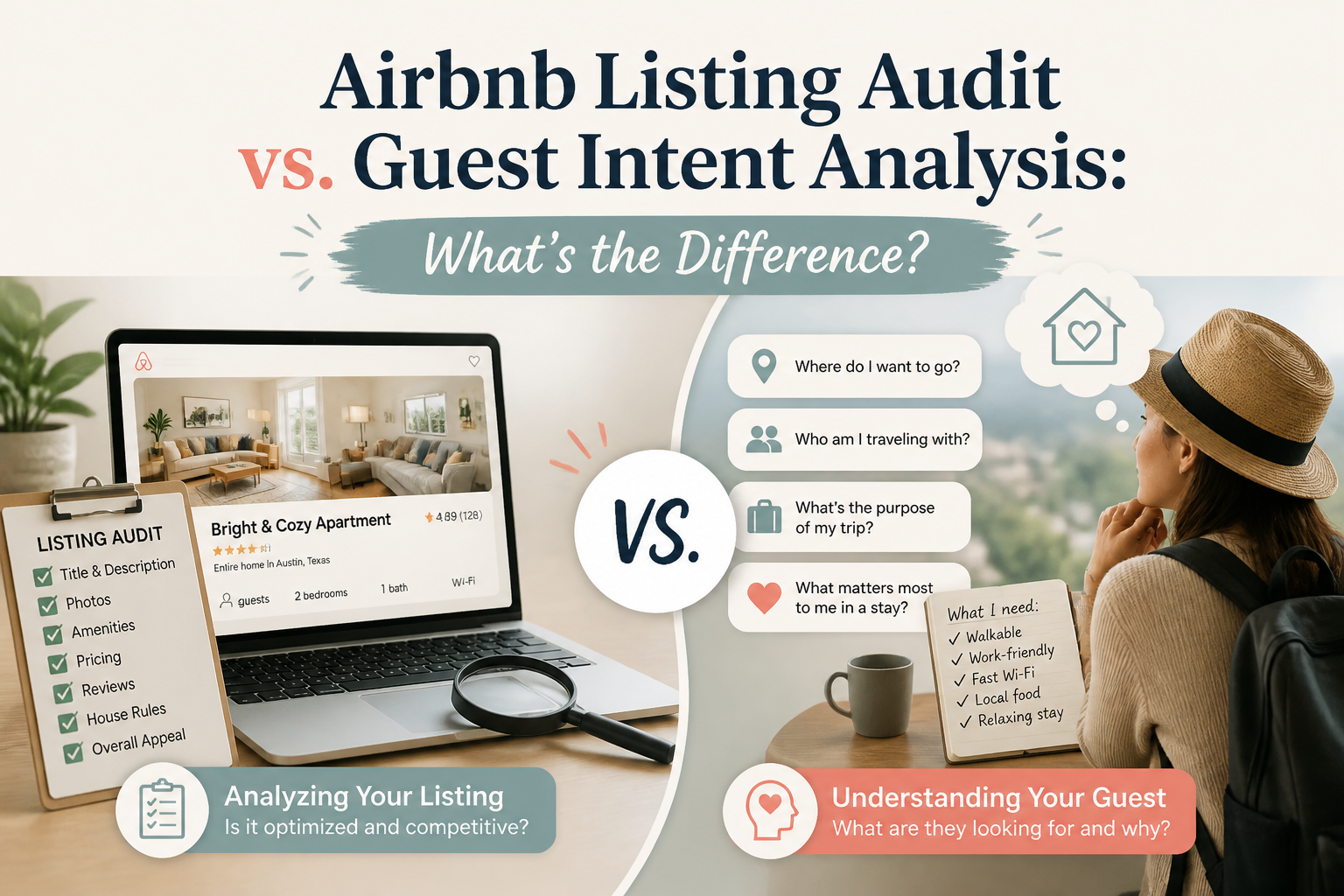
An Airbnb listing can be complete and still struggle to convert. That is because structural problems and guest hesitation are not the same thing. Here is the difference between auditing a listing and analyzing how potential guests may react to it.
One of the things I learned after reviewing a lot of Airbnb listings is that a listing can be complete and still not be convincing.
Those are two different problems.
A listing might have all the right sections filled out, accurate amenities, a solid description, and good photos. Structurally, there may be nothing obviously wrong with it. But guests can still open the page, look around, and decide not to book.
That is why I separate an Airbnb Listing Audit from Guest Intent Analysis. They answer different questions.
The Audit asks: Is the listing built properly?
Guest Intent asks: What might be making a guest hesitate?
What an Airbnb Listing Audit Looks For
I think of the Listing Audit as the first layer.
It looks at the structure of the listing and checks whether the important pieces are there, whether they are being used properly, and where the biggest weaknesses appear to be.
That includes things like the title, summary, main property description, amenities, listing completeness, and other sections that help Airbnb and guests understand the property.
The goal is not simply to tell you that something could be “better.” It is to give you an order of priority.
That matters because hosts often see ten things they could change and have no idea which one to touch first. A weak title and an incomplete amenity list are not necessarily equal problems. Neither is a thin description compared with a minor wording issue in another section.
The Audit is meant to help separate the important gaps from the smaller ones.
What Guest Intent Analysis Looks For
Guest Intent comes at the listing from a different direction.
Instead of asking whether the listing is structurally complete, it looks at how the listing may feel to someone considering a booking.
That means looking at the relationship between the photos, the copy, and what previous guests have actually said in their reviews.
This is where you start finding problems that a checklist may not catch.
Maybe the listing emphasizes peace and quiet, but several reviews mention road noise. Maybe the photos suggest a large outdoor space, but guests repeatedly describe it as smaller than expected. Maybe the listing talks heavily about luxury, while the reviews focus mostly on convenience and location.
None of those necessarily means the listing is incomplete.
They mean the message the host is sending and the experience guests are describing may not be perfectly aligned.
A Listing Can Pass an Audit and Still Lose Bookings
This is the distinction I think is most important.
Imagine a listing where every amenity is selected correctly. The title is specific. The bedrooms and beds are accurate. Guest Access is complete. The description explains the property clearly.
From a structural point of view, that listing may be in very good shape.
But then you read the reviews and notice that several guests mention difficult parking.
The listing technically mentions parking, so an audit may not flag the section as missing. But if the wording makes parking sound simple while guests consistently describe it as stressful, there is a trust problem.
That is the kind of issue Guest Intent is designed to find.
The listing is complete.
The expectation is not.
The Audit Finds Gaps. Guest Intent Finds Friction.
That is probably the simplest way I can explain the difference.
The Audit looks for gaps.
Is important information missing? Is a major section weak? Are there obvious structural problems? Is the listing complete enough to give Airbnb and guests the information they need?
Guest Intent looks for friction.
Is anything making the guest pause? Are the photos and copy telling the same story? Do reviews reinforce the listing or quietly contradict it? Is the property positioned around the things guests actually value?
Both matter, but I would not solve them in the same order.
I Would Usually Run the Audit First
If I am looking at an existing listing that has not been reviewed carefully in a while, I would normally start with the Audit.
There is no point doing deep analysis of guest hesitation while obvious structural problems are still sitting there.
If the description is incomplete, fix it.
If important amenities are missing, fix them.
If the title says almost nothing useful, improve it.
If Guest Access has never been filled out, deal with that first.
Once the listing is structurally strong, Guest Intent becomes more useful because now you are looking for the less obvious reasons someone may still hesitate.
It is a little like fixing a house. First make sure the doors close and the roof does not leak. Then you start asking why the room does not feel quite right.
Reviews Become Much More Important at the Guest Intent Stage
Reviews are interesting because hosts and future guests read them differently.
A host usually experiences reviews one at a time. A guest may sit down and read fifteen of them in ten minutes.
That means the guest may notice patterns more easily.
One person mentioning a firm mattress may mean nothing. Six people mentioning the mattress means something.
One guest saying the street is noisy could be an unusual night. Several guests mentioning traffic tells you that future guests are going to notice the pattern too.
Reviews can also reveal strengths.
If guest after guest talks about the view, the backyard, the host communication, or how easy it is to walk downtown, and those things are barely mentioned in your listing, you may be underselling one of the reasons people actually enjoy staying there.
Guest Intent is not only about finding negatives. It is also about identifying where the listing and the actual guest experience could be better aligned.
Which One Do You Need?
If the listing has never really been optimized, start with the Airbnb Listing Audit.
If it has been live for years and has accumulated random edits, start with the Audit.
If you are not sure whether all the important sections are complete, start with the Audit.
If the listing looks strong but guests are clicking and not booking, Guest Intent becomes more interesting.
If you have good traffic and decent visibility but conversion still feels weak, look at Guest Intent.
If you want to understand whether reviews are reinforcing or undermining the story your listing tells, Guest Intent is the better fit.
In many cases, I would use both. Just not for exactly the same purpose.
What Happens After the Analysis?
Neither tool is supposed to make every decision for you.
The host still knows the property better than any software ever will.
An Audit may tell you that the summary is weak, but you know which features deserve to be emphasized. Guest Intent may show that parking creates hesitation, but you know whether the solution is clearer instructions, better photos, different wording, or an actual operational change.
The point of analysis is to stop guessing where the problem is.
Once you understand the problem, you can decide whether the next step is a small Revamp, a larger Listing Workshop, a photo change, an amenity update, a pricing adjustment, or sometimes no change at all.
Two Different Questions
I built the Airbnb Listing Audit and Guest Intent Optimization separately because I do not think “Is my listing optimized?” is one question.
It is at least two.
Have I built the listing properly?
And then:
Does what the guest sees make them want to book it?
Start with the first question.
Then move to the second.
That sequence makes it much easier to understand what you are actually trying to fix.
Airbnb optimization specialist, Superhost, and founder of one of the largest Airbnb host communities.
Continue Reading
Chosen for you from The Optimization Journal.
 When Does an Airbnb Listing Need a Refresh vs. a Complete Rewrite?
Not every Airbnb listing that feels stale needs to be rebuilt from scratch. Sometimes a few focused changes are enough. Other times, the listing has drifted so far that patching individual sections no longer makes sense. Here is how I would decide between a refresh and a deeper rewrite.
5 min read How Often Should You Update Your Airbnb Listing?
Your Airbnb listing should not be something you publish once and forget about. Properties change, seasons change, Airbnb adds new fields, and guest priorities shift. Here is how often I think hosts should review their listing, what is worth changing, and which type of update actually makes sense.
6 min read Airbnb Listing Setup Checklist: Everything to Complete Before You Go Live
A strong Airbnb listing starts before the first guest ever sees it. Before you publish, make sure the property is complete, clear, and easy to understand. Here is the checklist I would work through before going live.
7 min read How to Audit Your Airbnb Listing Before Changing Your Price
When bookings slow down, many hosts immediately lower the rate. Sometimes that is the right move, but sometimes the problem is somewhere else in the listing. Before discounting, I prefer to figure out whether the issue is visibility, conversion, or actually price.
5 min read How to Measure Where Your Airbnb Listing Appears in Search
Airbnb search position is not as simple as searching your city and looking for your own property. Results can change based on dates, guest count, filters, location, and personalization. Here is a better way to think about Airbnb search visibility and how to tell whether your listing is improving over time.
5 min read