
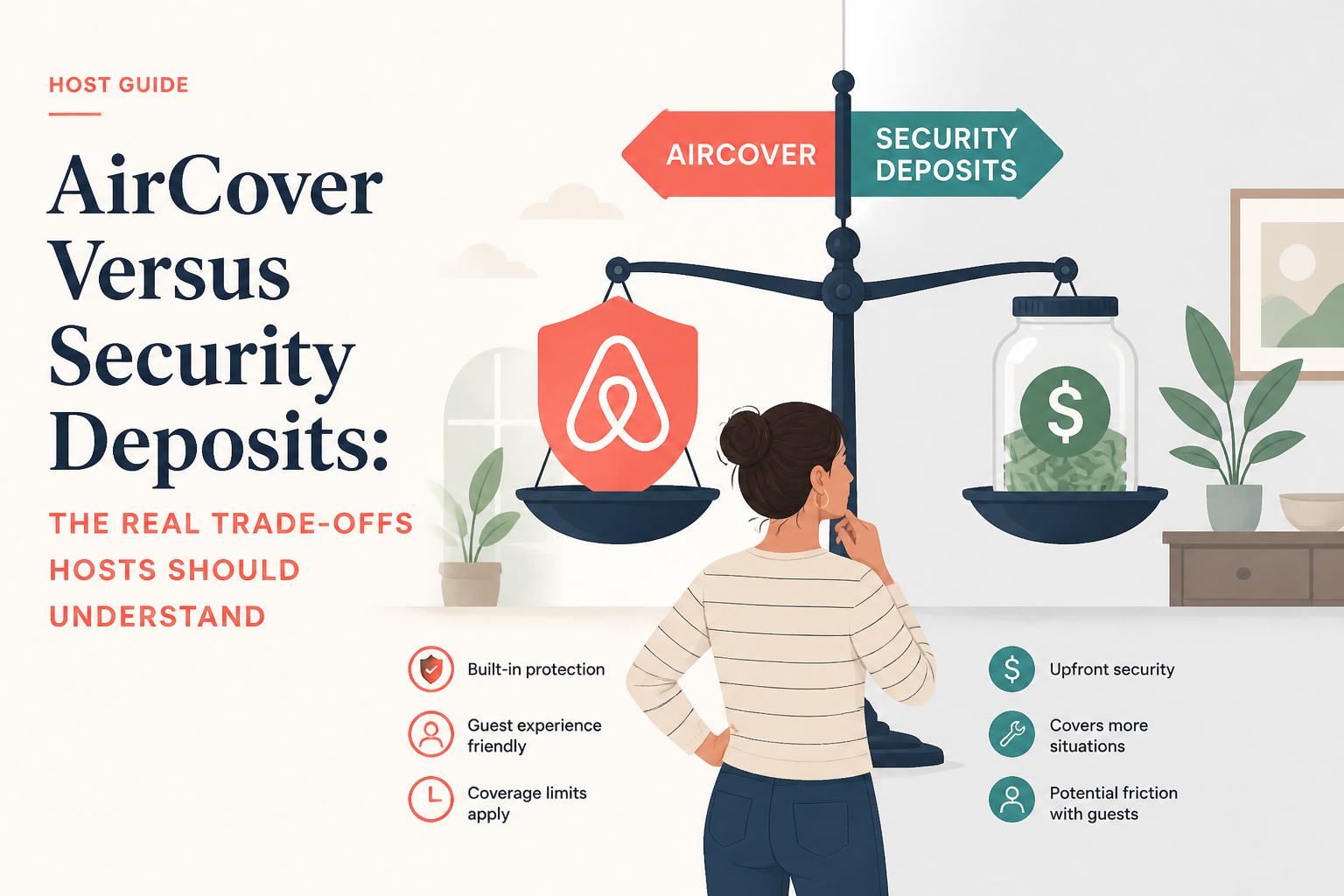
AirCover Versus Security Deposits: The Real Trade-Offs Hosts Should Understand
Both approaches work for different hosts in different situations. What makes the difference is not which one you choose but whether you understand what each one actually does and does not do.
Key takeaways
- Document damage with clear photos, contractor bids, and receipts for extra cleaning.
- Compare repair and replacement options carefully, because depreciation may reduce replacement payouts for older items.
- Research your market’s deposit norms before implementing a security deposit policy.
- Consider combining AirCover for major damage with independent deposits for smaller claims.
A guest's dog chewed through a log bed. The host got a contractor's assessment, submitted it to AirCover, and received a payout. She also discovered something unexpected: having the bed repaired rather than replaced produced a better outcome financially than a depreciated replacement claim would have.
That story contains several things that are useful about AirCover. It confirms the system can work. It reveals conditions that hosts only discover when they actually file. And it implies something worth sitting with: the system rewards hosts who understand how it works before they need it, not after.
What AirCover actually means
AirCover is Airbnb's host protection program, which covers damage to your property caused by guests up to defined limits. In practice, it means that if a guest causes damage, you can file a claim and potentially be reimbursed for repair or replacement costs. The coverage is automatic for every booking. It does not require additional setup or cost.
The conditions that determine whether a claim succeeds are mostly about documentation. Contractors' bids, receipts for extra cleaning, photos that clearly show the damage and its scope. The platform does not pay for owner time: only third-party labor and materials are covered. And the platform's assessment of fair repair or replacement value may differ from yours, particularly for older items where depreciation affects what they consider a reasonable payout.
One host described using AirCover three times and having it work each time. He offered two practical observations: get contractor bids even if you plan to do the work yourself, because the bid is what the claim is based on. And consider repair versus replacement carefully, because replacement claims for older items may be reduced for depreciation while repair claims tend to fare better.
What AirCover does not protect against
AirCover works best for significant, documentable damage. It is much harder to use for small losses: a chipped plate, a stained towel, a scratched surface. The effort of documenting and filing a claim for thirty dollars is rarely worth the time, and the platform's minimum thresholds for claims may exclude these smaller items entirely.
The documentation standard is real and it is demanding. One host described filing a valid claim and finding that it required a substantial volume of documentation and considerable communication before it resolved. He was not unhappy with the outcome. But he was honest about what it cost to get there, and about the fact that he would not have attempted the claim for anything minor.
The expectation gap between what AirCover promises and what it delivers in practice is a genuine source of frustration in the host community. Hosts who have experienced straightforward claim processes tend to credit their documentation. Hosts who have had difficult claims often describe providing the same level of documentation and receiving different results. The inconsistency is real, and it shapes how experienced hosts think about whether to rely on AirCover alone.
What independent deposits actually do
Independent security deposits, held through a property management system via a credit card hold, give hosts a direct mechanism for recovering small and medium damages without going through a platform claims process. The hold is placed at booking, released after checkout if there are no issues, and can be partially or fully retained if damage occurs.
The behavioral case for deposits comes up repeatedly in the host community. One host, with five others agreeing, observed that deposits tend to produce more carefully behaved guests. When a guest knows money is at stake, they treat the property with more attention. Whether that effect is large or small probably varies by property and guest type, but the observation appears consistently enough to be worth taking seriously.
One host who uses deposits through a property management system described the process as seamless in practice. A few guests have asked about the deposit. When he shows them the section of the Airbnb documentation that confirms hosts may collect deposits when disclosed in the listing, the conversation ends there. The number of guests who pushed back significantly has been very small.
The market friction problem
The reality is more complicated than a simple case for deposits. One host described using deposits successfully at one property but finding that at a newer listing in a more competitive urban market, guests pushed back against the deposit in ways that hurt her bookings. She eventually removed it from that property.
The deposit friction question is market-dependent. In markets where short-term rental guests are accustomed to deposits, the requirement is unremarkable. In markets where the norm is AirCover-only listings, a deposit requirement can feel unusual enough to prompt guests to choose a comparable listing without one. Knowing your market's norms before implementing a deposit policy is worth the research.
The platform distrust argument
Some hosts who use independent deposit systems describe the decision less as a financial calculation and more as a response to declining trust in the platform's dispute resolution. One host said plainly that Airbnb has become increasingly anti-host in his view and that he does not trust them to adjudicate damage claims fairly anymore. The deposit gives him direct control over small and medium damage recovery without depending on a system he no longer trusts.
That position is a minority one in the community but it is not a small minority. The hosts who hold it tend to have had specific experiences with claim outcomes that drove the distrust, and those experiences are real even if the general picture is more mixed than their accounts suggest.
The case for layering both
Several hosts described using both AirCover and independent deposits as complements rather than alternatives. AirCover provides a ceiling for major damage that exceeds what a deposit hold would cover. The deposit provides quick resolution for the smaller claims that AirCover would not address. Together they cover a wider range of outcomes than either does alone.
This layered approach requires more setup and a willingness to manage the deposit process consistently. For hosts with higher-value properties or in markets where guests expect accountability, the coverage it produces is more complete than any single mechanism can provide.
Keep reading
Airbnb optimization specialist, Superhost, and founder of one of the largest Airbnb host communities.
Continue Reading
Chosen for you from The Optimization Journal.
 How to Build a Property Protection System That Actually Gives You Peace of Mind
Peace of mind in hosting comes from having a clear path to recovery before something goes wrong, not from figuring it out under pressure after it already has.
5 min read Why the Cleaning Fee Is About More Than Covering Your Cleaner
The cleaning fee question touches platform mechanics, guest psychology, dispute protection, and how guests compare your listing to the hotel down the road. The decision is worth thinking about carefully.
4 min read Why Most Airbnb Hosts Let Small Damage Slide
Ask a crowd of Airbnb hosts whether they file a claim for every broken glass and the answer is almost always no. Here is the reasoning behind that shrug, and what it reveals about hosting as a business.
5 min read Should You Trust Airbnb to Screen Your Guests — or Do It Yourself?
Airbnb has a verification system. But a growing number of hosts have stopped relying on it alone — and what they've found has changed how they host.
5 min read The Airbnb Verification Gap: What Hosts Are Doing About It
Guest accounts can be created, renamed, and duplicated in ways the platform's verification badge doesn't catch. Here's how experienced hosts are closing that gap.
5 min read