
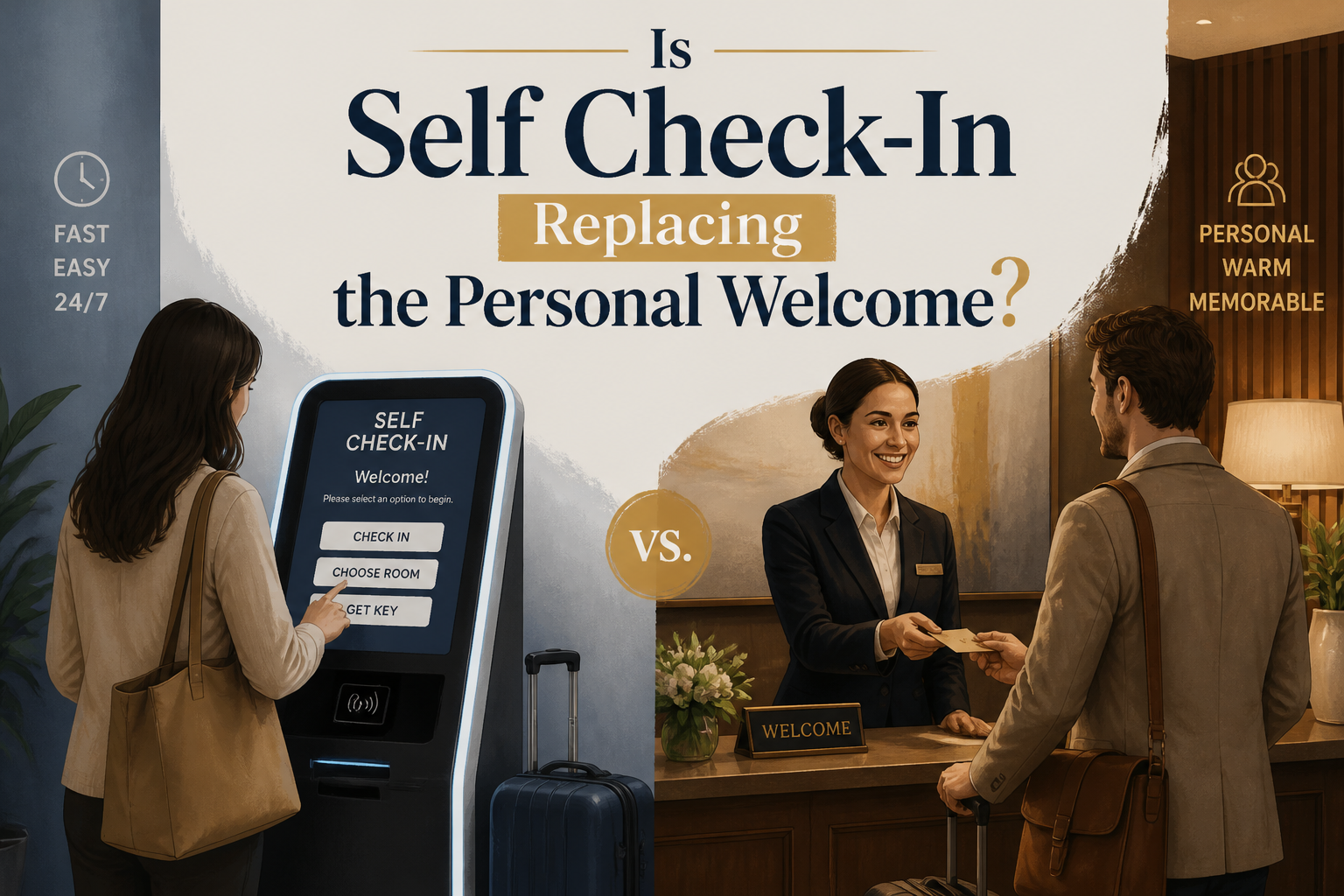
Is Self Check-In Replacing the Personal Welcome?
Most Airbnb hosts now rely on self check-in, but few have given up on hospitality. What the community's answers reveal about welcome, scale, and the way guests actually want to arrive.
Key takeaways
- Choose a check-in approach based on what your circumstances allow and what you can deliver consistently.
- Support self check-in with clear written instructions, photos, or a video walkthrough.
- Use personal messages before arrival to welcome guests and explain your availability if they need help.
- Take your cue from guests about how much interaction they want.
One host estimated she has hosted around two hundred guests and has personally met about five of them. She offers to greet anyone who would prefer it, but almost everyone chooses the lockbox. That single detail captures where much of hosting has landed. When a large community of hosts was asked whether they greet guests in person or rely on self check-in, the majority said self check-in. But almost none of them described giving up on hospitality. They simply moved it somewhere else.
The Case Against Doing It Yourself
Hosts who rely on self check-in rarely describe it as a convenience for themselves alone. Many framed it as a necessity of scale. One host manages a single property with a personal greeting but six others with self check-in only, explaining that her presence cannot stretch across all of them. Distance mattered just as much. One host who lives more than two hours away said she would probably choose to greet guests herself if she lived closer.
There is also a guest side to the logic. One host said people like their privacy, adding that her own social energy is limited. Others noted that most guests, offered a meeting, prefer to arrive on their own schedule. For a traveler landing late after a long journey, a code and a clear set of instructions may feel more welcoming than a conversation at the door.
Where the Welcome Went
If self check-in removes the greeting, what replaces it? The answer, according to hosts who do it well, is information delivered with care. One described sending step by step directions with photos and a steady stream of personal messages before arrival, arguing that the messages, not a person at the door, make guests feel looked after. Another shares a video walkthrough alongside written instructions and meets guests only if asked.
Some hosts make their availability visible in the messages themselves. A host with a city centre apartment who lives only fifteen minutes away tells guests exactly how close she is if anything goes wrong. That small piece of information carries much of the reassurance of a face at the door. The welcome has not vanished. It has become something you can write once and reuse.
The Hybrid Middle
A large group of hosts split the difference, and they tend to do it by length of stay or circumstance. One is mostly self check-in but makes an effort to meet anyone staying more than ten days, and has personally checked in every guest staying more than thirty. Another greets guests in person at arrival but uses a lockbox for departure, treating arrival as the moment worth the effort.
Other hosts end up hybrid by geography. Those who live on the property or next door tend to cross paths with guests anyway, even with a formal self check-in system. One says so openly in her listing and tells guests she will take her cue from them about how much interaction they want. Another gives a quick hello and gauges whether a guest wants a fully hosted stay or prefers to be left alone.
The Hosts Who Always Greet
A smaller group insists on personal greeting, and their reasons are more varied than nostalgia. One host welcomes guests with local pastries, wine, and water, walks them through the apartment, and sits down with a map to point out the best of the city. For her, arrival is the first few minutes of the stay, delivered on purpose. Another helps with luggage, shows guests around, and brings arrival treats once they are settled.
For some, it is a matter of the building. One host manages apartments inside a secure gated complex that requires an access fob, which makes a lockbox impossible. She also likes knowing who is staying in her properties, and says she has never had a complaint. Another has a full self check-in process available and chooses to meet every guest anyway, no matter the time, treating automation as a backup rather than the default.
What Scale Does to Hospitality
If you step back, the most interesting thing is how much the answer depends on circumstances rather than personality. The host with one property and the host with six described the same instinct toward hospitality and expressed it differently, because only one of them can be in six places at once. Distance and building constraints settled the question for others before preference could.
That suggests a useful way to think about your own choice. Ask what your situation allows before you ask what you would enjoy. A gesture you cannot deliver consistently is worse than a simpler one you can. Hospitality that depends on your being available every single time will eventually fail on the one night you are not.
Is Anything Lost?
Something is, to be honest. A greeting builds rapport quickly, lets you explain quirks, and gives guests a face to associate with the place. Hosts who greet in person often say it creates goodwill that shows up later in reviews. Self check-in, by comparison, relies entirely on the quality of your instructions and on the guest never needing help.
But hosts also described how little guests seemed to miss it. Several said guests asked to meet them only occasionally. Others offered to meet and found that most guests declined. What guests wanted most was clarity and reliability, and a system that delivers both can feel warmer than a hello that arrives late or awkwardly.
The Takeaway
The community did not treat this as a choice between warm and cold. Almost every host wanted guests to feel expected from the first minute. Some built that feeling out of a warm hello. Others built it out of a photo, a short video, and a message sent at the right moment. If you can reliably make a guest feel awaited, the format you choose matters less than you might think.
Keep reading
Airbnb optimization specialist, Superhost, and founder of one of the largest Airbnb host communities.
Continue Reading
Chosen for you from The Optimization Journal.
 Do Airbnb Welcome Gifts Actually Matter? Lessons From Baskets Nobody Touched
Some hosts swear by welcome gifts and others quietly stopped after nobody touched them. What the community's experience says about what guests actually notice.
4 min read Should You Trust Airbnb to Screen Your Guests — or Do It Yourself?
Airbnb has a verification system. But a growing number of hosts have stopped relying on it alone — and what they've found has changed how they host.
5 min read How Check-In Flexibility Becomes One of Your Best Hospitality Tools
The gesture that costs you nothing can be worth more than any amenity you add to your listing. Here's how to make check-in flexibility work in your favor.
5 min read Security Versus Privacy: Where Airbnb Hosts Draw the Line on Cameras
Most hosts use outdoor cameras and none inside. What the community's answers reveal about protecting a property without making guests feel watched.
4 min read The True Cost of Generosity: Should You Stock Your Airbnb Like Home?
Most hosts say stock it like home, but one host did the math and could not afford it. A closer look at generosity, margins, and what guests really remember.
4 min read