
Airbnb's New Direct Booking Link Changes More Than the Fee
Airbnb is testing a new Direct Booking Link that gives some hosts a reduced service fee when they bring the guest themselves. The savings are interesting—but the bigger story is what this feature reveals about the value of your own audience, your brand, and the difference between generating a booking and owning the guest relationship.
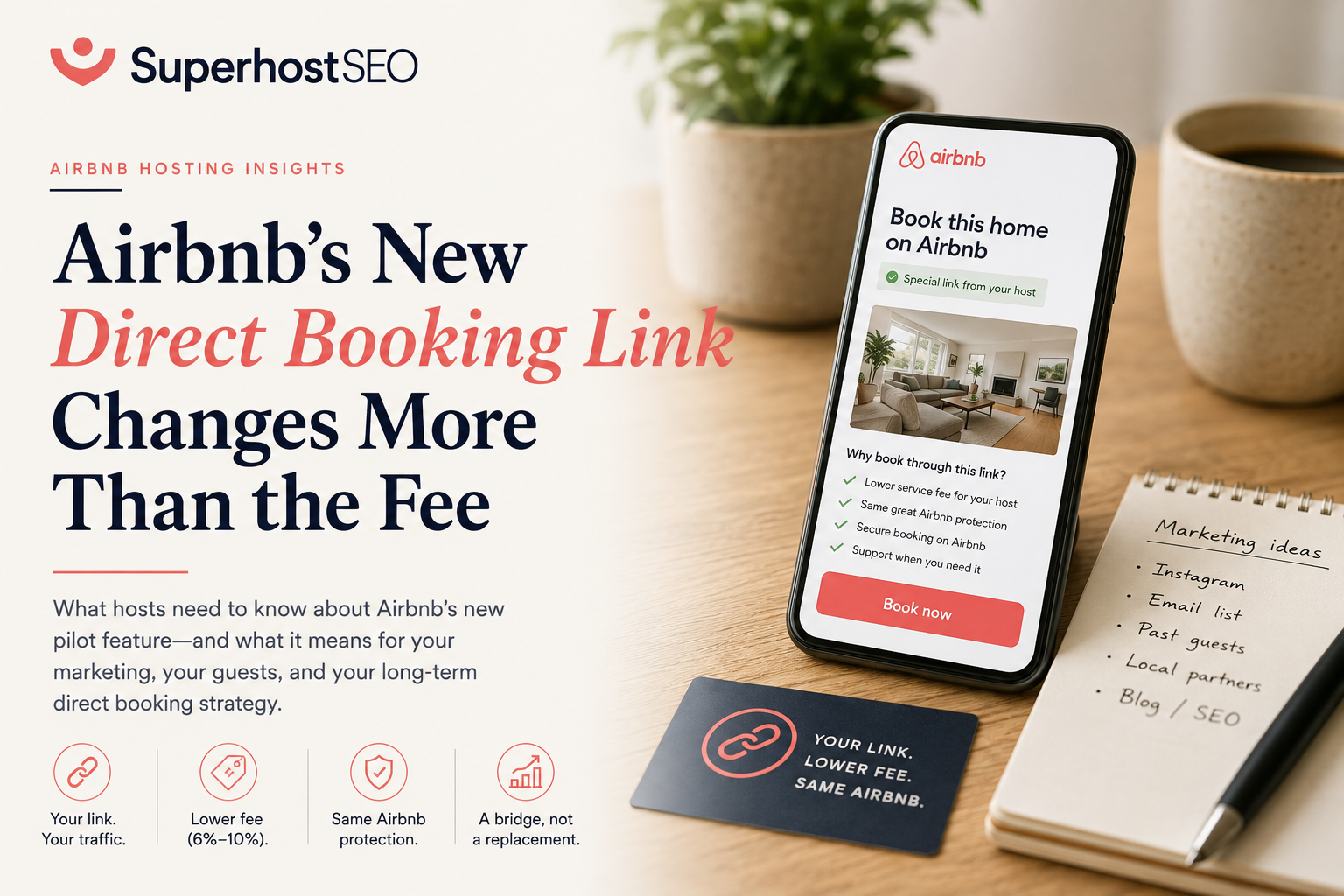
Airbnb is testing a new feature with selected hosts that I think deserves more attention than the fee reduction itself.
It's being called a Direct Booking Link.
The basic idea is simple.
Airbnb gives an eligible host a special link to their listing.
The host can share that link through their own marketing channels—social media, email, their website, or wherever they already communicate with potential guests.
If someone follows that link and completes a reservation on Airbnb, the host may receive a significantly reduced Airbnb service fee compared with a standard booking.
Some hosts participating in the pilot have reported a fee of 6%, while others have reported 10%.
Airbnb still processes the reservation.
The guest still books on Airbnb.
The reservation still operates within Airbnb's system.
And eligible reservations still receive the Airbnb protections and infrastructure associated with a normal platform booking.
At first glance, this sounds primarily like a fee story.
I don't think that's the most interesting part.
To me, this feature is really about something much bigger:
Airbnb is putting a different price on a guest it finds and a guest you find.
And hosts should think carefully about what that means.
Your Traffic Has Value
Imagine two guests booking exactly the same property for exactly the same dates.
The first guest opens Airbnb, searches the destination, finds your listing in the results, compares it with several competitors, and books.
Airbnb created the marketplace where that discovery happened.
That has enormous value.
Now imagine another guest.
They already follow your property on Instagram.
Or they found one of your Facebook posts.
Or a friend recommended you.
Or they stayed with you last year.
Or they found your website through Google.
You created that demand.
Your photos created it.
Your content created it.
Your previous hospitality created it.
Your reputation created it.
Your brand created it.
Until now, if you sent both guests to Airbnb, the platform generally treated those bookings in essentially the same way from a fee perspective.
This pilot introduces an interesting distinction.
If Airbnb didn't have to acquire the guest, Airbnb may be willing to charge less for completing the transaction.
That is significant.
Because it confirms something I have been encouraging hosts to understand for years:
Generating demand is an asset.
This Is Not Really a Direct Booking
We should also be precise with the terminology.
Traditionally, when we say direct booking in the short-term rental industry, we mean that the guest books directly with the host or the host's business.
The reservation might happen through the property's own website and booking engine.
The host manages the customer relationship.
The payment is processed through the host's chosen systems.
The host determines the policies and booking experience within the legal and operational framework of their business.
Airbnb's new Direct Booking Link is different.
The traffic may be direct. The booking is still Airbnb.
That distinction matters.
The host generates the customer.
Airbnb closes the transaction.
Perhaps a better way to think about it is:
Host-generated traffic with Airbnb-powered checkout.
That description isn't as catchy as "Direct Booking Link," but strategically, I think it's more accurate.
And That Doesn't Make It a Bad Feature
I don't think hosts need to react to this as either completely good or completely bad.
That's rarely how hosting decisions work.
There are real advantages here.
Suppose you don't have a direct booking website.
You have a good Instagram following.
You participate in local Facebook groups.
Past guests recommend your property.
People occasionally message you asking how to book.
Your choices used to be fairly limited.
You could build your own direct-booking infrastructure.
Or you could send those people back to your regular Airbnb listing and pay the normal applicable platform fee.
This feature potentially creates a third option.
Bring the guest yourself, but let Airbnb handle the transaction at a lower fee.
For many hosts, that's useful.
You don't have to process the payment.
You don't have to introduce an unfamiliar booking experience.
You don't have to convince someone who already trusts Airbnb to trust a completely separate checkout.
You retain the convenience of the platform while potentially reducing the cost.
That's a legitimate tradeoff.
The Most Important Word Is Trust
Direct booking conversations often focus too heavily on fees.
Hosts calculate:
Airbnb costs X.
My payment processor costs Y.
Therefore I should always send the guest to whichever option costs less.
Real guests don't make decisions that way.
Guests book where they feel confident.
A repeat guest who has stayed with you three times may be completely comfortable booking through your website.
A stranger who discovered you fifteen minutes ago on Instagram may not be.
They might look at your website and wonder:
- Is this legitimate?
- What happens if I need to cancel?
- Who holds my payment?
- What happens if the property isn't as advertised?
- Who do I call if something goes wrong?
Then they see an Airbnb booking option.
They already know Airbnb.
That familiarity removes uncertainty.
And removing uncertainty is one of the most important parts of conversion.
So for some guests, paying Airbnb a smaller percentage may be economically smarter than insisting that every person book independently and losing some of them in the process.
The cheapest booking channel is not necessarily the most profitable booking channel if fewer guests complete the reservation.
This Could Become an Excellent Bridge Strategy
This is where I think the new feature becomes genuinely interesting.
Hosts often think there are only two stages:
Airbnb
or
Direct booking.
But there can be something between them.
A host could build an independent identity without immediately becoming completely independent from the platform.
Imagine this progression:
- The guest discovers you through Airbnb.
- You gradually build a recognizable property name and brand.
- You develop your own website, social presence, or email audience.
- People begin discovering you outside Airbnb.
- Guests who still prefer Airbnb can use your Airbnb Direct Booking Link.
- Guests who already know and trust your business can potentially book through your independent direct channel.
Now you're not forcing every customer through exactly the same door.
You're allowing trust to determine the appropriate booking path.
That is much closer to how mature hospitality businesses operate.
Your Website Doesn't Have to Be Only a Booking Engine
This also reinforces something I think hosts misunderstand about direct-booking websites.
People sometimes ask:
"Why should I build a website if guests are just going to book on Airbnb?"
Because a website has another job.
It gives your property an identity outside the marketplace.
Your Airbnb listing is excellent for competing inside Airbnb.
Your website can tell a much larger story.
It can show more about the destination.
It can explain what makes the property special.
It can contain local guides.
It can rank in Google.
It can give social media visitors somewhere meaningful to land.
It can give past guests a name to remember.
And now, depending on what becomes available through this pilot, it could potentially send guests either toward a direct checkout or toward a discounted Airbnb-powered booking path.
The website becomes the marketing asset even when Airbnb remains one of the checkout options.
That's an important distinction.
Airbnb Is Excellent at Discovery
I also don't think hosts should interpret this feature as evidence that Airbnb no longer has value.
Quite the opposite.
Airbnb's greatest advantage is incredibly difficult for an individual host to recreate:
millions of travelers already arrive there intending to book accommodation.
You don't need to educate those people about what Airbnb is.
You don't need to convince them to enter their credit card information.
You don't need to create search demand from nothing.
Airbnb already created the marketplace.
That's why I have never believed that a serious direct-booking strategy requires abandoning Airbnb.
Platforms can be extraordinary acquisition channels.
The danger is not using a platform.
The danger is confusing access to someone else's audience with ownership of your own.
Who Brought the Guest?
I think this new feature gives hosts a very useful question to begin asking about every reservation:
Who brought this guest?
If Airbnb brought them, the platform has clearly delivered substantial value.
If Vrbo brought them, Vrbo delivered the discovery.
If Booking.com brought them, Booking.com did.
But what if the guest came from:
- your Instagram account?
- your Facebook page?
- your email newsletter?
- your blog?
- your Google Business presence?
- a previous guest?
- a referral?
- your own website?
Then you generated the demand.
And that is worth measuring.
This is one reason hosts should stop looking only at occupancy and begin understanding where their guests actually come from.
A full calendar tells you that people booked.
It doesn't necessarily tell you who created the demand.
The 6% Versus 0% Argument Is Too Simple
Some hosts with direct booking websites will understandably look at this and say:
"Why would I pay Airbnb 6% or 10% for a guest I generated when I can take the booking myself?"
That's a fair question.
But there is another side to the calculation.
What are you receiving for that percentage?
Payment processing.
A booking environment the guest already recognizes.
Airbnb's communication infrastructure.
Platform-based guest and host protections.
A familiar dispute process.
A profile and review ecosystem.
For a repeat guest who trusts you completely, perhaps those things add very little.
For a brand-new guest, they may be worth considerably more.
The correct question isn't simply, "Which percentage is lower?"
The better question is:
What am I receiving in exchange for the percentage, and is it valuable for this particular guest?
What I Would Not Do
I would not immediately replace every link to an independent booking site with Airbnb's new link simply because the fee is lower than a regular Airbnb reservation.
If you've already built a direct channel that converts well, you've built something valuable.
Don't dismantle it.
I also wouldn't assume every guest should be pushed toward an independent direct checkout merely because the transaction cost is lower.
If forcing the guest away from a trusted platform creates enough hesitation that they don't book, you've saved 100% of the commission on a reservation you never received.
That's not a saving.
I would instead think in terms of channels.
Let Airbnb do what Airbnb does well.
Let your website do what your website does well.
Let your brand generate recognition.
Let your repeat guests become increasingly valuable.
And if this new Airbnb link gives you another useful path between discovery and full independence, use it where it makes sense.
What I Would Test
If Airbnb gives you access to this feature, I would test it rather than debate it theoretically.
Track where you're sharing the link.
Social media.
Email.
Your website.
Past guest communications, where permitted.
Referrals.
Then watch what happens.
How many people click?
How many actually book?
What fee does Airbnb apply to your account?
Does offering part of the savings to the guest improve conversion?
How does that conversion compare with your own booking website?
What type of guest prefers each channel?
Don't choose based on ideology.
Choose based on the behavior of your actual guests.
There Is Also an Important Warning: This Is a Pilot
Hosts should remember that this feature is currently being tested with selected accounts.
Not everyone has it.
Reported fee levels are not identical for every participating host.
And pilots can change.
Airbnb can alter the economics, eligibility, or structure later.
That doesn't make the feature less useful today.
But it reinforces the larger lesson.
Never build your entire business around a feature you don't control.
Use platform tools.
Take advantage of them.
Optimize around them when they make sense.
But continue building assets that survive when the platform changes.
Your reputation.
Your guest experience.
Your property name.
Your content.
Your audience.
Your website.
Your repeat guests.
Those belong to the business you're building.
The Bigger Message Airbnb Just Sent Hosts
The direct booking link may ultimately become a small feature.
Perhaps Airbnb expands it.
Perhaps the pricing changes.
Perhaps it eventually becomes something much larger.
We don't know yet.
But I think the pilot has already communicated something important.
Airbnb knows there is a difference between traffic Airbnb creates and traffic a host creates.
Hosts should understand that difference too.
If people follow you...
If past guests remember you...
If travelers search for your property by name...
If people subscribe to your email list...
If your articles appear in Google...
If referrals bring new travelers...
If someone visits your website because of something you created...
Then you are no longer simply operating an Airbnb listing.
You are building demand.
And demand that you create yourself changes the economics of the business.
The Bottom Line
Airbnb's new Direct Booking Link appears to be a genuinely useful feature for hosts who receive access to it.
If you're already bringing guests to Airbnb through your own marketing, paying a reduced service fee instead of the normal applicable fee can be meaningful.
But I wouldn't call this the end of direct bookings.
I wouldn't call it a replacement for your own website.
And I wouldn't dismiss it simply because Airbnb remains involved.
I would call it another channel.
And good hosts don't ask whether one channel is universally better than another.
They ask what each channel does for them.
Airbnb can provide discovery.
Your own marketing can create demand.
Your website can build identity.
Your hospitality can create loyalty.
Your direct-booking infrastructure can create ownership.
And this new Airbnb link may provide a useful bridge between some of those pieces.
The smartest strategy isn't necessarily to choose Airbnb or direct booking.
It's to understand exactly who brought the guest, who owns the relationship, what you're paying for, and whether that trade makes sense for your business.
That's a much more important decision than simply comparing two percentages.
Airbnb optimization specialist, Superhost, and founder of one of the largest Airbnb host communities.
Continue Reading
Chosen for you from The Optimization Journal.
 CornerstoneShould You Lower Airbnb Prices When Bookings Slow Down? What Hosts Actually Say
When Airbnb bookings slow down, should you lower your nightly rate or hold firm? Discover what experienced hosts reported, why some regret discounting, and how to make smarter pricing decisions.
15 min read Vrbo’s New U.S. and UK Terms: What Hosts With Direct Booking Sites Need to Know
Vrbo’s new host terms in the U.S. and UK introduce broad language around pricing, policies, availability, booking conditions, and listing content across other channels. If you also take direct bookings, this is worth reading carefully.
3 min read Why the Cleaning Fee Is About More Than Covering Your Cleaner
The cleaning fee question touches platform mechanics, guest psychology, dispute protection, and how guests compare your listing to the hotel down the road. The decision is worth thinking about carefully.
4 min read Do Long-Stay Discounts Actually Make Financial Sense for Your Rental?
She stopped offering discounts. Her occupancy did not change. She made more money. Another host in a different market reached the exact opposite conclusion with equal certainty. Both ran the numbers.
4 min read The Flat Rate Versus Per-Person Pricing Debate in Short-Term Rentals
When one person pays the same nightly rate as eight, is that fair? When a solo guest cannot afford a space that costs as much as it does for a full group, is that fair? The pricing question is more interesting than it first appears.
5 min read