
Should You Lower Airbnb Prices When Bookings Slow Down? What Hosts Actually Say
When Airbnb bookings slow down, should you lower your nightly rate or hold firm? Discover what experienced hosts reported, why some regret discounting, and how to make smarter pricing decisions.
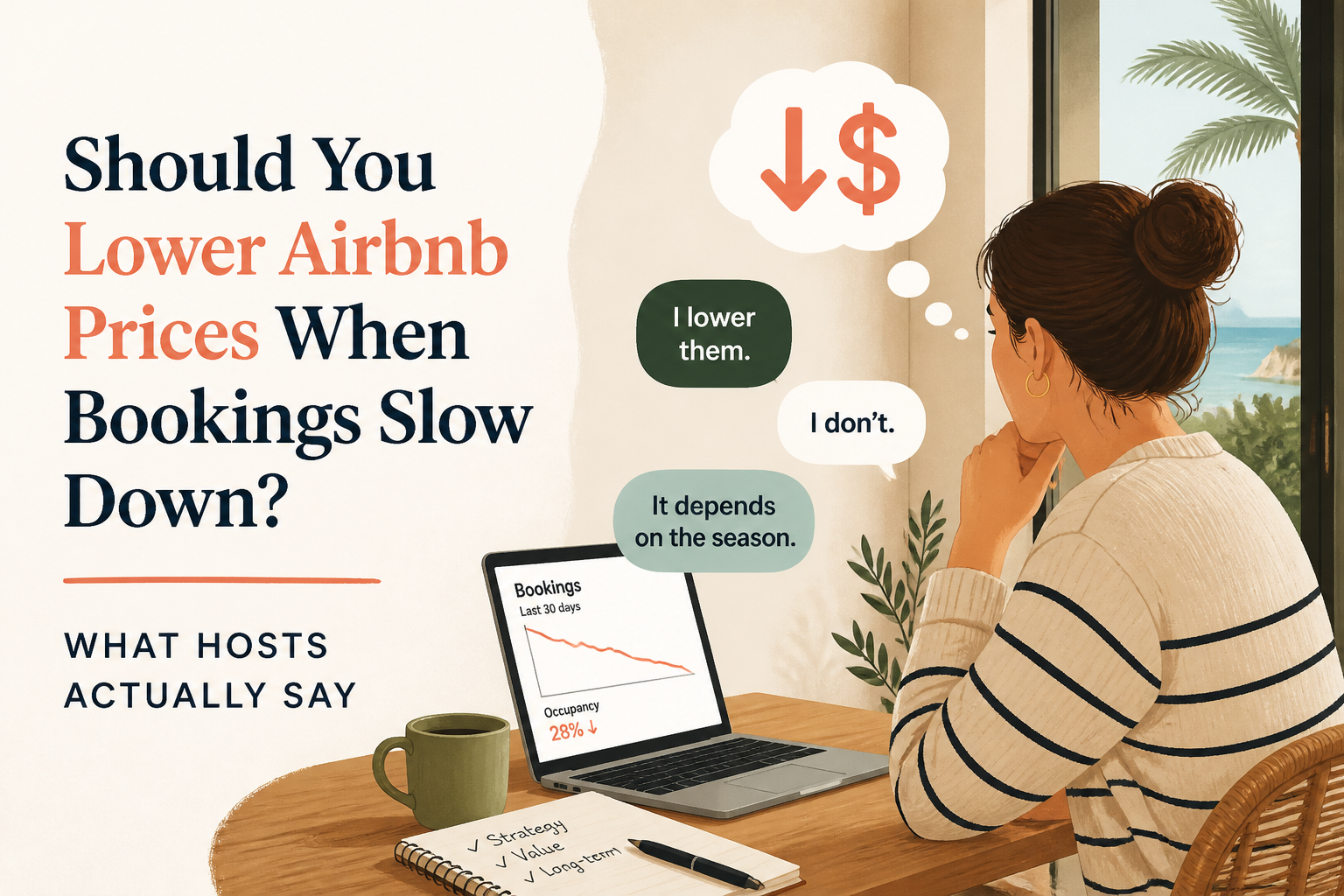
When Airbnb bookings slow down, should you lower your nightly rate or hold your price?
There is no universal answer. Lowering prices can make a listing more competitive and help attract bookings, but it can also reduce revenue per reservation without addressing the underlying problem. Holding firm may protect your margins, but it can leave nights empty when market demand has genuinely weakened.
The right decision depends on your property's costs, the competition, local demand, booking pace, and what you are trying to achieve.
I wanted to understand how experienced hosts actually handle this situation, so I put the question to my Airbnb hosting community.
The responses were more divided than I expected.
Some hosts had lowered prices and regretted it. Others had refused to discount, even when their calendars were unusually empty. Several reported raising prices and continuing to receive bookings.
And then there were hosts who explained why lowering rates was unavoidable in their markets.
The most interesting part wasn't which side was right.
It was what each group understood about the tradeoffs involved.
- Why Lowering Your Airbnb Price Isn't Always the Answer
An empty calendar creates pressure.
You look at the upcoming weeks, notice more available nights than usual, and begin wondering whether your price is too high.
Lowering your nightly rate is appealing because it is immediate.
You can change the price in minutes.
But Airbnb pricing is more complicated than filling empty dates.
A booking at a lower rate may generate income that would otherwise be lost. It may also leave very little after cleaning, utilities, platform fees, maintenance, and the time required to manage the stay.
This is why I distinguish between occupancy and profitability.
Occupancy tells you how full your calendar is. Profitability tells you whether those bookings are worth taking.
A property can have high occupancy and disappointing profits.
Another property can have fewer bookings but generate stronger financial results because its average nightly rate and operating margins are higher.
Neither outcome can be judged by occupancy alone.
Before reducing your rate, you need to understand what you are trying to improve.
Is the goal more bookings?
More total revenue?
Higher profit?
Better occupancy during a temporary slow period?
The answer matters because different goals can lead to different pricing decisions.
- What Happened When I Asked Airbnb Hosts About Lowering Prices
For The Airbnb Hosting Decisions Playbook, I collected perspectives from my Airbnb Listing Optimization host community.
One question was particularly revealing:
When bookings slow down, do you drop your prices or hold firm?
The replies were not a simple yes-or-no debate.
They reflected different properties, different markets, and different experiences.
Three broad approaches emerged.
Group One: Hosts Who Refuse to Lower Their Rates
Several experienced hosts said they would rather accept some empty nights than lower their rates beyond a certain point.
Some reported increasing their prices despite slower booking periods.
One host described raising rates and continuing to receive reservations. Another said she increased her prices every year rather than reducing them when demand softened.
One host explained that she had established a minimum rate she would not go below.
The reasoning was straightforward.
She knew what her property cost to operate, understood the type of business she wanted to run, and was willing to accept some vacancy rather than book below her chosen threshold.
This approach is not automatically right for every property.
A host carrying substantial fixed costs may not have the financial flexibility to leave nights empty.
But the underlying principle is valuable.
Set your pricing boundaries before the calendar becomes stressful.
Group Two: Hosts Who Lowered Prices Because Their Markets Changed
Another group described a very different reality.
Their markets had become more competitive, and holding the same prices was no longer producing the same results.
One host managing large vacation properties in the Orlando area explained that a fourteen-bedroom home which previously commanded more than $1,000 per night was now closer to $800.
His explanation was increasing short-term rental supply.
The properties themselves had not become worse.
But more competing homes had entered the market, changing what guests were willing to pay.
Another host in Arizona described an exceptionally slow year and making modest rate reductions while resisting deeper discounts.
These examples show why pricing cannot be separated from local market conditions.
If supply increases faster than demand, holding last year's prices may not be realistic.
Staying competitive and racing to the bottom are not the same thing.
The challenge is identifying the difference.
Group Three: Hosts Who Discounted and Regretted It
The third group had experimented with price reductions and later reconsidered their approach.
Several reported that discounting filled nights but also changed the type of booking requests they received or their experiences with guests.
One host described lowering rates, receiving bookings, and later feeling that the additional reservations were not worth the tradeoff.
Another host in Tampa discussed reducing weekday prices during a slow summer period. She reported that the discounts attracted bookings but also brought guest experiences she considered less desirable.
She eventually stopped discounting in the same way.
These are individual host experiences, not controlled evidence that lower-paying guests are inherently worse or more likely to cause problems.
Guest behavior cannot be reliably predicted from price alone.
But the accounts reveal something worth monitoring.
A pricing change can affect more than occupancy.
It may change your reservation mix, length of stay, turnover costs, workload, and overall guest experience.
Those outcomes deserve attention alongside the additional booking revenue.
- The Most Important Pricing Decision: Establish Your Floor Rate
One of the most practical ideas from the host discussion was the concept of a pricing floor.
A floor rate is the minimum nightly price you are willing to accept under your chosen financial and operating conditions.
It should not be an arbitrary number based on what feels comfortable.
It should reflect your actual costs and business objectives.
Consider expenses such as:
- Cleaning and laundry
- Consumables and guest supplies
- Utilities associated with occupied nights
- Platform and payment fees
- Additional wear and maintenance
- Your time or management costs
- Taxes and other applicable operating expenses
You also need to consider how fixed costs, such as insurance and property expenses, affect your required long-term returns.
The calculation will be different for every host.
A single-night reservation may have relatively high turnover costs because the property still requires cleaning and preparation.
A longer reservation can spread some of those costs across more nights.
That means a profitable nightly rate can depend on the length of the stay, not just the amount charged per night.
Before accepting a deeply discounted reservation, ask:
After the costs directly associated with this booking, is the remaining contribution worthwhile—and does it support my broader financial goals?
A discounted booking can still make economic sense if it generates a positive contribution toward costs that would exist anyway.
But it is important to know the difference between generating cash flow and earning an acceptable profit.
Your floor should be a deliberate business decision, not a number you invent because tomorrow night is still empty.
- Understand Your Market Before Changing Your Price
One of the biggest mistakes I see hosts make is comparing their property with listings that are not genuinely comparable.
A three-bedroom family home should not automatically copy the prices of a one-bedroom apartment nearby.
A professionally photographed property with a private pool, excellent reviews, and flexible amenities may offer a different value proposition from a basic rental with fewer features.
In The Airbnb Optimization Playbook, I recommend establishing a relevant competitor set.
Start with properties that have similar characteristics:
- Location
- Bedroom count
- Sleeping capacity
- Property type
- Quality and condition
- Amenities
- Guest ratings and review history
Then compare the total price guests actually see for similar dates and lengths of stay.
The goal is not to copy the cheapest competitor.
It is to understand the price range for properties guests might reasonably consider instead of yours.
Look at booking pace, not just empty dates
Booking pace measures how reservations for future dates are developing compared with your usual pattern.
Some markets have long booking windows.
Guests planning a summer beach vacation may reserve months ahead.
Other markets depend heavily on last-minute reservations.
An empty date sixty days away may be completely normal in one location and a serious warning sign in another.
Before lowering prices, ask:
- How far in advance do my guests usually book?
- Is my current booking pace behind the comparable period last year?
- Are nearby properties showing similar availability patterns?
- Are there upcoming events or seasonal demand changes?
- Is my price significantly above comparable properties for the same stay?
This context makes pricing decisions more useful than reacting to a single empty week.
And remember that competitor calendars have limitations.
A blocked date does not necessarily represent a paid booking. A host may have reserved it for personal use, maintenance, or another purpose.
Use competitor availability as a signal, not proof of another property's revenue.
- Does Lowering Your Airbnb Price Improve Search Ranking?
Potentially, yes.
Airbnb identifies price as one of the factors influencing how listings appear in search results.
According to Airbnb's own documentation, the platform considers the total price of a stay and how it compares with similar properties for the dates being searched.
Properties offering more attractive prices relative to comparable listings may perform better in search.
But this does not mean the cheapest listing automatically ranks first.
Airbnb also considers factors such as quality, popularity, location, availability, and guest preferences.
You can read Airbnb's explanation in its official guide: "How Search Results Work" (https://www.airbnb.com/help/article/39).
A lower rate can influence competitiveness.
It cannot guarantee that guests will book.
If your opening photographs are unconvincing, your description is confusing, or your availability excludes common searches, a discount may not solve the most important problem.
And if your property is already attracting qualified guests at its current rate, reducing prices unnecessarily can leave revenue on the table.
The key is to understand what is preventing the booking before deciding whether price is the right lever.
- Before Discounting, Make Sure Your Airbnb Listing Justifies Its Price
Imagine two properties in the same neighborhood.
Both have similar sleeping capacity, amenities, and nightly rates.
The first listing has clear professional photographs, an informative title, detailed room descriptions, and an accurate presentation of its strongest features.
The second uses generic wording, incomplete descriptions, and photographs that make it difficult to understand the layout.
Even at the same price, the properties may create very different impressions.
Guests are not buying a nightly rate in isolation.
They are comparing the experience and certainty that each listing communicates.
This is why I believe listing optimization and pricing need to work together.
Before lowering your nightly rate, review the basics.
Are your best features immediately visible?
A private pool, mountain view, dedicated workspace, or exceptional outdoor area should not be hidden deep inside the listing.
Is your title specific?
Generic phrases like "beautiful home" or "great location" rarely explain why one property is worth choosing over another.
Does your description create confidence?
Guests should understand the layout, sleeping arrangements, amenities, access details, and any limitations that affect their stay.
Are all your amenities selected accurately?
A property may offer important features that are missing from Airbnb's structured amenity settings.
Does your calendar allow the stays guests actually want?
Minimum-night restrictions and blocked dates can prevent a property from matching otherwise relevant searches.
These factors are worth reviewing before assuming the only way to compete is by lowering your price.
Not sure whether your Airbnb listing is communicating its full value?
"Run a free Airbnb Listing Audit with SuperhostSEO" (https://www.superhostseo.com/audit/) to identify weaknesses in your listing's presentation and completeness.
The audit is not a dynamic pricing tool. It helps you find listing-related issues that may be affecting how confidently guests evaluate your property.
- Sometimes a Smaller Pricing Adjustment Is Enough
A price change does not need to be dramatic.
In The Airbnb Optimization Playbook, I recommend responding to booking pace and demand gradually rather than making large reactive discounts.
A small adjustment may be appropriate when an unbooked date is approaching and comparable properties suggest your rate is no longer competitive.
But the right adjustment depends on your market, costs, and the remaining opportunity to sell those nights.
The same logic applies to minimum stays.
If a two-night gap remains between reservations but your listing requires three nights, a price reduction alone cannot make that gap bookable for a two-night search.
You may need to reconsider the minimum-stay rule for those particular dates.
Other possible approaches include:
- Adjusting prices selectively for weaker dates
- Reviewing seasonal rates before demand shifts
- Protecting premium weekends rather than discounting the entire calendar
- Making shorter calendar gaps bookable when financially worthwhile
- Improving photos or descriptions so the property's value is clearer
Not every situation requires a discount.
Sometimes the best response is changing availability.
Sometimes it is improving presentation.
Sometimes it is waiting for your normal booking window.
And sometimes the market genuinely requires a more competitive rate.
- Why Raising Your Airbnb Price Can Sometimes Make Sense
One of the most surprising parts of the community discussion was hearing from hosts who reported receiving more bookings after increasing their rates.
That does not prove that higher prices caused those bookings.
Demand may have changed, the properties may have been underpriced, or other factors may have influenced the results.
But these examples challenge the assumption that lowering prices is always the only way to stimulate reservations.
There are situations where a higher rate can be sensible.
Perhaps an upcoming event is increasing demand.
Perhaps your property has been consistently booking far ahead of your normal pace.
Perhaps comparable properties of similar quality are charging substantially more.
Or perhaps you've improved the property's amenities and presentation enough to justify a different price position.
The objective is not to charge more simply to appear premium.
It is to price the property according to its actual value, demand conditions, and financial goals.
A pricing strategy should work in both directions.
Sometimes the right decision is to decrease.
Sometimes it is to increase.
And sometimes it is to leave the price alone.
- A Practical Decision Framework for Slow Airbnb Bookings
When you notice a slowdown, I recommend working through five questions in order.
Question 1: Is the slowdown happening across my market?
Compare your booking pace with seasonal patterns and relevant local competitors.
If the entire market has weakened, the problem may not be specific to your listing.
Question 2: Are guests finding my listing?
Review your listing views and search visibility.
If visibility has declined, investigate pricing competitiveness, availability, amenities, photos, and relevant listing settings.
Question 3: Are guests viewing the listing but not booking?
Look at conversion.
Review your photographs, property descriptions, total price, reviews, and the questions a guest might still have.
Question 4: Would a lower rate actually be worthwhile?
Calculate the incremental costs of the booking and compare them with the additional revenue.
Do not confuse a full calendar with a profitable business.
Question 5: What is the smallest useful change I can make?
Maybe the answer is a modest price adjustment.
Maybe it is a shorter minimum stay for a particular gap.
Maybe it is improving a weak listing section.
Make a deliberate change and track the results.
You do not need to rebuild your entire pricing strategy every time the calendar has a slow week.
- Use Listing Optimization to Support Your Pricing Strategy
In my experience, the strongest approach is to stop treating pricing and listing quality as unrelated decisions.
Pricing determines part of the value proposition.
Listing quality helps communicate why that value is reasonable.
When your presentation is weak, guests may have difficulty understanding why your property costs more than another option.
When your listing is clear, complete, and accurate, guests can compare it more confidently.
That is one reason I built the SuperhostSEO tools around diagnosing the listing before making random changes.
The Airbnb Listing Audit evaluates your listing and identifies priority improvements.
Guest Intent Optimization examines whether your listing content, photographs, and reviews communicate the experience guests expect.
These tools do not replace pricing research or revenue management.
They help address the presentation and confidence side of the booking decision.
Combining that information with your market data is more useful than assuming every empty night requires a discount.
Frequently Asked Questions
Should I lower my Airbnb price when I'm not getting bookings?
Not automatically. First, determine whether the slowdown reflects weaker market demand, reduced listing visibility, poor conversion, restrictive booking settings, or an uncompetitive price. A discount may be appropriate, but it should address an identified problem.
Does lowering Airbnb prices increase bookings?
It can. Lower prices may make a property more competitive and attractive to guests, but additional bookings are not guaranteed. Results depend on demand, availability, property quality, reviews, and competing listings.
Can lowering my Airbnb price hurt profitability?
Yes. Discounting reduces revenue per booked night. If the resulting reservation has substantial cleaning, utility, management, or maintenance costs, the financial benefit may be small. Compare the incremental contribution of a discounted booking with the value of leaving the night available for another reservation.
Is it better to have high occupancy or a higher nightly rate?
Neither metric is sufficient by itself. The relevant goal is usually sustainable profit, supported by healthy total revenue and an acceptable operating margin. Different properties may achieve that with different combinations of occupancy and nightly rates.
Why are other Airbnbs getting bookings when mine isn't?
Possible explanations include pricing, availability, listing presentation, guest reviews, location, property characteristics, or differences in the booking restrictions guests encounter. Competitor calendars alone cannot confirm how many paid bookings another host has received.
What is an Airbnb floor rate?
A floor rate is a minimum price a host chooses not to go below under defined conditions. It should reflect booking-related costs, business requirements, and financial goals rather than being chosen emotionally during a slow period.
Can an Airbnb listing audit tell me whether my price is too high?
A listing audit can help identify presentation or completeness weaknesses that affect how guests evaluate your property. Determining whether a particular price is competitive also requires market comparisons, availability, booking pace, seasonality, and operating-cost information.
Final Thoughts: Don't Let an Empty Calendar Make Every Decision
The biggest lesson I took from asking experienced hosts about slow-period pricing was not that discounts are bad.
It was that deliberate decisions are better than reactive ones.
Some hosts have good reasons to protect their rates.
Others operate in markets where prices genuinely need to come down.
Neither approach is automatically right.
What matters is knowing your costs, understanding demand, evaluating your property's position, and deciding what kind of booking is financially worthwhile.
An empty night is not automatically a failure.
And a filled night is not automatically a success.
The goal is to build a profitable hosting business, not simply to make every available date disappear from your calendar.
Before changing your rate again, make sure the property is being presented as clearly and competitively as possible.
Want to know whether your listing has optimization problems worth fixing first?
"Run your free Airbnb Listing Audit at SuperhostSEO" (https://www.superhostseo.com/audit/) and get a structured assessment of your listing, including its strengths, weaknesses, and prioritized improvements.
Written by Elie Parienti, founder of SuperhostSEO and author of The Airbnb Optimization Playbook and The Airbnb Hosting Decisions Playbook. The community experiences discussed here are drawn from Chapter 15, "When Business Is Slow," of The Airbnb Hosting Decisions Playbook.
Further Reading
- "Airbnb: How Search Results Work" (https://www.airbnb.com/help/article/39)
- "How to Audit Your Airbnb Listing Before Changing Your Price" (https://www.superhostseo.com/blog/audit-airbnb-listing-before-changing-price)
- "How to Compare Your Airbnb Calendar With Competitors" (https://www.superhostseo.com/blog/compare-airbnb-calendar-competitors)
- "How to Choose the Right Airbnb Competitors to Watch" (https://www.superhostseo.com/blog/choose-airbnb-competitors)
Airbnb optimization specialist, Superhost, and founder of one of the largest Airbnb host communities.
Continue Reading
Chosen for you from The Optimization Journal.
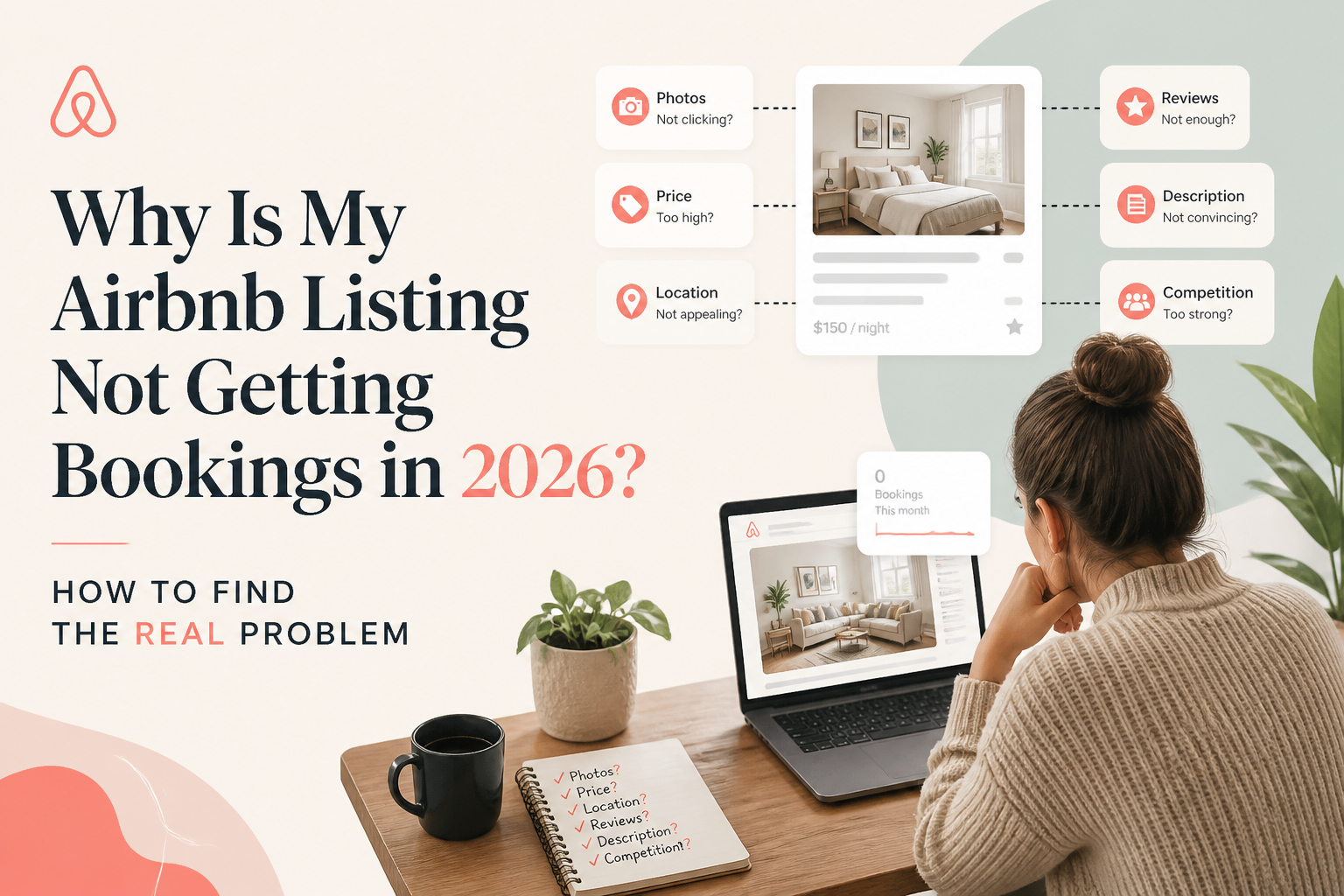 CornerstoneWhy Is My Airbnb Listing Not Getting Bookings in 2026? How to Find the Real Problem
When Airbnb bookings slow down, lowering your price is not always the solution. Learn how to identify whether your listing has a visibility problem, a conversion problem, or a market-demand problem—and what to fix first.
12 min read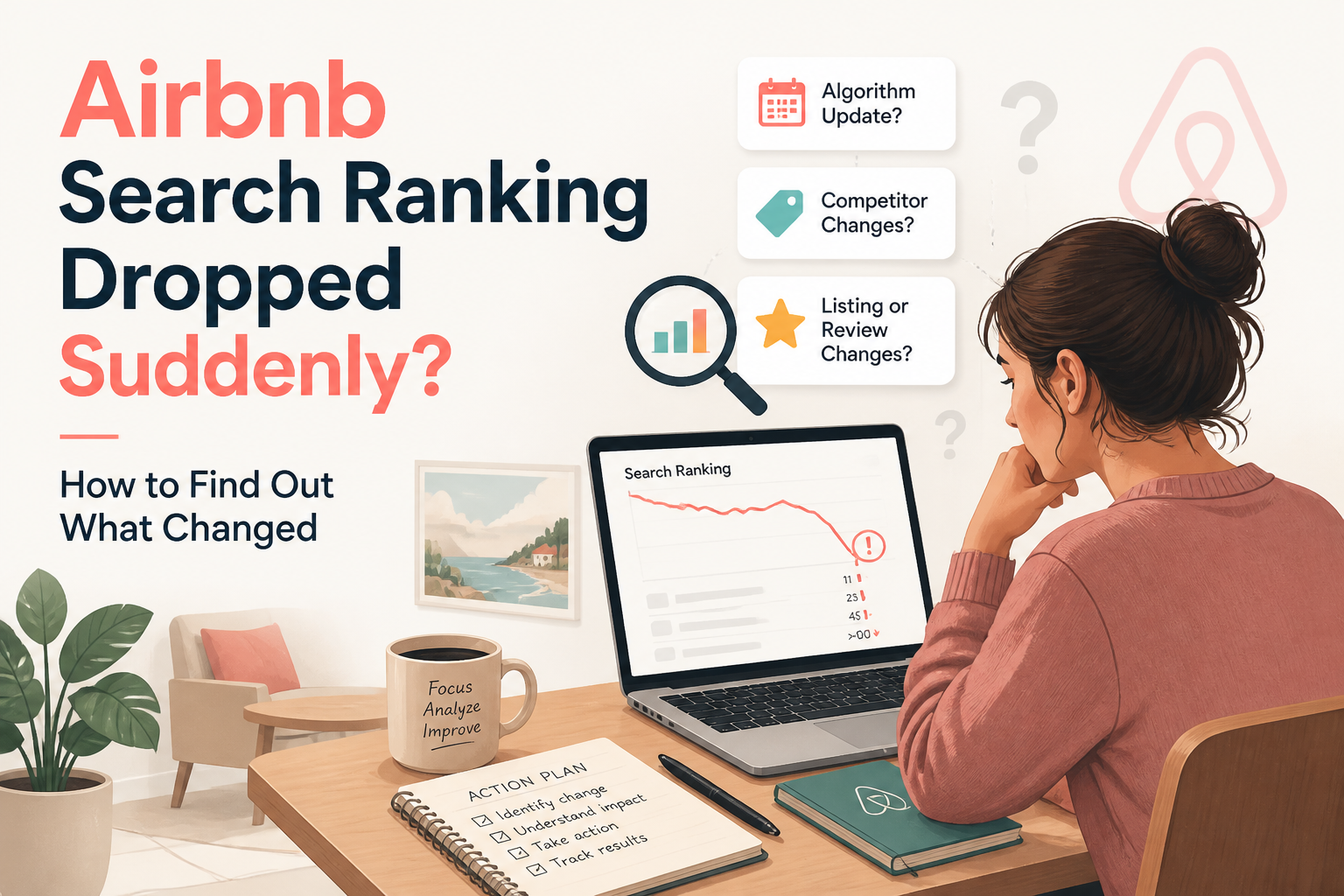 CornerstoneAirbnb Search Ranking Dropped Suddenly? How to Find Out What Changed
Did your Airbnb listing suddenly lose views or search visibility? Learn how to diagnose ranking changes, check availability and pricing, compare market conditions, and identify what to fix before rewriting your listing.
19 min read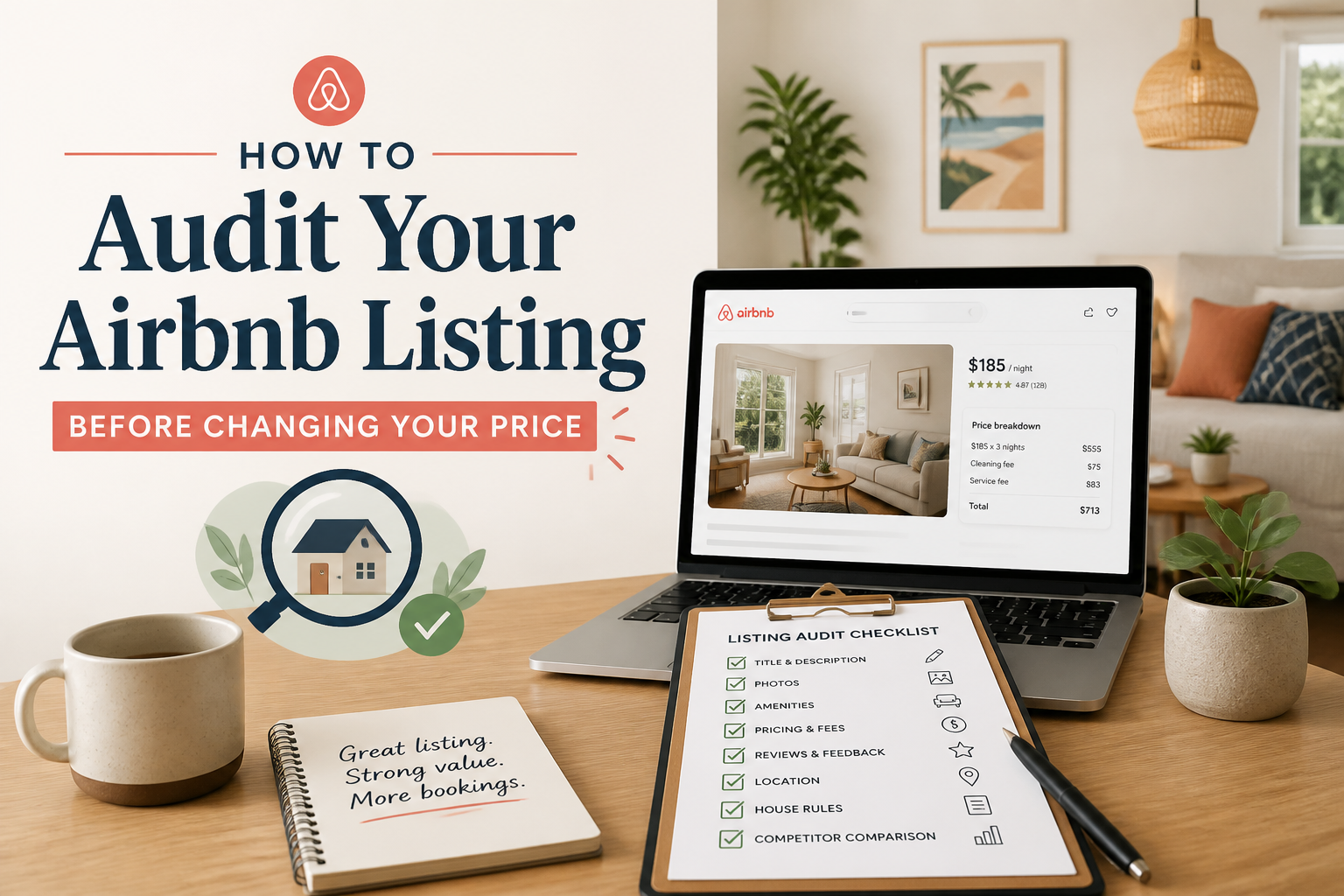 How to Audit Your Airbnb Listing Before Changing Your Price
When bookings slow down, many hosts immediately lower the rate. Sometimes that is the right move, but sometimes the problem is somewhere else in the listing. Before discounting, I prefer to figure out whether the issue is visibility, conversion, or actually price.
5 min read CornerstoneWhy Your Airbnb Calendar Shows Available Dates That Guests Can't Book
Your Airbnb calendar shows open dates, but guests still can't reserve them. Learn how minimum stays, check-in restrictions, preparation time, advance notice, and calendar synchronization can silently block bookings.
19 min read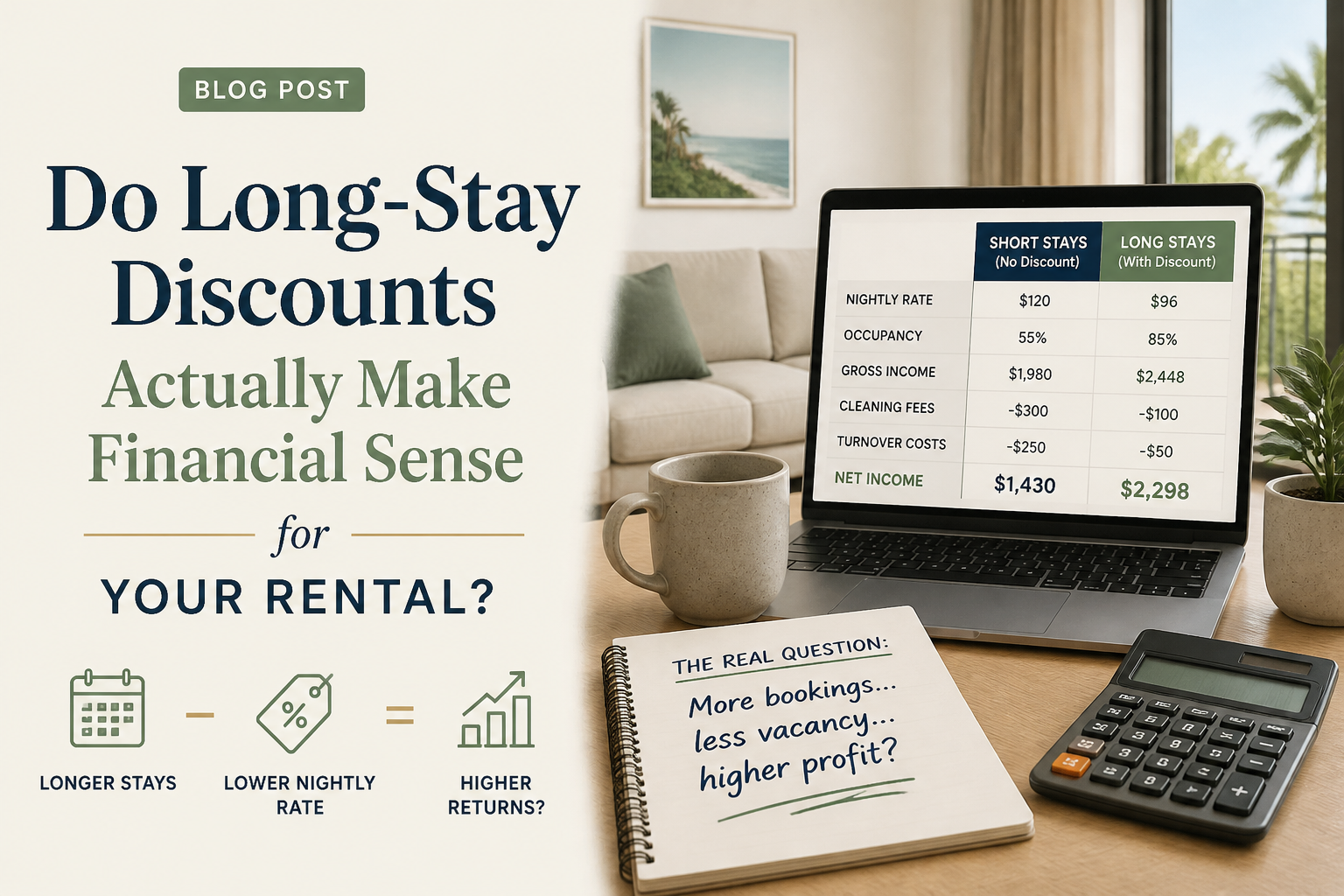 Do Long-Stay Discounts Actually Make Financial Sense for Your Rental?
She stopped offering discounts. Her occupancy did not change. She made more money. Another host in a different market reached the exact opposite conclusion with equal certainty. Both ran the numbers.
4 min read