
Got a 4-Star Airbnb Review? Here's the 30-Day Improvement Plan
A 4-star Airbnb review can be frustrating, especially when a guest seemed happy. Learn how to respond professionally, identify what went wrong, and turn feedback into a practical 30-day plan for improving your listing and guest experience.
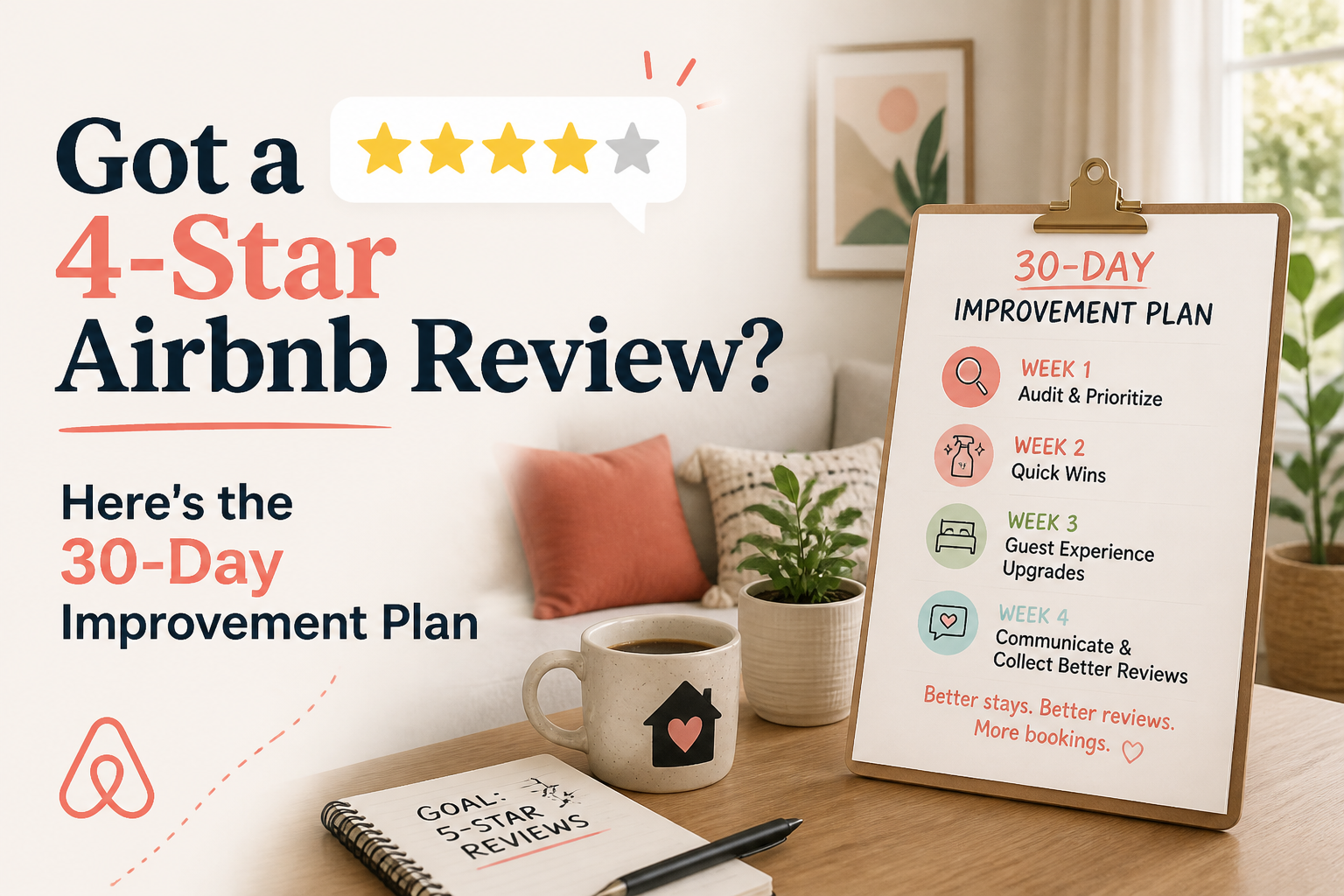
Getting a 4-star Airbnb review can be confusing, particularly when the guest seemed perfectly happy during their stay.
There were no complaints.
They thanked you when they left.
Everything appeared to go smoothly.
Then you open Airbnb and see four stars instead of five.
The temptation is to write a defensive response, ask what went wrong, or immediately start changing things around the property.
But the most useful response is to treat the review as information.
A 4-star Airbnb review is not automatically a crisis. It is an opportunity to examine whether your listing, guest communication, and actual hosting experience are aligned.
Sometimes the feedback reveals a genuine operational problem.
Sometimes it exposes an expectation your listing did not set clearly.
And sometimes the guest simply had different preferences, even though the property delivered exactly what was advertised.
In The Airbnb Optimization Playbook, I explain why review management begins long before checkout. Reviews reflect the experience guests expected, the experience they received, and the friction they encountered along the way.
Here is the 30-day process I recommend for turning a disappointing review into meaningful improvements.
- First, Understand What a 4-Star Airbnb Review Means
Airbnb uses a five-star rating system.
Guests can provide an overall rating and feedback on specific parts of their stay, including areas such as cleanliness, accuracy, check-in, communication, location, and value.
The overall rating matters because it forms part of the public information prospective guests use when evaluating properties.
Airbnb also considers ratings and reviews among its listing-quality signals.
But receiving one 4-star review does not mean your property has been penalized or that bookings will suddenly disappear.
The significance depends on your existing ratings, the overall pattern of guest feedback, and the specific concerns raised.
Don't assume four stars always means something went seriously wrong
Guests interpret rating scales differently.
Some consider four stars a very good experience.
Others reserve five stars for a stay that substantially exceeded expectations.
A review might say:
"Great property, clean and comfortable. We enjoyed our stay."
And still have an overall rating of four stars.
There may be no obvious complaint to fix.
This is why I recommend reviewing the written feedback and available category ratings rather than reacting to the overall number alone.
Look for a specific signal
Ask yourself:
- Did the guest identify an actual problem?
- Did they describe something that surprised them?
- Was the complaint about a feature we control?
- Did the review contradict the way our listing describes the property?
- Have other guests mentioned the same concern?
These questions are much more useful than simply asking why the guest didn't leave five stars.
For more information about Airbnb's review system, see "Airbnb's official guide to reviews for homes" (https://www.airbnb.com/help/article/13).
- The First 24 Hours: Don't Respond Emotionally
In The Airbnb Hosting Decisions Playbook, I explored a question with my host community:
When a guest leaves a bad review, should you respond publicly or let it stand?
The hosts were divided.
Some believed a response was essential because future guests would read it.
Others preferred to let their history of positive reviews speak for itself.
A third group responded selectively, particularly when they needed to correct an important factual misunderstanding.
Despite their different approaches, one lesson emerged clearly.
A defensive, emotional reply can make the situation worse.
Why your public response matters
When you respond to an Airbnb review, you aren't only speaking to the guest who wrote it.
You're also communicating with future guests who may be comparing your listing with other properties.
Imagine reading this exchange.
Guest review:
"The apartment was comfortable, but parking was difficult to find."
Defensive host response:
"The parking instructions were clearly provided before arrival. We have never had this complaint before, and you should have read the messages more carefully."
Even if the instructions were provided, the response creates an unpleasant impression.
It suggests the host is more concerned with defending themselves than understanding the experience.
Now consider a different reply.
Professional response:
"Thank you for staying and sharing your feedback. We're glad you found the apartment comfortable. We've reviewed our arrival instructions and added clearer parking directions to help future guests find the space more easily."
The second response acknowledges the concern and explains a constructive next step.
Importantly, only say you've made a change if that change has actually been completed.
My recommendation for the first day
Read the review.
Check the relevant facts.
Look at the guest's messages and the available category feedback.
Then decide whether a public response would help future guests understand the situation.
You don't need to respond immediately.
And you don't necessarily need to respond at all.
Your response should have a purpose.
- When Should You Respond to a 4-Star Airbnb Review?
Not every review requires the same approach.
Here is how I would decide.
Situation A: The review identifies a real problem
Suppose a guest reports that the property was not as clean as expected.
If the concern is valid, acknowledge it and investigate the cause.
A suitable response might be:
"Thank you for your feedback. I'm sorry the cleanliness did not meet expectations. I've reviewed the issue with our cleaning team and added an additional inspection step before future arrivals."
This response is appropriate only if you've taken the action described.
Don't claim the cleaning process has changed if it hasn't.
Situation B: The review contains an important factual misunderstanding
Imagine a guest writes that the property had no parking.
But your listing accurately explains that a reserved parking space is available in a separate garage.
You may want to clarify the arrangement politely.
For example:
"Thank you for staying. I'm sorry the parking arrangement wasn't as convenient as you expected. The apartment includes one reserved space in the nearby garage, and we've updated the arrival details to make the location easier to find."
The objective is to clarify the facts without arguing.
Situation C: The review is generally positive
Suppose the guest gives four stars and writes:
"Lovely stay. The location was great, and the host was very helpful."
There may be little value in publishing a long explanation.
A short thank-you may be sufficient.
Or you may decide not to respond publicly.
A positive written review with four stars is not necessarily something you need to defend.
Situation D: The review raises a subjective preference
Perhaps the guest describes the mattress as too firm.
Another guest might consider the same mattress ideal.
Subjective preferences deserve attention, especially when several guests mention the same thing.
But you shouldn't automatically replace furniture or rewrite your listing based on one isolated opinion.
Review the broader pattern before making a decision.
- Days 2–3: Read Your Previous Reviews for Patterns
This is where review analysis becomes more valuable.
One guest mentioning an issue might represent an isolated experience.
Several guests describing the same problem suggest something that deserves closer investigation.
In The Airbnb Optimization Playbook, I recommend treating repeated feedback as an improvement signal rather than merely as criticism.
Start by reading your recent reviews.
If you have twenty or thirty, use those.
If you're a newer host, review whatever feedback you have, including private notes.
Look for repeated comments involving:
- Check-in difficulties
- Parking confusion
- Cleanliness
- Noise
- Wi-Fi problems
- Bed comfort
- Kitchen equipment
- Temperature control
- Checkout instructions
- Accuracy of photographs
- Unclear property layouts
Pay attention to positive patterns too.
A review analysis should identify strengths worth preserving, not just weaknesses.
Example: Three reviews mention parking
Imagine your recent reviews contain the following comments.
Review 1:
"Great apartment, but we had trouble locating the parking space."
Review 2:
"Comfortable stay. Parking instructions could be clearer."
Review 3:
"We eventually found the garage, but it took some time."
You now have a recurring theme.
The problem may not be the parking space itself.
It could be the instructions.
Perhaps the entrance is difficult to recognize at night.
Perhaps the garage has several entrances.
Or perhaps guests receive too much arrival information in one long message.
This feedback gives you a specific problem to investigate.
That's much more useful than guessing why your review average changed.
- Days 4–7: Separate Operational Problems From Listing Problems
This is one of the most important distinctions in my optimization methodology.
Some problems require improvements to the property or hosting process.
Others require improvements to the listing's description, photographs, or information.
And some require both.
Let's consider several examples.
Example One: Guests complain about cleanliness
This is primarily an operational issue.
Rewriting the property description will not make the home cleaner.
You may need to:
- Review the cleaning checklist
- Inspect commonly missed areas
- Improve turnover communication
- Add a quality-control inspection
- Replace worn or difficult-to-clean items
Once the actual problem is resolved, ensure the photographs continue to represent the property's real condition.
Example Two: Guests complain about road noise
Suppose your apartment sits near a busy street.
The noise may be a characteristic of the location rather than something you can eliminate completely.
Your options could include improving window insulation, adding appropriate sound-reducing features, or setting more accurate expectations.
If the location is naturally lively, don't describe it as exceptionally peaceful.
Clear disclosure helps guests decide whether the accommodation suits them.
Example Three: Guests are surprised by stairs
If several guests arrive and discover that the bedrooms are upstairs, the listing may not explain the layout clearly enough.
Review the main description, accessibility information, and photographs.
You may need to show the staircase more clearly or explain that the bedrooms are on the upper level.
This is a listing-information problem unless there are also physical accessibility issues requiring attention.
Example Four: Guests struggle with check-in
A difficult arrival is often a communication or operational problem.
Check whether your instructions explain:
- Which entrance to use
- Where to park
- How to identify the building
- When access becomes available
- What guests should do if something doesn't work
If guests repeatedly ask the same question, the instructions probably need clarification.
A useful classification system
For every recurring complaint, assign it to one of three groups:
Operational fix
Something about the actual hosting experience needs to change.
Listing fix
The property is functioning as intended, but the listing doesn't communicate it clearly.
Combined fix
The experience needs improvement, and guests need more accurate information before booking.
This simple exercise prevents hosts from trying to solve every problem through copywriting.
- Days 8–14: Improve the Three Areas Most Likely to Create Friction
Chapter 16 of The Airbnb Optimization Playbook identifies recurring sources of disappointing guest experiences.
Three areas deserve particular attention.
First: Arrival and check-in
The beginning of a stay creates an important first impression.
Guests may have traveled for hours.
They may be tired, traveling with children, or arriving after dark.
Confusing directions, unclear parking, or a difficult entrance can make an otherwise attractive property feel stressful.
Review your arrival process from beginning to end.
If possible, have someone unfamiliar with the property follow the instructions.
Watch where they become uncertain.
Then simplify.
Second: Cleanliness and maintenance
Cleanliness is a basic expectation.
Guests should arrive to a property that matches the standard communicated in your photographs and description.
Review your cleaning operation for consistency.
Don't focus only on whether the home generally looks tidy.
Look at details such as:
- Bathrooms
- Kitchen surfaces
- Bedding
- Floors
- Frequently touched surfaces
- Appliance cleanliness
- Outdoor seating
- Supplies and consumables
A written turnover checklist and final inspection can help prevent recurring oversights.
The exact process should reflect the size and complexity of the property.
Third: Checkout instructions
A long checkout task list can create frustration at the end of an otherwise enjoyable stay.
In The Airbnb Optimization Playbook, I recommend keeping guest checkout tasks simple and practical.
Ask yourself which tasks are genuinely necessary.
Do guests really need to complete a long list of chores?
Are instructions easy to understand?
Do guests know where to leave keys and how to secure the property?
Your final interaction with a guest should feel organized rather than burdensome.
A smoother checkout experience may help guests leave with a better overall impression.
- Days 15–21: Compare Your Reviews With Your Airbnb Listing
Now that you've reviewed the experience itself, examine the story your listing tells.
This is where review analysis becomes a form of listing optimization.
Your photographs, title, and descriptions communicate what you promise.
Your reviews contain observations from guests who actually stayed.
When those two sources agree, they can reinforce confidence.
When they consistently disagree, prospective guests may hesitate.
Example: The listing promotes something guests don't experience
Imagine your description says:
"Perfect for remote workers with fast, reliable Wi-Fi."
But recent guests repeatedly mention connection problems.
You need to investigate the internet service.
The answer is not simply replacing "fast" with an even more impressive adjective.
Fix the underlying issue where possible and update the listing to reflect what can honestly be promised.
Example: Guests love something you barely mention
Now imagine your listing focuses heavily on its modern interior.
But guest after guest praises the private backyard and outdoor dining space.
Perhaps you've overlooked one of the property's strongest selling points.
You might improve the listing by featuring the outdoor area earlier in the photo gallery, explaining it more clearly, or mentioning it in the short summary.
You haven't invented a new benefit.
You've identified one guests already value.
Example: The photos create an inaccurate expectation
Imagine the listing's main photograph makes the outdoor space look entirely private.
But several reviews explain that guests share the courtyard with another unit.
Even if the property is excellent, the presentation may be creating the wrong expectation.
Clarify the privacy arrangement in Guest Access and photo captions.
The goal isn't to hide limitations.
It's to attract guests who understand and appreciate the property as it actually is.
This is a central principle of my Guest Intent Optimization methodology:
A compelling listing should also be a believable listing.
- Use Guest Intent Optimization to Investigate Booking Hesitation
Reading your reviews manually is useful.
But identifying patterns across your listing's photographs, descriptions, amenities, and guest feedback can take more work.
That's one of the reasons I built "SuperhostSEO Guest Intent Optimization" (https://www.superhostseo.com/guest-intent).
The free analysis examines your live listing alongside available guest reviews.
Rather than simply checking whether sections are complete, it looks at how the listing communicates its value and where expectations may be misaligned.
What the analysis examines
Guest Intent Optimization evaluates areas such as:
Guest intent match
Who the listing appears designed to attract and whether the content supports that audience.
Why guests choose the property
Features and experiences that differentiate the property, including strengths reinforced by past reviews.
The booking journey
Potential sources of hesitation across photographs, descriptions, and other guest-facing information.
Prioritized recommendations
A set of focused improvements organized by likely importance.
The report includes a roadmap grouped into shorter tasks and more substantial projects.
How this differs from an Airbnb Listing Audit
The Listing Audit focuses on structure, completeness, and other measurable listing elements.
Guest Intent Optimization examines a different question:
Even when the listing is complete, does it give guests the right information and confidence to book?
The two tools complement each other.
A listing might have every required section completed while still creating uncertainty about privacy, parking, or suitability for a particular traveler.
Guest Intent Optimization is designed to identify those subtler issues.
What it cannot tell you
The analysis cannot know why a particular guest selected another property.
It doesn't have access to every prospective guest's thoughts.
And it cannot guarantee that implementing a recommendation will improve your rating or bookings.
Its purpose is to identify plausible sources of friction and help you decide which improvements are worth considering.
Want to see how your listing's reviews and presentation work together?
"Run your free Guest Intent Optimization Analysis" (https://www.superhostseo.com/guest-intent).
Create a free account, add your listing, and receive prioritized recommendations based on its published information and guest feedback.
- Days 22–30: Build a Repeatable Guest Experience System
By the fourth week, you should have identified the most useful improvements.
The next objective is making sure those changes become part of your normal hosting process.
A good solution shouldn't depend entirely on remembering something after the next complaint.
Create a simple arrival checklist
Confirm that parking and access instructions are clear.
Verify that entry equipment works.
Make sure guests receive the necessary information at the appropriate time.
Strengthen the turnover process
Use a consistent cleaning and maintenance checklist.
Inspect critical areas before arrivals.
Document significant maintenance issues so they aren't forgotten between reservations.
Update the House Manual
Repeated questions about Wi-Fi, appliances, heating, trash, or parking should lead to clearer instructions.
Your House Manual should help guests solve ordinary questions without needing to message you repeatedly.
Review the public listing
Make sure photos, amenities, descriptions, Guest Access, and Other Things to Note accurately reflect the property.
If you've made a physical improvement, update the relevant information.
Monitor feedback without overreacting
Continue reading new reviews and private notes.
Look for whether the same issue appears again.
If guests stop mentioning a problem, that's encouraging, but it doesn't necessarily prove every aspect of the issue has been resolved.
Your goal is consistent improvement over time.
- Should You Ask Airbnb to Remove a 4-Star Review?
Sometimes hosts wonder whether they can request the removal of a review they consider unfair.
Airbnb allows users to dispute reviews that violate its Reviews Policy.
But a review isn't removable simply because a host disagrees with it or feels the rating should have been higher.
For example, a guest may honestly believe the mattress was uncomfortable even if many other guests love it.
That's a subjective experience, not automatically a policy violation.
Airbnb's policy addresses issues such as fake, irrelevant, improperly incentivized, and qualifying retaliatory reviews, as well as other policy violations.
A guest failing to complain during the stay does not, by itself, establish that a review qualifies for removal.
When a removal request may be appropriate
If you believe a review violates Airbnb's current policy:
- Read the specific policy requirements.
- Identify the section you believe applies.
- Gather relevant, legitimate evidence.
- Submit your request through Airbnb's official process.
- Wait for Airbnb's decision.
Avoid submitting an appeal based only on frustration or disagreement.
You can read the current policy here: "Airbnb Reviews Policy" (https://www.airbnb.com/help/article/2673).
For reviews that do not violate policy, focus on a professional response where useful and improvements you can genuinely control.
- What Not to Do After Receiving a 4-Star Review
Here are five mistakes I recommend avoiding.
Mistake One: Publicly arguing with the guest
A defensive response may draw more attention to a complaint and make future guests question how you handle problems.
Mistake Two: Pressuring guests for a higher rating
Don't try to manipulate ratings, bargain over feedback, or pressure a guest to change an honest review.
Focus on providing an experience that deserves positive feedback.
Mistake Three: Rewriting the entire listing immediately
A review about check-in instructions does not necessarily mean your title, photo gallery, and property description all need replacing.
Identify the relevant issue first.
Mistake Four: Dismissing every complaint as unreasonable
Guests can sometimes notice problems that hosts have become accustomed to overlooking.
Even feedback you disagree with may reveal an expectation worth clarifying.
Mistake Five: Fixing the description instead of the experience
If the property is dirty, clean it.
If the Wi-Fi is unreliable, investigate it.
If an appliance is broken, repair it.
A description cannot compensate for an operational problem that remains unresolved.
- Your 30-Day Airbnb Review Improvement Checklist
Use this schedule after receiving disappointing feedback.
Day 1: Understand the review
- Read the written feedback and category ratings.
- Check relevant guest communication.
- Decide whether a public response is appropriate.
- Avoid emotional or defensive replies.
Days 2–3: Identify patterns
- Review recent guest feedback.
- Note recurring complaints.
- Note recurring compliments.
- Separate one-off opinions from issues that deserve investigation.
Days 4–7: Find the root cause
- Classify concerns as operational, listing-related, or both.
- Prioritize issues affecting accuracy, cleanliness, and access.
- Identify specific actions rather than vague promises.
Days 8–14: Improve the experience
- Review check-in and parking instructions.
- Strengthen cleaning and maintenance processes.
- Simplify checkout procedures where appropriate.
- Update your House Manual.
Days 15–21: Improve listing accuracy
- Compare photographs with guest feedback.
- Correct misleading or incomplete descriptions.
- Highlight genuine strengths guests repeatedly praise.
- Review amenities, access, and important disclosures.
Days 22–30: Monitor and maintain
- Confirm that improvements have been implemented.
- Review new feedback when available.
- Check whether recurring problems are being addressed.
- Add successful changes to your standard hosting procedures.
There is no guarantee that new reviews will arrive within 30 days or that your average rating will change during that period.
This is an action plan for improving the experience, not a promise of immediate rating recovery.
Frequently Asked Questions
Is a 4-star Airbnb review bad?
A 4-star review is below the maximum rating, but its significance depends on the listing's broader review history and the guest's feedback. One review should be considered in context rather than treated as proof that the property has a serious problem.
Should I respond to every 4-star Airbnb review?
Not necessarily. Respond when you can clarify an important issue, acknowledge useful feedback, or reassure future guests with a meaningful update. A generic or defensive response may add little value.
Can a 4-star review lower my Airbnb rating?
Yes. Because Airbnb calculates ratings using guest feedback, a new rating below your existing average can reduce the overall average. The size of that change depends on the number and values of your other ratings.
Can a 4-star Airbnb review affect search ranking?
Airbnb identifies ratings and reviews among its listing-quality signals. However, it does not provide a fixed formula stating how much one 4-star review changes an individual property's search position.
What should I say in response to a 4-star review?
Thank the guest for their feedback, acknowledge a specific concern when appropriate, and explain any completed improvement. Keep the response concise, factual, and professional.
Can I remove an unfair Airbnb review?
Airbnb may remove reviews that violate its Reviews Policy. A review generally won't qualify for removal solely because the host disagrees with the rating or considers the guest's opinion unfair.
Why do guests leave four stars when they seemed happy?
Guests may interpret the rating scale differently, experience an issue they did not mention during the stay, or have preferences that weren't obvious to the host. The exact reason isn't always knowable from the overall rating.
How can I improve my Airbnb review scores?
Focus on accurate expectations, reliable cleanliness, clear check-in information, responsive communication, well-maintained amenities, and an uncomplicated checkout process. Read guest feedback and address meaningful recurring issues.
Can I use AI to analyze my Airbnb guest reviews?
Yes. AI tools can help identify recurring themes and possible mismatches between reviews and listing information. Their conclusions should be treated as recommendations rather than proof of why guests gave a particular rating or didn't book.
What is Guest Intent Optimization?
SuperhostSEO Guest Intent Optimization is a free analysis that evaluates how a listing communicates its value, including information from its published descriptions, amenities, photographs, and guest reviews. It provides prioritized recommendations for addressing potential booking hesitation.
Final Thoughts: Don't Chase Five Stars. Improve the Experience.
A 4-star Airbnb review can be disappointing.
But reacting emotionally rarely produces anything useful.
A better approach is to ask what the review reveals.
Was an expectation unclear?
Did the guest experience unnecessary friction?
Was there a genuine cleaning or maintenance issue?
Or was the stay simply not what that particular guest preferred?
The most effective improvements come from answering those questions honestly.
Sometimes the solution is a better check-in process.
Sometimes it's updating the photographs.
Sometimes it's revising the listing's description.
And sometimes the right decision is to make no immediate change and continue watching for a pattern.
In The Airbnb Optimization Playbook, I explain that consistently strong guest experiences are built through systems, not luck.
Clear expectations.
Reliable preparation.
Thoughtful communication.
And a willingness to learn from the people who actually stay in the property.
That is the foundation of better reviews and a stronger listing.
Want to understand whether your listing and guest reviews are telling the same story?
"Run your free Guest Intent Optimization Analysis at SuperhostSEO" (https://www.superhostseo.com/guest-intent).
Discover potential sources of booking hesitation and get a prioritized improvement roadmap based on your real listing information.
Written by Elie Parienti, founder of SuperhostSEO and author of The Airbnb Optimization Playbook, The Airbnb Tools Playbook, and The Airbnb Hosting Decisions Playbook. This framework draws on Chapter 16, "Reviews," of The Airbnb Optimization Playbook; Chapter 20, "Fired Back or Let It Go," of The Airbnb Hosting Decisions Playbook; and Chapter 2, "Guest Intent Optimization," of The Airbnb Tools Playbook.
Further Reading
- "Airbnb: How to Handle a Bad Review" (https://www.airbnb.com/resources/hosting-homes/a/how-to-handle-a-bad-review-376)
- "Airbnb: Use Guest Reviews to Improve" (https://www.airbnb.com/resources/hosting-homes/a/use-guest-reviews-to-improve-665)
- "Airbnb Reviews Policy" (https://www.airbnb.com/help/article/2673)
- "What Your Airbnb Reviews Can Tell You About Your Listing" (https://www.superhostseo.com/blog/airbnb-reviews-listing-problems)
- "Airbnb Listing Audit vs. Guest Intent Analysis" (https://www.superhostseo.com/blog/airbnb-listing-audit-vs-guest-intent)
- "Free Guest Intent Optimization Analysis" (https://www.superhostseo.com/guest-intent)
- "Free Airbnb Listing Audit" (https://www.superhostseo.com/audit/)
Airbnb optimization specialist, Superhost, and founder of one of the largest Airbnb host communities.
Continue Reading
Chosen for you from The Optimization Journal.
 CornerstoneAirbnb Search Ranking Dropped Suddenly? How to Find Out What Changed
Did your Airbnb listing suddenly lose views or search visibility? Learn how to diagnose ranking changes, check availability and pricing, compare market conditions, and identify what to fix before rewriting your listing.
19 min read CornerstoneAirbnb Listing Audit: What to Fix First (And What Can Wait)
Not every weakness in your Airbnb listing deserves the same attention. Learn how to read an Airbnb listing audit, identify high-impact problems, and prioritize improvements that actually matter to guests.
14 min read CornerstoneWhy Is My Airbnb Listing Not Getting Bookings in 2026? How to Find the Real Problem
When Airbnb bookings slow down, lowering your price is not always the solution. Learn how to identify whether your listing has a visibility problem, a conversion problem, or a market-demand problem—and what to fix first.
12 min read CornerstoneWhy Your Airbnb Calendar Shows Available Dates That Guests Can't Book
Your Airbnb calendar shows open dates, but guests still can't reserve them. Learn how minimum stays, check-in restrictions, preparation time, advance notice, and calendar synchronization can silently block bookings.
19 min read CornerstoneWhy Is My Airbnb Listing Not Showing Up in Search? 9 Things to Check
Can't find your Airbnb listing in search results? It may not be an algorithm problem. Learn how to check listing status, blocked dates, minimum stays, booking restrictions, amenities, and visibility before making unnecessary changes.
18 min read