
Airbnb Booking Conversion Rate: How to Find Where You're Losing Guests
Getting Airbnb views but not enough reservations? Learn how Airbnb measures booking conversion, identify where guests drop out of the booking journey, and use a practical diagnostic framework to find what needs improvement.
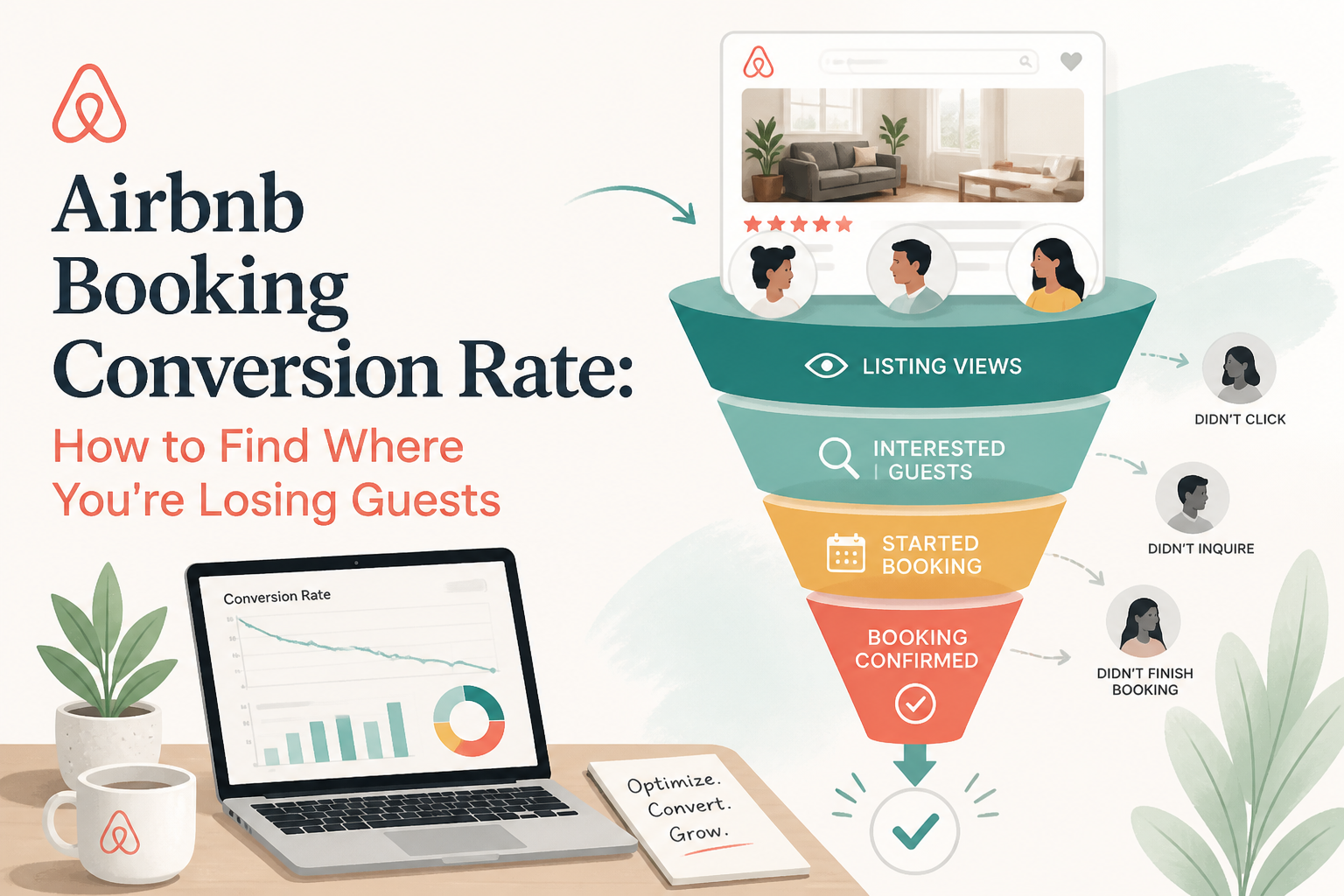
If your Airbnb listing is getting views but not enough bookings, the first step is to identify where potential guests are dropping out of the booking journey.
Airbnb measures conversion across three stages: search impressions, clicks into your listing, and completed bookings.
A weakness at each stage suggests a different problem.
If guests see your property in search but rarely open it, investigate your first impression.
If they open your listing but don't book, examine pricing, property information, guest expectations, and booking conditions.
The key is to identify the stage that's underperforming before changing your title, description, photographs, or nightly rate.
In The Airbnb Optimization Playbook, I explain why visibility and conversion must be diagnosed separately.
A property can receive plenty of attention without converting that attention into reservations.
It can also convert a relatively high percentage of its visitors but receive too few visitors to generate consistent bookings.
Those situations require different solutions.
Here is how I recommend diagnosing Airbnb booking conversion using performance data, guest feedback, and a structured review of the listing.
- What Is Airbnb Booking Conversion Rate?
Airbnb booking conversion describes how guest interest progresses toward a confirmed reservation.
More specifically, Airbnb's professional hosting tools distinguish three stages of conversion.
These stages help hosts understand how guests move from seeing a property in search to opening its listing and eventually booking.
Stage 1: First-Page Search Impressions
This metric relates to guests seeing your listing in Airbnb search results.
It tells you something about the property's exposure.
It does not mean the guest opened your listing.
A property can generate search impressions without attracting many listing-page visits.
What to investigate if impressions are weak:
- Availability
- Minimum-stay restrictions
- Booking window
- Pricing competitiveness
- Search eligibility
- Market demand
- Relevant amenities and property characteristics
However, a decline in impressions does not automatically mean Airbnb has penalized your property.
It may reflect changes in demand or the searches your listing qualifies for.
Stage 2: Search-to-Listing Conversion
This stage measures the transition from seeing your property in search results to opening the full listing.
At this point, guests can evaluate information such as:
- Opening photographs
- Total price
- Location
- Review rating
- Visible property characteristics
- Suitability for their trip
A weak first impression may reduce the number of guests who decide to explore your property.
What to investigate if search-to-listing conversion is weak:
- Cover photo and opening gallery
- Title
- Total price compared with similar listings
- Whether your strongest features are immediately recognizable
- How the property compares with the alternatives shown in search
The problem may not be that your entire listing is poorly written.
It may simply be that the search result doesn't communicate enough value to earn the click.
Stage 3: Listing-to-Booking Conversion
This stage concerns guests who have opened your listing and whether they go on to book.
Once a guest reaches the full page, they can evaluate much more information.
They may review:
- The complete photo gallery
- Property descriptions
- Sleeping arrangements
- Amenities
- Guest reviews
- House rules
- Cancellation conditions
- Total price
- Booking availability
If a listing attracts clicks but relatively few bookings, I investigate what guests discover after opening it.
Where to Find Your Airbnb Conversion Data
According to Airbnb's official documentation, eligible hosts using professional hosting tools can navigate to:
Insights → Performance → Conversion
If you do not see the Performance tab, you may need to enable professional hosting tools.
The dashboard provides available conversion information and comparisons with similar listings.
Source: "Airbnb — Understanding Performance Data for Conversion" (https://www.airbnb.com/help/article/2714).
- How Do You Calculate Your Airbnb Booking Conversion Rate?
A simple way to understand conversion is to compare the number of bookings with the number of listing views during a defined period.
The basic calculation is:
Bookings ÷ Listing Views × 100
For example, imagine your property received 500 listing views and 10 bookings.
The calculation would be:
10 ÷ 500 × 100 = 2%
That produces a simplified bookings-to-views ratio of 2%.
But there is an important distinction.
This manual calculation may not match Airbnb's official conversion metric.
Airbnb's reporting uses its own definitions, including unique visitors and specific conversion stages.
Bookings and views also do not necessarily represent identical visitor groups within a given reporting period.
A guest may view a property several times before booking, and the dates of the browsing activity and reservation may differ.
For official measurement, use the conversion figures Airbnb provides in Insights.
The manual calculation is useful for understanding the general relationship between visitor activity and bookings.
It should not be presented as a replacement for Airbnb's reporting.
Example: The Same Views, Different Results
Consider two hypothetical Airbnb properties.
Property A
- Listing views: 500
- Bookings: 15
- Simplified bookings-to-views ratio: 3%
Property B
- Listing views: 500
- Bookings: 5
- Simplified bookings-to-views ratio: 1%
Both listings received the same number of views.
But Property A generated more reservations.
Does this automatically mean Property A has better photographs?
No.
Property B may have higher prices, different booking restrictions, weaker seasonal demand, or a different target audience.
The numbers identify a performance difference.
They do not establish the cause.
That is where diagnosis begins.
- What Is a Good Airbnb Booking Conversion Rate?
There is no single conversion rate that every Airbnb property should achieve.
A luxury beachfront villa and a budget-friendly city apartment serve different types of travelers.
Their typical booking windows, nightly rates, guest expectations, and lengths of stay may be very different.
A percentage that looks strong for one market may be disappointing for another.
Compare Your Property With Its Own History
I generally start by comparing a property's current conversion performance with previous periods.
In The Airbnb Optimization Playbook, I recommend using the last 30 days as a practical starting point for ongoing performance reviews.
But context matters.
If your destination is highly seasonal, a year-over-year comparison may be more informative than comparing summer with autumn.
If you made an important change only a few days ago, there may not be enough data to evaluate the result.
Compare With Similar Listings
Airbnb's professional hosting tools may provide comparisons with similar properties.
These can help you understand whether your performance differs from relevant local alternatives.
A useful comparison accounts for differences in:
- Location
- Property size
- Guest capacity
- Amenities
- Property quality
- Available dates
- Seasonality
A weak result relative to comparable properties deserves investigation.
But even then, the difference doesn't prove that your description or photographs are responsible.
Don't Rely on Tiny Samples
Imagine your listing received 20 views and one booking.
Your simplified bookings-to-views ratio is 5%.
Now imagine it received one additional booking.
That ratio would become 10%.
With so little data, a small change produces a dramatic percentage difference.
Avoid drawing major conclusions from short periods with limited activity.
My Recommendation
Instead of chasing a universal benchmark, answer three questions:
- Is my conversion performance improving or declining?
- How does it compare with relevant properties when comparable data is available?
- Does the change correspond with something meaningful in my listing, pricing, availability, or market?
Those questions are more useful than trying to achieve an arbitrary percentage.
- The Four Airbnb Conversion Scenarios
In Chapter 11 of The Airbnb Optimization Playbook, I describe four common combinations of listing views and conversion performance.
They provide a starting point for determining what to investigate.
Scenario 1: Low Views and Low Conversion
Your property isn't attracting many listing visitors, and relatively few of those visitors are booking.
Possible problem: Both discovery and the booking decision may need attention.
Start by checking whether the property is eligible for relevant searches.
Review availability, booking restrictions, amenities, and pricing.
Then examine whether the listing clearly communicates the property's value.
Possible weaknesses include a generic title, an uncompetitive opening photo, unclear descriptions, or a mismatch between what guests expect and what the listing shows.
First action: Review search eligibility and run a structural listing audit.
Scenario 2: Low Views but Strong Conversion
The guests who open your listing seem relatively interested in booking.
But the property may not be receiving enough relevant visitors.
Possible problem: Discovery or first impressions.
Investigate whether the listing qualifies for the dates and guest searches you want to attract.
Review your cover photo, title, pricing competitiveness, and relevant amenities.
A complete rewrite of the main property description might not be the most useful first step.
First action: Investigate search impressions, search-to-listing conversion, and availability.
Scenario 3: Strong Views but Low Conversion
Guests are opening your listing, but relatively few proceed to book.
Possible problem: Booking confidence, perceived value, or booking conditions.
This is where I look carefully at the complete listing experience.
Do the photographs match the title?
Does the description answer important questions?
Do reviews contradict the listing's promises?
Is the total price competitive?
Are house rules creating unnecessary concerns?
First action: Examine listing-to-booking conversion and investigate possible hesitation.
Scenario 4: Strong Views and Strong Conversion
Your listing appears to be attracting relevant visitors and converting them relatively effectively.
Possible problem: No obvious conversion problem at present.
That doesn't mean maintenance is unnecessary.
Review your listing regularly, monitor market conditions, and respond to genuine guest feedback.
But don't rewrite effective sections simply because optimization software suggests alternatives.
First action: Maintain accuracy and monitor trends.
An Important Limitation
These scenarios are diagnostic categories.
They do not identify a confirmed cause by themselves.
For example, strong views and weak conversion may indicate guest hesitation, but could also reflect changing prices or availability for the dates visitors want.
Treat the framework as a way to decide what evidence to examine next.
- How to Identify What Is Hurting Your Listing-to-Booking Conversion
Once you've established that guests are opening your listing but not booking at the rate you expect, I recommend examining six specific areas.
Each one represents a different possible explanation.
Problem 1: The Listing Promises Something the Details Don't Support
Imagine your title highlights a private swimming pool.
Your opening photograph shows a beautiful pool area.
A guest clicks because they want that experience.
But when they explore the listing, they discover that the pool is shared.
The property may still be perfectly suitable for many guests.
But the opening impression could have created an inaccurate expectation.
The problem is not necessarily the quality of the property.
It's the difference between what the guest expected and what the listing actually offers.
How to investigate:
Read your title.
Look at the first five photographs.
Then examine the full property description.
Ask whether they communicate the same experience.
If the listing highlights a feature, make sure the supporting information explains it accurately.
Problem 2: Guests Can't Understand the Layout
A beautiful gallery doesn't always explain how a property works.
Consider a home advertised for eight guests.
The listing includes photographs of several beds, a sofa, and an additional sleeping area.
But a prospective guest cannot determine where all eight people would sleep.
Are there three bedrooms or four?
Does the eighth guest use a sofa bed?
Are the bedrooms upstairs?
How many bathrooms are on each floor?
These questions matter, especially to families and groups.
In The Airbnb Optimization Playbook, I recommend explaining the accommodation room by room.
A useful description should answer the practical questions guests need resolved before committing.
How to investigate:
Ask someone unfamiliar with your property to read the listing.
Can they explain the sleeping arrangements and layout?
If not, the description may need clearer structure.
Problem 3: Total Price Doesn't Match Perceived Value
Guests don't evaluate price in isolation.
They compare what they would pay with the accommodation they believe they will receive.
For example, imagine two nearby properties.
Both accommodate four guests.
Both have similar review ratings.
But one offers private parking, a larger kitchen, and an outdoor terrace.
If that property costs more, guests may consider the difference worthwhile.
If a listing costs substantially more without clearly communicating its advantages, guests may continue comparing alternatives.
Cleaning fees and other relevant price components also affect the total.
How to investigate:
Choose genuinely comparable properties.
Check the same dates, guest count, and length of stay.
Compare the total guest-facing cost.
Then ask whether your listing clearly communicates the features that justify its position.
Don't automatically lower the price.
First determine whether the issue is actual competitiveness or poor communication of value.
Problem 4: Reviews Reveal an Unresolved Concern
Guest reviews provide an important source of information.
They can reveal strengths that hosts underestimate.
They can also identify problems guests repeatedly encounter.
Imagine your listing describes the location as peaceful.
But multiple reviews mention late-night road noise.
A prospective guest seeking a quiet retreat may notice the contradiction.
The appropriate response may involve operational changes, clearer expectations, or both.
The solution is not to hide legitimate concerns.
It is to represent the accommodation accurately.
How to investigate:
Read your recent reviews alongside the listing.
Look for repeated themes involving:
- Cleanliness
- Noise
- Parking
- Accuracy
- Wi-Fi
- Sleeping comfort
- Check-in
- Property access
Prioritize recurring, specific issues rather than treating one unusual comment as a permanent diagnosis.
Problem 5: House Rules Create Unnecessary Uncertainty
Guests want to understand important rules before booking.
But rules that are unclear, contradictory, excessive, or unexpectedly restrictive can make a property feel difficult to reserve.
Imagine a listing advertised as family-friendly.
Yet the rules contain several confusing restrictions about children using the outdoor space.
Or a property advertises a beautiful terrace but doesn't explain whether guests may use it in the evening.
The issue may be a legitimate safety or operational restriction.
If so, it should be communicated clearly.
How to investigate:
Read your house rules from the perspective of your target guest.
Check that they are:
- Accurate
- Understandable
- Proportionate
- Consistent with the rest of the listing
- In line with applicable Airbnb policies
Do not remove necessary safety restrictions just to make the listing more appealing.
Problem 6: Booking Conditions Don't Match Guest Demand
Sometimes the property presentation is excellent, but a reservation is difficult or impossible under the current settings.
Examples include:
- A four-night minimum when many guests search for weekends
- A narrow booking window
- Restrictive check-in days
- Advance-notice requirements
- Preparation time between stays
- Accidentally blocked dates
These restrictions can affect which guest searches the property qualifies for.
They can also make certain desired stays unavailable.
How to investigate:
Test representative dates and stay lengths.
Review your private Airbnb calendar settings.
Don't assume that an open night is automatically bookable.
And remember that a public listing audit cannot see every restriction inside your hosting account.
- The Guest Intent Test: What Does a Guest Have to Assume?
This is the question I find particularly useful when reviewing an Airbnb listing:
What does a prospective guest have to guess before deciding to book?
A host knows the property intimately.
A guest doesn't.
You know which bedroom has the king bed.
You know whether the backyard is shared.
You know how difficult parking is.
You know whether the outdoor pool is heated.
And you know how the kitchen connects to the living area.
If those details aren't explained clearly, the guest has to make assumptions.
Some guests ask questions.
Others simply keep comparing properties.
The Five-Question Exercise
Open your listing and answer these questions as if you were a stranger.
- Do I know exactly what I'm booking?
The layout, rooms, sleeping arrangements, and private or shared spaces should be understandable.
- Do the photographs support the title's promises?
If the title highlights a remarkable view, that view should be accurately represented.
- Are important amenities clearly explained?
For example, is parking private? Is the pool seasonal? Is the workspace dedicated?
- Do reviews reinforce the presentation?
Look for recurring praise and concerns.
- Is there anything I would discover only after booking that should have been explained beforehand?
This final question is especially important.
If guests repeatedly arrive surprised by an important feature or limitation, your listing may need clearer expectations.
In The Airbnb Tools Playbook, I describe this as a different kind of analysis from a normal listing audit.
An audit identifies structural weaknesses.
Guest Intent Optimization investigates the parts of the listing that may be complete but still leave guests uncertain.
Those are two different problems.
- How to Use SuperhostSEO Guest Intent Optimization
If your listing is getting views but you cannot identify what might be creating hesitation, a second opinion can help.
This is the purpose of "SuperhostSEO Guest Intent Optimization" (https://www.superhostseo.com/guest-intent).
The tool analyzes the available information from your live Airbnb listing, including its written content, amenities, photographs, and guest reviews.
It looks at how those elements work together to communicate the property's value.
What the Free Analysis Examines
The report considers several aspects of the guest decision.
Guest Intent Match
Who the listing appears to speak to and whether its presentation fits the guests most likely to appreciate the property.
Why Guests Choose You
The property's differentiators, drawing on listing details and recurring themes in guest reviews.
The Booking Journey
Potential hesitation between the search result, opening photographs, descriptions, and booking decision.
Prioritized Recommendations
Specific improvements organized around the most important issues identified.
What You Receive
The current SuperhostSEO Guest Intent report includes:
- A dashboard with multiple assessment scores
- Three to five ranked recommendations
- A practical improvement roadmap
- Short tasks and larger strategic improvements
- Progress tracking for later analyses
- A downloadable PDF report
The analysis is free and does not require a paid subscription or credit card.
A free account is needed to save your listing and report.
Example: A High-Scoring Listing With a Guest-Expectation Problem
Imagine a listing that receives a strong structural audit score.
Its title is clear.
Its main description is detailed.
Amenities are selected correctly.
But recent reviews repeatedly mention that the property is difficult to access for guests with mobility limitations.
Meanwhile, the listing prominently emphasizes convenience without adequately describing the stairs.
A structural audit may not identify the complete problem.
Guest Intent Optimization can bring attention to the inconsistency between presentation and guest experience.
The recommendation may be to describe the stairs more accurately, add helpful photographs, and review relevant accessibility information.
The point isn't to make every listing appropriate for every guest.
It's to make the listing easier for the right guests to evaluate.
What Guest Intent Optimization Cannot Tell You
This distinction matters.
The tool cannot know exactly why a particular person viewed your listing and decided not to book.
It does not have access to every visitor's private decision-making process.
Its scores are not Airbnb's official conversion metrics.
And improving its assessment score does not automatically prove a change in booking conversion.
The report provides structured hypotheses and recommendations based on the available listing information.
You should review those findings and monitor actual Airbnb performance separately.
Start With the Free Analysis
If you suspect your listing may be creating unnecessary uncertainty, you can run the analysis here:
"Analyze Your Airbnb Listing With Guest Intent Optimization — Free" (https://www.superhostseo.com/guest-intent)
The report can help you decide whether you need clearer property details, more accurate expectations, improved positioning, or an operational change.
- Should You Run a Listing Audit Before Guest Intent Optimization?
Usually, yes.
In The Airbnb Tools Playbook, I recommend starting with the audit because structural problems should be identified before investigating more subtle issues.
The two tools serve different purposes.
Use the Airbnb Listing Audit for Structural Problems
The "free SuperhostSEO Listing Audit" (https://www.superhostseo.com/audit/) evaluates nine weighted categories and identifies priority improvements.
It can help find:
- Weak titles
- Incomplete summaries
- Poorly organized property descriptions
- Missing listing information
- Sections that need clarification
- Other structural opportunities
Its purpose is to identify what needs to be fixed within the listing's measurable foundation.
Use Guest Intent Optimization for Booking-Decision Problems
Guest Intent Optimization analyzes how the information already present works together.
It examines the relationship between descriptions, photos, amenities, and reviews.
It is particularly useful when the listing looks reasonably complete but may still be communicating the wrong expectations.
My Preferred Sequence
First, run the structural audit.
Second, address genuine omissions or inaccuracies.
Third, use Guest Intent Optimization to investigate possible remaining hesitation.
Fourth, implement the most important recommendations.
Finally, monitor actual Airbnb performance.
You do not have to change every section in one sitting.
The objective is to identify the likely bottleneck and work through it deliberately.
- A 30-Minute Airbnb Conversion Diagnosis
If your booking conversion has declined, here's a practical review you can complete before making major changes.
Minutes 1–5: Review Airbnb Insights
Open your available conversion reports.
Check:
- Search impressions
- Search-to-listing conversion
- Listing-to-booking conversion
- Listing views
- Bookings
- Relevant historical trends
Identify which stage appears to have weakened.
Don't assume every decline is caused by the same problem.
Minutes 6–10: Review Search Eligibility
Check representative future dates.
Make sure your property is available and bookable for the stay lengths your guests typically request.
Verify minimum stays, advance notice, booking window, and relevant amenities.
Minutes 11–15: Compare Total Price and Value
Choose a few genuinely comparable properties.
Look at the same dates and guest count.
Compare total guest-facing prices and important differences in the accommodations.
Ask whether your listing communicates its actual advantages clearly.
Minutes 16–20: Examine the Guest Experience
Open your public Airbnb page.
Read it as if you had never visited the property.
Can you understand the layout?
Do the first photographs support the title?
Are amenities and restrictions explained?
Do guest reviews reinforce what the listing promises?
Minutes 21–25: Run the Appropriate Free Analysis
If the listing appears structurally incomplete, use the "Free Airbnb Listing Audit" (https://www.superhostseo.com/audit/).
If the structure looks strong but potential guest hesitation remains unclear, use "Guest Intent Optimization" (https://www.superhostseo.com/guest-intent).
Review the recommendations against what you already know about the property.
Minutes 26–30: Choose One Priority Improvement
Write down:
- The problem you're investigating
- The evidence supporting that concern
- The change you plan to make
- The date of the change
- The metric you will monitor afterward
A small change log is often more useful than making five unrelated adjustments in one afternoon.
Thirty minutes may not solve every conversion problem.
But it should help you stop guessing and identify a reasonable next step.
- How Long Should You Wait After Changing Your Listing?
One of the most common mistakes I see is changing too many things too quickly.
A host updates the cover photograph.
Two days later, they rewrite the title.
Then they lower the nightly price.
The next day, they change the description.
When bookings improve or decline, they have no reliable way to identify which adjustment mattered.
In The Airbnb Optimization Playbook, I recommend making deliberate changes and allowing enough time to observe meaningful trends.
For many hosts, a week or two is a practical initial observation period after a significant change.
But the amount of data matters more than an arbitrary number of days.
A property receiving hundreds of views may gather useful information faster than a seasonal listing with very few visitors.
Keep a Simple Change Record
For example:
October 1
Updated the short summary to explain sleeping arrangements more clearly.
October 15
Reviewed Airbnb conversion results after the update.
October 20
Corrected inaccurate parking information identified in guest feedback.
November 5
Reviewed the next meaningful performance period.
These dates are hypothetical.
The purpose is not to pretend you are running a perfectly controlled experiment.
Demand, price, competition, and availability can all change during the same period.
The purpose is to make your decisions traceable.
Know When Not to Make Another Change
If you have confirmed that the listing is accurate, prices are competitive, availability is appropriate, and obvious information gaps are resolved, continued editing may not be useful.
Sometimes the next step is simply to monitor performance.
An uncertain week is not enough evidence to conclude that your entire optimization strategy has failed.
- Can Improving Airbnb Conversion Increase Revenue?
Potentially, yes.
But higher conversion is not automatically the same as higher profit.
Imagine two pricing situations.
Situation A: Higher Price, Fewer Reservations
A property receives:
- 10 bookings
- Average booking revenue of $600
Total booking revenue: $6,000
Situation B: Lower Price, More Reservations
After a substantial discount, the property receives:
- 13 bookings
- Average booking revenue of $430
Total booking revenue: $5,590
These are hypothetical examples.
Situation B generates more reservations.
But it produces less booking revenue before operating costs.
It may also involve more cleaning, laundry, and turnover expenses.
The lesson is simple.
More bookings do not automatically mean better business performance.
Evaluate Conversion Alongside Revenue
When assessing an optimization change, consider:
- Listing views
- Booking conversion
- Total booking revenue
- Occupied nights
- Average daily rate
- Cleaning and turnover costs
- Booking lead time
- Overall profitability
A conversion improvement that attracts more suitable guests at a sustainable price may be valuable.
A conversion improvement driven entirely by excessive discounting may not be.
In The Airbnb Hosting Decisions Playbook, I explore why pricing decisions should account for actual operating economics rather than occupancy alone.
The objective is to improve the quality and financial results of your bookings, not chase a conversion percentage in isolation.
Frequently Asked Questions
What is Airbnb booking conversion rate?
Airbnb booking conversion measures how guest interest progresses toward completed reservations. Airbnb distinguishes search impressions, search-to-listing conversion, and listing-to-booking conversion in its professional hosting performance tools.
What is a good Airbnb booking conversion rate?
There is no universal conversion benchmark that applies to every property. Rates vary with market demand, property type, price, seasonality, availability, and guest preferences. Compare your performance with relevant historical periods and similar listings where data is available.
How do I find my Airbnb conversion rate?
Hosts with professional hosting tools can access available data through Insights → Performance → Conversion in Airbnb. The dashboard provides conversion metrics and may allow comparisons with similar listings.
How do I calculate Airbnb views-to-bookings conversion?
A simplified ratio is bookings divided by listing views, multiplied by 100. However, Airbnb's official conversion metrics use specific definitions, including unique visitors and conversion stages, so the manual calculation may not match Airbnb Insights.
Why is my Airbnb getting views but no bookings?
Possible explanations include uncompetitive total pricing, unclear descriptions, photographs that create inaccurate expectations, recurring review concerns, restrictive booking settings, or weaker market demand. Examine listing-to-booking conversion and investigate the evidence before choosing a fix.
Can a better Airbnb description increase conversion?
A clearer description may help guests understand the property and make a more informed booking decision. It cannot guarantee additional reservations. Pricing, reviews, photographs, availability, and other factors also affect guest choices.
Should I lower my Airbnb price if conversion is low?
Not automatically. First compare total guest-facing prices with genuinely similar listings and check whether your property clearly communicates its advantages. Discounting may help in some situations but can also reduce revenue or profit unnecessarily.
Do Airbnb reviews affect booking conversion?
Reviews can influence guest confidence by describing the actual experience. Repeated concerns about accuracy, cleanliness, noise, parking, or access may deserve investigation. However, a review pattern alone cannot prove why individual visitors chose not to book.
What is the difference between Airbnb search-to-listing conversion and listing-to-booking conversion?
Search-to-listing conversion concerns guests opening your full property page after seeing it in search. Listing-to-booking conversion concerns guests moving from the full listing toward a confirmed reservation.
Is there a free Airbnb conversion optimization tool?
Yes. "SuperhostSEO Guest Intent Optimization" (https://www.superhostseo.com/guest-intent) provides a free analysis of listing content, amenities, and guest reviews to identify potential booking hesitation and prioritized improvements. Airbnb Insights also provides native performance data to eligible hosts.
Can an Airbnb listing audit tell me why conversion is low?
A listing audit can identify structural weaknesses and missing information that may contribute to booking hesitation. It cannot determine the exact reason every visitor did not book. Guest Intent Optimization provides a different analysis of the guest-facing experience.
Can AI predict which Airbnb guests will book?
No independent listing analysis can reliably know the private intentions of individual guests who view a property. AI tools can identify patterns, potential concerns, and opportunities based on available information, but they cannot guarantee booking outcomes.
How quickly will my conversion rate improve after optimizing my listing?
There is no guaranteed timeline. Changes require enough relevant visitor activity to evaluate. Monitor performance over meaningful periods and account for seasonality, demand, pricing, and other simultaneous changes.
Final Thoughts: Fix the Stage Where You're Losing Guests
Airbnb booking conversion isn't one mysterious number.
It's a progression.
Guests see your property in search.
Some open the listing.
And some make reservations.
Each stage presents a different optimization challenge.
If search exposure is weak, investigate eligibility, availability, and competitiveness.
If guests see your listing but rarely click, examine the first impression.
If guests open the listing but don't book, investigate whether the complete presentation makes the property easy to understand, trust, and choose.
In The Airbnb Optimization Playbook, I emphasize that hosts should separate visibility problems from conversion problems.
That remains one of the most useful lessons in Airbnb optimization.
Don't rewrite your entire listing because bookings slowed down.
Don't lower your price before evaluating the competition.
And don't assume a high structural audit score means every guest-expectation issue has been resolved.
Start with the data.
Identify the stage that needs attention.
Review the evidence.
Then make the most useful improvement you can.
If your listing is getting views but booking conversion remains disappointing, your next step may be a guest-focused analysis.
"Run Your Free Guest Intent Optimization Analysis" (https://www.superhostseo.com/guest-intent)
See how your listing's descriptions, photographs, amenities, and reviews work together, and receive prioritized recommendations designed to help you improve the guest booking experience.
If you haven't completed a structural listing review yet, start with the "Free Airbnb Listing Audit" (https://www.superhostseo.com/audit/) to identify missing information and foundational weaknesses first.
Diagnose first. Improve what matters. Measure the results.
Written by Elie Parienti, founder of SuperhostSEO and author of The Airbnb Optimization Playbook, The Airbnb Tools Playbook, and The Airbnb Hosting Decisions Playbook. This article draws on Chapter 11, Understanding Airbnb Insights, and Chapter 22, Troubleshooting, of The Airbnb Optimization Playbook, together with Chapter 2, Guest Intent Optimization, of The Airbnb Tools Playbook. Performance metric definitions are based on Airbnb's published documentation.
Further Reading
- "Airbnb: Understanding Performance Data for Conversion" (https://www.airbnb.com/help/article/2714)
- "Airbnb: How Search Results Work" (https://www.airbnb.com/help/article/39)
- "Why Your Airbnb Listing Gets Views but Not Bookings" (https://www.superhostseo.com/blog/airbnb-views-but-no-bookings)
- "How to Find Booking Friction in Your Airbnb Listing" (https://www.superhostseo.com/blog/airbnb-booking-friction)
- "How to Audit Your Airbnb Listing Before Lowering Your Price" (https://www.superhostseo.com/blog/audit-airbnb-listing-before-changing-price)
- "Free Guest Intent Optimization Analysis" (https://www.superhostseo.com/guest-intent)
- "Free Airbnb Listing Audit — SuperhostSEO" (https://www.superhostseo.com/audit/)
Airbnb optimization specialist, Superhost, and founder of one of the largest Airbnb host communities.
Continue Reading
Chosen for you from The Optimization Journal.
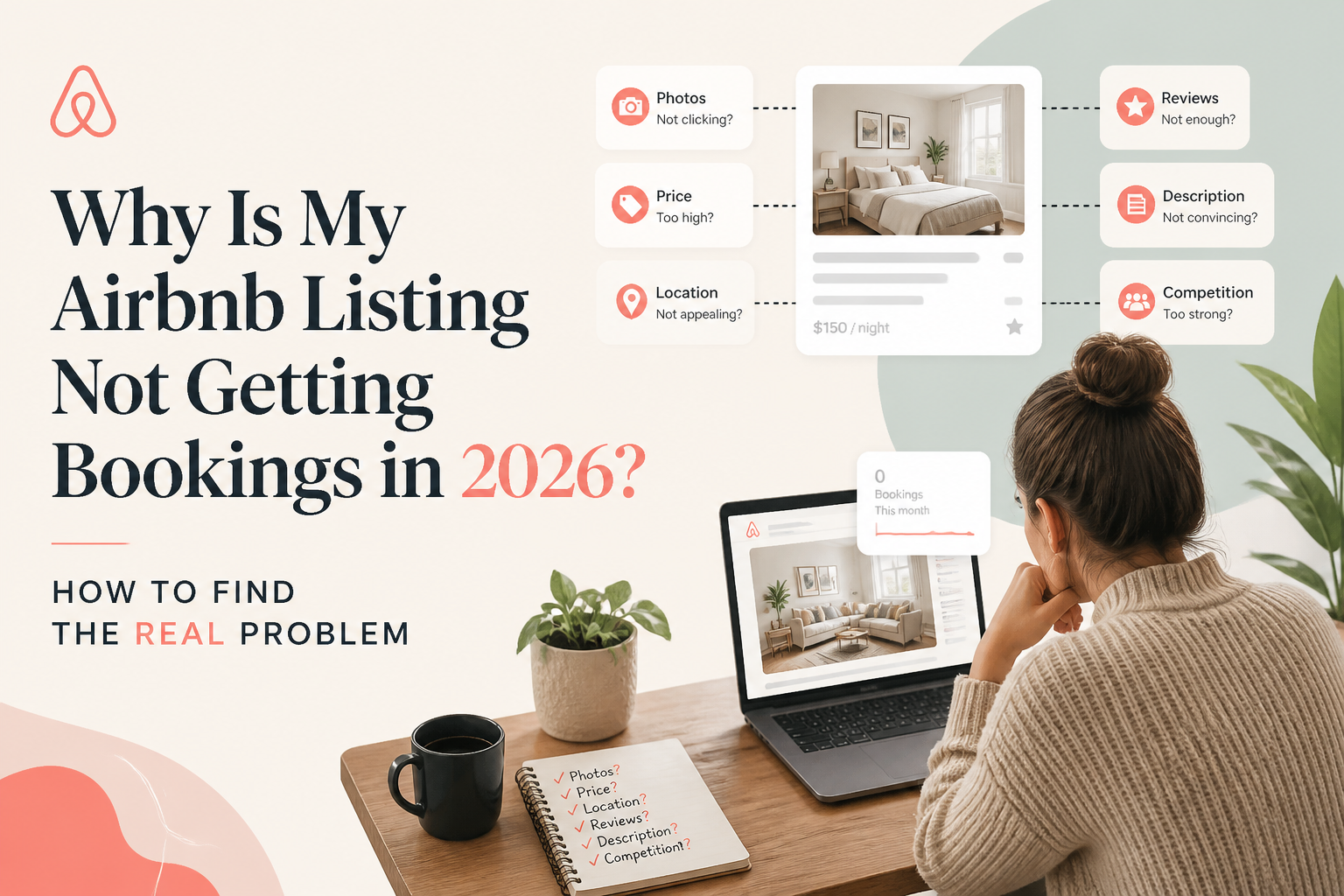 CornerstoneWhy Is My Airbnb Listing Not Getting Bookings in 2026? How to Find the Real Problem
When Airbnb bookings slow down, lowering your price is not always the solution. Learn how to identify whether your listing has a visibility problem, a conversion problem, or a market-demand problem—and what to fix first.
12 min read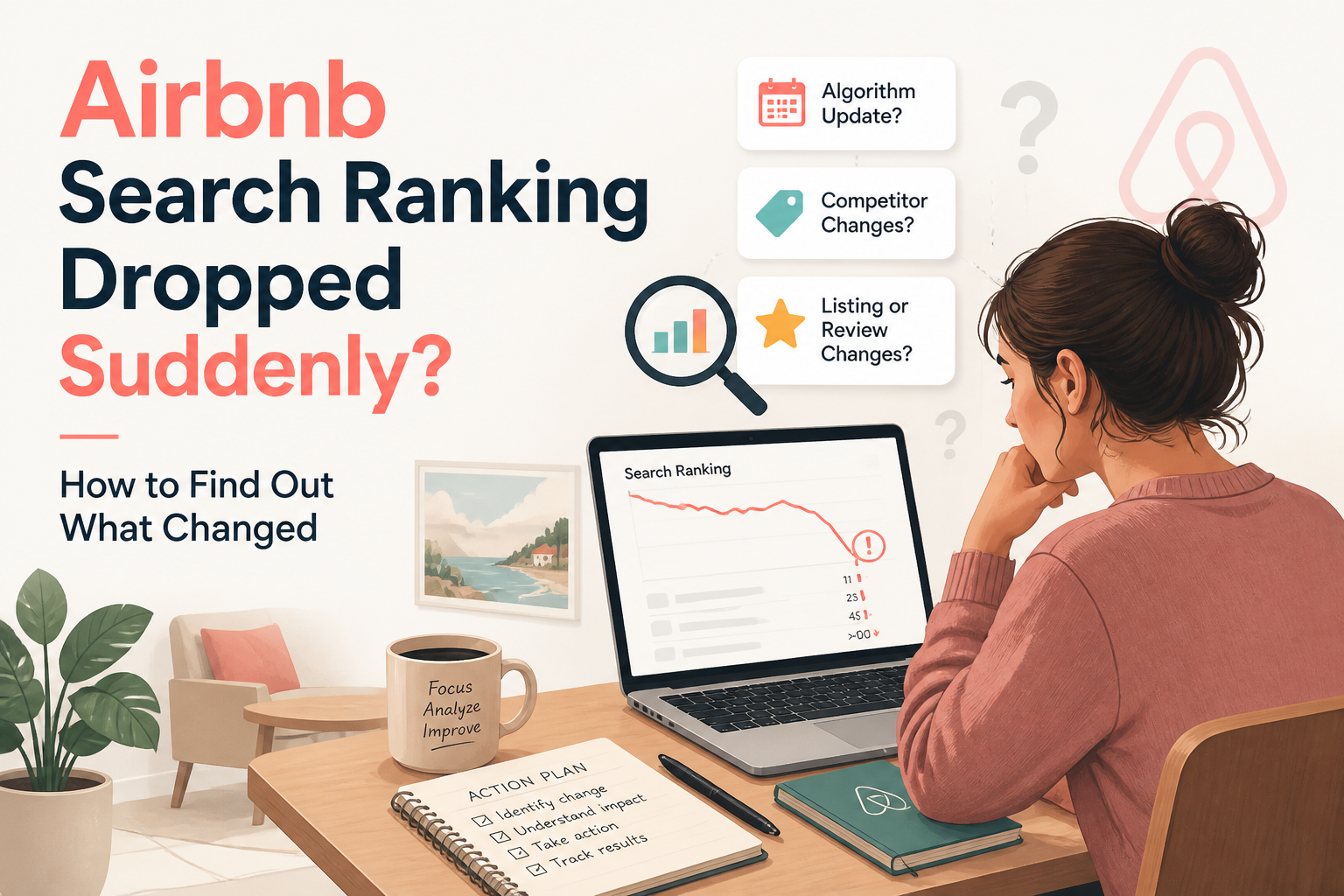 CornerstoneAirbnb Search Ranking Dropped Suddenly? How to Find Out What Changed
Did your Airbnb listing suddenly lose views or search visibility? Learn how to diagnose ranking changes, check availability and pricing, compare market conditions, and identify what to fix before rewriting your listing.
19 min read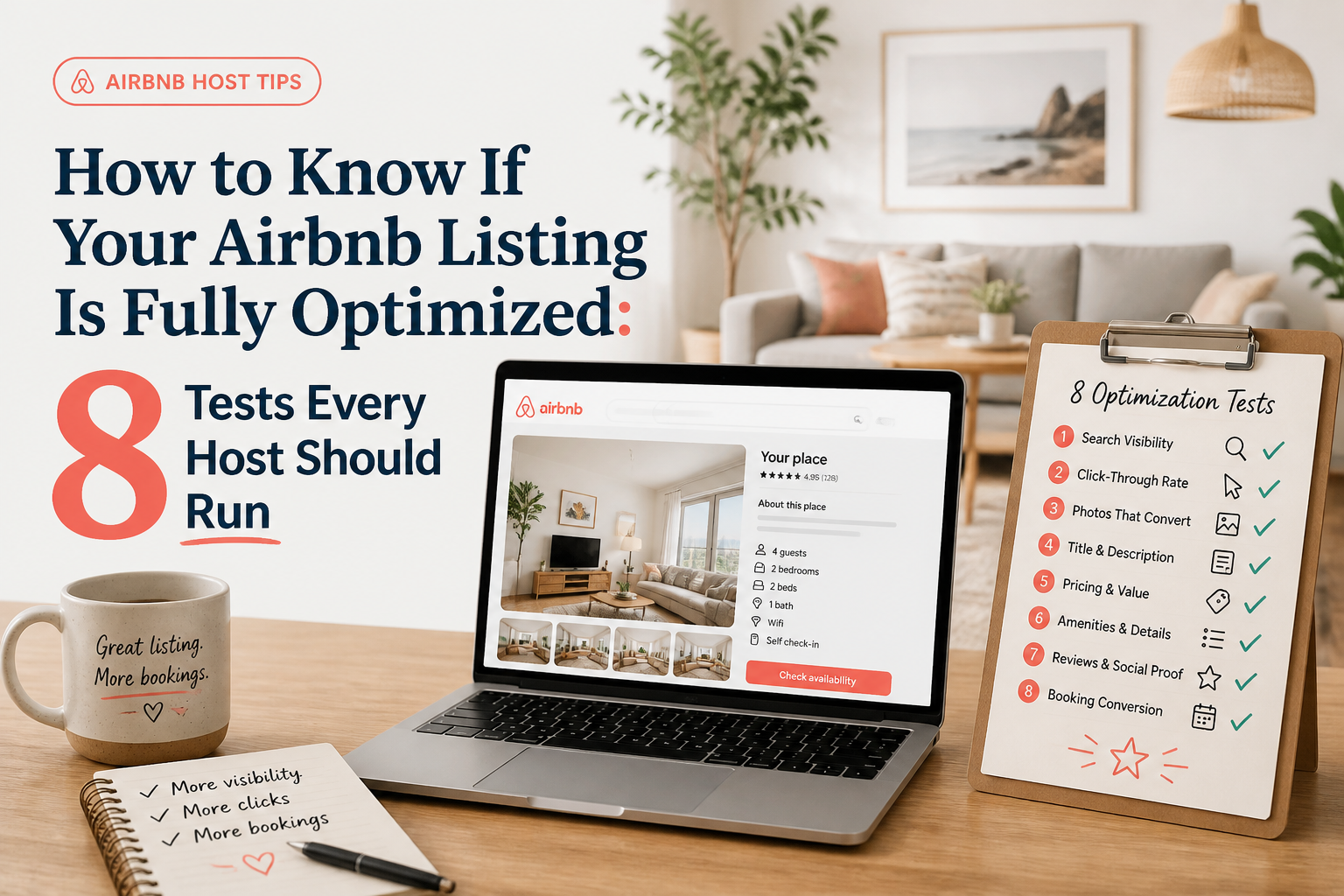 CornerstoneHow to Know If Your Airbnb Listing Is Fully Optimized: 8 Tests Every Host Should Run
Is your Airbnb listing actually optimized, or does it just look complete? Use these eight practical tests to evaluate your photos, title, descriptions, amenities, guest expectations, and booking performance before making unnecessary changes.
21 min read CornerstoneWhy Is My Airbnb Listing Not Showing Up in Search? 9 Things to Check
Can't find your Airbnb listing in search results? It may not be an algorithm problem. Learn how to check listing status, blocked dates, minimum stays, booking restrictions, amenities, and visibility before making unnecessary changes.
18 min read CornerstoneWhy Your Airbnb Calendar Shows Available Dates That Guests Can't Book
Your Airbnb calendar shows open dates, but guests still can't reserve them. Learn how minimum stays, check-in restrictions, preparation time, advance notice, and calendar synchronization can silently block bookings.
19 min read