
Airbnb Listing Score Explained: What Your Audit Result Really Means
What does an Airbnb listing score of 55, 70, or 90 actually mean? Discover how SuperhostSEO evaluates listings across nine weighted categories, how to interpret your results, and which improvements to prioritize first. Includes a real Airbnb audit example.
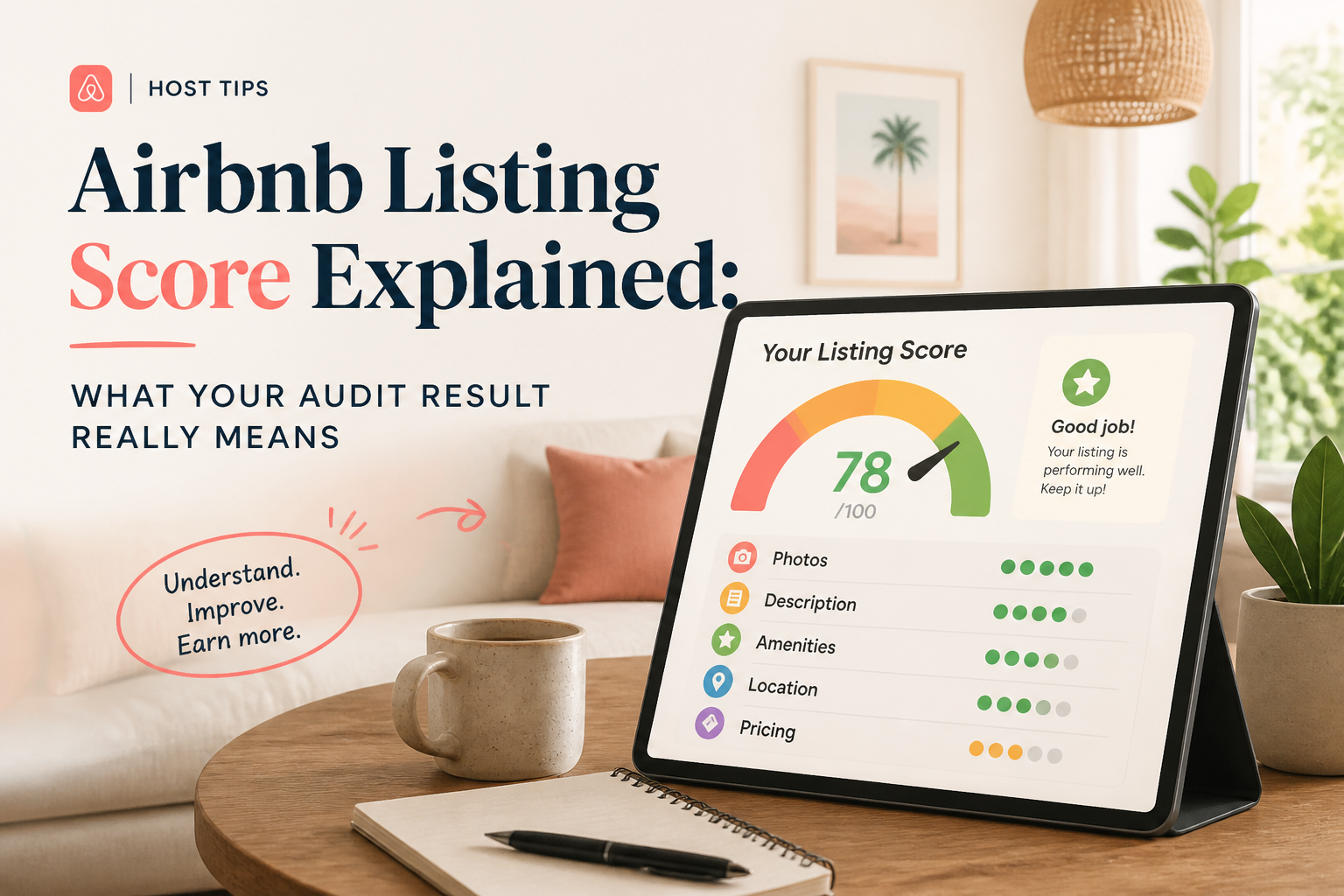
What does an Airbnb listing score of 55, 70, or 90 out of 100 actually mean?
An Airbnb listing audit score measures how well a property performs against the evaluation criteria used by a particular audit tool. In SuperhostSEO, the score summarizes nine weighted categories covering the listing's title, descriptions, photographs, amenities, guest access, and completeness.
It is not an official Airbnb search-ranking score, and it does not predict how many bookings your property will receive.
The real value of an audit isn't simply knowing your score.
It's understanding why you received that score, which sections need improvement, and what you should fix first.
That distinction matters because two Airbnb listings can receive the same overall score while having completely different problems.
One might have a strong title but an incomplete property description.
Another might have excellent descriptions but missing amenities and unclear guest access information.
Both might score 70 out of 100.
But the right optimization plan could be very different.
In The Airbnb Tools Playbook, I explain why I built the SuperhostSEO Listing Audit around weighted categories and prioritized recommendations instead of a single vague number.
Here is how to understand your score, interpret the report, and turn the results into a practical optimization plan.
- Is There an Official Airbnb Listing Optimization Score?
No. Airbnb does not publish a universal SEO optimization score out of 100 for hosts.
Airbnb has its own systems for evaluating listing quality, guest satisfaction, and search relevance.
But those systems are not equivalent to the scores generated by independent listing-audit tools.
According to "Airbnb's official explanation of search results" (https://www.airbnb.com/help/article/39), the algorithm considers several major factors.
These include:
- Listing quality
- Listing popularity
- Price competitiveness
- Property location
- Guest search preferences
- Availability
- Host behavior and hospitality-related signals
The importance of these factors can vary according to the search being performed.
For example, a listing may be attractive to a family searching for a week-long vacation while being unsuitable for someone looking for a one-night business stay.
The same property can appear differently depending on the dates, guest count, filters, and other search conditions.
This is why no third-party tool can legitimately claim to know one permanent ranking score that Airbnb has assigned to your property.
Then what is an Airbnb audit score?
An audit score is an independent evaluation of the listing information that can be inspected and assessed.
The purpose is to help hosts identify problems they might otherwise overlook.
For example, an audit may identify:
- A title that communicates little useful information
- A short summary that fails to describe the property's strengths
- A main description that is difficult to scan
- Missing or incomplete listing sections
- Photos that deserve closer review
- Important property details that haven't been explained clearly
These are practical optimization opportunities.
Correcting them can make a listing more complete, accurate, and useful to guests.
But the audit score and Airbnb search position are two different measurements.
- How SuperhostSEO Calculates an Airbnb Listing Score
The SuperhostSEO Airbnb Listing Audit evaluates a live property across nine weighted categories.
Each category receives a section score, and the overall assessment is calculated using the weighting assigned to those categories.
The total possible weighted score is 100.
Here is the scoring framework displayed in a real SuperhostSEO sample report.
Category 1: Listing Title — 27 Points
The listing title carries a maximum of 27 points in the SuperhostSEO scoring framework.
It evaluates how clearly the title communicates meaningful property features and benefits.
A strong title should help prospective guests understand what makes the accommodation attractive.
For example, a title highlighting a private pool, ocean view, or dedicated workspace may communicate more useful information than one relying entirely on generic adjectives.
Category 2: Short Summary — 23 Points
The short summary carries a maximum of 23 points.
It evaluates how effectively the opening description introduces the property and communicates its strengths.
The summary should explain relevant benefits, establish clear expectations, and encourage prospective guests to explore the complete listing.
A generic introduction or administrative notice may waste valuable space.
Category 3: The Space / Your Property — 29 Points
The main property description carries a maximum of 29 points.
This is the most heavily weighted individual category in the SuperhostSEO audit.
It evaluates the structure, clarity, detail, and completeness of the property's main description.
A useful description explains the layout, sleeping arrangements, important amenities, and practical information guests need before booking.
Category 4: Photo Order — 5 Points
Photo Order carries a maximum of 5 points.
This category examines the organization of the opening gallery and whether the sequence communicates the property effectively.
The first photographs should help guests recognize the accommodation's strongest features.
Category 5: Photos — 4 Points
The Photos category carries a maximum of 4 points.
It checks measurable photo-related elements within the listing.
This score does not represent a complete artistic or professional assessment of the photographs.
Category 6: Amenities — 4 Points
The Amenities category carries a maximum of 4 points.
It evaluates available amenity information and completeness.
Accurate amenity information helps guests understand what the property offers and can affect eligibility for relevant filtered searches.
Category 7: Guest Access — 2 Points
Guest Access carries a maximum of 2 points.
It checks whether important information about the spaces guests can use is provided.
A clear Guest Access section can help explain private areas, shared spaces, and relevant restrictions.
Category 8: Other Things to Note — 2 Points
Other Things to Note carries a maximum of 2 points.
This category reviews additional property information and important disclosures.
It is an opportunity to clarify essential details that guests should understand before reserving the accommodation.
Category 9: Listing Completeness — 4 Points
Listing Completeness carries a maximum of 4 points.
This category evaluates other important completeness-related elements.
Its purpose is to help identify information that may have been overlooked.
Total Possible Score: 100 Points
All nine categories together contribute to the overall score.
The title, short summary, and main property description account for 79 of the possible 100 points.
That weighting is intentional.
Source: "SuperhostSEO — Real Airbnb Listing Audit Example" (https://www.superhostseo.com/audit/sample).
Why do the three text sections carry so much weight?
In The Airbnb Tools Playbook, I explain that these sections contain written information that can be evaluated directly.
The audit can examine whether the title communicates meaningful benefits.
It can assess whether the summary provides relevant information about the stay.
And it can evaluate the structure, detail, and completeness of the main property description.
A weak main description might leave the bedrooms, sleeping arrangements, and outdoor features unclear.
An incomplete summary might waste valuable introductory space.
A generic title might fail to highlight the property's actual advantages.
These are issues the audit can identify through the published listing information.
Does this mean Airbnb gives descriptions 79% of its ranking weight?
Absolutely not.
The 79-point weighting belongs to the SuperhostSEO Optimization Framework.
It is not an Airbnb algorithm formula.
Airbnb has not published a rule saying that the title, summary, and main property description represent 79% of a property's search ranking.
The SuperhostSEO weighting reflects what the audit is designed to measure and how it prioritizes measurable content.
Understanding this difference prevents hosts from making incorrect assumptions about what their score represents.
- Why Photos Receive Fewer Audit Points Than Descriptions
One detail sometimes surprises hosts.
In the SuperhostSEO framework, Photos and Photo Order together account for only nine of the 100 possible points.
Does that mean photographs are relatively unimportant?
No.
In The Airbnb Optimization Playbook, I emphasize that photographs are central to the way guests evaluate properties.
Your opening images can communicate the property's strongest features before someone reads the full description.
But there's a difference between the importance of an element and how reliably an automated audit can evaluate it.
What a structural photo check can assess
An audit can consider certain visible or structural characteristics.
For example:
- Whether relevant photographs are present
- Whether the opening gallery has a sensible sequence
- Whether the listing provides useful visual coverage
- Whether important photo-related information deserves review
What the audit cannot fully judge
A structural analysis cannot completely reproduce the visual judgment of a prospective guest.
It cannot fully determine whether your property's staging is attractive.
It cannot reliably measure the emotional impact of a sunset photograph.
And it cannot know whether a particular camera angle makes the space feel inviting to your ideal audience.
That is why I recommend reviewing photographs separately, even when the audit's photo-related categories score well.
A high audit score doesn't replace a careful human review of the complete gallery.
Similarly, a low photo-category weight does not mean you should ignore obvious photography problems.
The score helps organize your work.
It should not replace common sense.
- What Does an Airbnb Listing Score of 55/100 Mean? A Real Example
Let's examine an actual audit published on SuperhostSEO.
The property is a two-bedroom townhouse in Jacksonville Beach, Florida.
It accommodates five guests and has several features that could make it attractive to the right travelers.
These include a fenced yard, pet-friendly accommodation, nearby beach access, and a firepit.
The published SuperhostSEO audit gave the listing an overall score of:
55 out of 100 — Needs Work.
You can "view the real sample audit here" (https://www.superhostseo.com/audit/sample).
The interesting part isn't the total score.
It's how the score breaks down.
The title scored 100/100
The property's title was strong.
It communicated several concrete benefits, including the fenced yard, pet-friendly positioning, proximity to the beach, and firepit.
In other words, the title was already doing a useful job.
Rewriting it wasn't the main priority.
This is an important lesson.
A property with a low overall score can still have individual sections that are performing well.
You shouldn't automatically rebuild every section simply because the total is disappointing.
The summary scored 0/100
This was a much more serious opportunity.
Instead of introducing the property and its benefits, the short summary focused on an administrative notice concerning guest contact information.
That meant one of the first pieces of text a guest encountered provided almost no useful explanation of the stay.
The audit's recommendation was to use that space to communicate what makes the accommodation appealing.
For example, the summary could highlight the property's fenced yard, beach access, outdoor firepit, and available beach equipment.
Only genuine, verified features should be included.
The goal isn't simply to write something more enthusiastic.
It's to communicate useful information that helps guests understand the property.
The Space scored 45/100
The main description already contained valuable property information.
But it was difficult to navigate.
Features, neighborhood recommendations, administrative details, and other information were mixed together instead of being organized into clear sections.
The audit recommended rebuilding the description into a more skimmable structure.
That could include sections for:
- Bedrooms
- Kitchen
- Outdoor spaces
- Beach equipment
- Additional property details
This follows the two-layer description method I teach in The Airbnb Optimization Playbook.
First, make essential information easy to find.
Then provide the fuller explanation guests need to understand the layout and experience.
Photo Order scored 40/100
The listing had appealing features, but its opening five photographs did not clearly demonstrate several of the strengths mentioned in the title.
The audit recommended reviewing the sequence so the first images better supported the property's most important selling points.
That could mean including clearer views of the fenced yard, firepit, and other distinctive features earlier in the gallery.
The photographs weren't necessarily the wrong photographs.
The opportunity was to present them in a more useful order.
Guest Access needed attention
The sample report also identified an empty Guest Access section.
This is important because guests need to understand which spaces belong to their reservation and which may be shared or restricted.
An incomplete section can create uncertainty even when the photographs look appealing.
What the 55/100 score actually tells us
This wasn't a property with nothing going for it.
It already had an effective title, relevant amenities, and features worth highlighting.
The weaknesses were concentrated in particular areas.
The audit's top three recommendations were:
- Rewrite the short summary.
- Reorganize the main property description.
- Improve the opening photo sequence.
That's the value of a useful listing score.
Instead of telling the host that everything is wrong, it identifies what is already working and where attention is most needed.
- What Is a Good Airbnb Listing Audit Score?
This is one of the most common questions hosts ask.
Is 70 a good Airbnb score?
Should every listing aim for 90?
Does 100 mean the listing is perfect?
The answer requires context.
There is no official Airbnb optimization-score benchmark that guarantees rankings or bookings.
Within SuperhostSEO, the overall score indicates how the property performs against the tool's own criteria.
A stronger score generally reflects better performance against those criteria.
But it does not necessarily mean a property is more profitable or receives more bookings than another listing with a lower score.
What about 70/100?
Imagine your listing receives 70 out of 100.
The next step isn't to decide that 70 is automatically good or bad.
It's to open the category results.
Perhaps your title, summary, and main description are strong, but other sections need attention.
Or perhaps one of those heavily weighted sections is substantially underperforming while the remaining categories are relatively complete.
Those situations require different solutions.
What about 90/100?
A listing scoring 90 may be performing very well against the structural assessment.
But it could still have an uncompetitive nightly price.
It might have minimum-stay rules that exclude many potential guests.
Or it could have photographs that are technically acceptable but not especially compelling.
A high score doesn't eliminate the need to review actual booking performance.
What about 100/100?
A perfect score means the listing meets the criteria used by that audit assessment.
It does not mean:
- The property will rank first in Airbnb search.
- It will achieve full occupancy.
- Every guest will give five stars.
- Its pricing is optimal for every date.
- No future improvements will be necessary.
A 100/100 audit score should be understood as a strong result within the evaluation framework, not as a promise of business performance.
- Why You Shouldn't Automatically Fix the Lowest-Scoring Category
This is one of the most important concepts in The Airbnb Tools Playbook.
Not every category carries the same weight.
Imagine your audit shows three areas that could be improved.
Example 1: Listing Title
Section Score: 80/100
Category Weight: 27 points
The title is performing reasonably well, but there may still be opportunities to make its benefits clearer.
Because the title carries 27 possible points, even a moderate weakness can affect the overall score.
At 80/100, this category contributes 21.6 of its 27 possible points.
That leaves 5.4 points of potential improvement within the audit framework.
Example 2: Short Summary
Section Score: 50/100
Category Weight: 23 points
The summary is only achieving half of its possible score.
Perhaps it relies on generic language.
Maybe it doesn't explain the property's most important features.
Or perhaps it provides administrative information instead of introducing the accommodation.
At 50/100, this category contributes 11.5 of its 23 possible points.
That leaves 11.5 points of potential improvement.
Example 3: Photos
Section Score: 25/100
Category Weight: 4 points
This is the lowest section score in our example.
At first glance, it may appear to be the most serious problem.
However, the Photos category carries only four possible points in the audit.
At 25/100, it contributes one point.
That leaves three points of potential improvement within the scoring framework.
Which category should you fix first?
Your immediate instinct might be Photos because 25 is the lowest number.
But compare the potential impact on the overall audit score.
Title: Up to 5.4 additional points.
Short Summary: Up to 11.5 additional points.
Photos: Up to 3 additional points.
These are hypothetical results, not a real property.
The summary represents the largest numerical opportunity in this example.
That doesn't mean photographs are unimportant in real life.
It means the audit's numeric priorities and the broader visual quality of the listing must be interpreted separately.
A photograph could be the first thing a guest notices, even though photo-related categories receive relatively little weight in the structural score.
Focus on the improvement roadmap
The SuperhostSEO report includes prioritized recommendations and identifies the biggest opportunity.
Instead of asking only which category has the lowest number, ask:
What is the report telling me to fix first, and why?
Then consider whether that recommendation matches what you know about your property and guest experience.
If it does, begin there.
If an urgent accuracy or safety issue exists elsewhere, correct that regardless of how many points the category carries.
The score helps prioritize.
It doesn't override real-world judgment.
- How to Turn Your Airbnb Listing Score Into an Optimization Plan
Once you understand your score, the next step is to act on it.
I recommend a simple five-step process.
Step 1: Identify what is already working
Start with your strongest categories.
If your title is effective, don't rewrite it unnecessarily.
If your amenities are accurate, preserve that information.
If the main description is organized and complete, focus on other weaknesses.
Optimization should not mean changing things merely to create activity.
Step 2: Read the top three priorities
Review the recommendations the audit identifies as most important.
Understand what each problem is and what improvement is being suggested.
Don't begin rewriting until you understand the reason for the recommendation.
Step 3: Separate easy corrections from larger projects
Some changes are straightforward.
You may need to complete an empty section, clarify parking information, or improve a generic summary.
Other improvements take more work.
Reorganizing an entire property description may require checking room details and writing a new structure.
Photography changes may require finding better images or arranging a new photo shoot.
Plan accordingly.
Step 4: Make deliberate changes
Implement the most important improvements.
Verify that every new statement is accurate.
Do not invent amenities, make misleading claims, or hide important property limitations simply to improve a score.
If possible, document what you changed and when.
Step 5: Monitor actual performance
After making meaningful improvements, review your available Airbnb performance metrics over an appropriate period.
Look at listing views, booking conversion, and relevant historical trends.
Be careful about interpreting short periods with very little data.
A higher audit score indicates improvement against the tool's criteria.
Whether your bookings improve is a separate question that needs actual performance data.
- Can Improving Your Audit Score Increase Airbnb Bookings?
Potentially, but not automatically.
Many of the issues identified by a listing audit concern information that guests need to make booking decisions.
For example, improving an incomplete property description can help a guest understand the accommodation.
Selecting missing amenities accurately can help a property qualify for relevant filtered searches.
Improving a generic title can make genuine property benefits clearer.
These changes may improve the way prospective guests evaluate your listing.
Airbnb's official search guidance supports the importance of listing quality, useful media, accurate information, amenities, and pricing competitiveness.
But that doesn't mean increasing a third-party audit score from 55 to 90 will produce a predictable increase in bookings.
There are other factors involved.
Your market may be experiencing lower demand.
Your dates may be unavailable.
Your nightly price may be uncompetitive.
Or the property may serve a very specific type of guest.
The purpose of improving the audit score is to address identified weaknesses in your presentation and completeness.
The purpose of monitoring Airbnb performance is to learn whether the overall business results are improving.
Both are useful.
They simply measure different things.
- What If You Have a High Airbnb Audit Score but Still Aren't Getting Bookings?
This is where diagnosis becomes more interesting.
Suppose your audit report shows a strong structural score.
Your title is clear.
Your descriptions are complete.
Your amenities are accurate.
Guest Access and other important sections are properly filled in.
Yet bookings remain disappointing.
At this stage, repeatedly rewriting the same sections may not be the best use of your time.
Instead, ask whether the problem lies outside the audit's main scope.
Check visibility
Are guests finding and opening your listing?
Low listing views could suggest a need to investigate availability, pricing competitiveness, first impressions, or broader market demand.
Check booking conversion
If visitors are opening the listing but not booking, look more closely at total price, guest expectations, reviews, and the complete presentation.
Check the calendar
Are your minimum stays, advance notice, and availability restrictions appropriate for your market?
Check guest expectations
Do your photographs and descriptions communicate the same experience guests describe in their reviews?
This final question is particularly important.
Where Guest Intent Optimization fits
The "SuperhostSEO Guest Intent Optimization" (https://www.superhostseo.com/guest-intent) tool examines the relationship between listing content, photographs, and guest reviews.
It is designed to identify possible sources of hesitation that a structural completeness check might miss.
The two tools answer different questions.
Listing Audit: Is the listing structurally complete and effectively organized?
Guest Intent Optimization: Could the way the property is presented be creating uncertainty or mismatched expectations?
Both can be useful, but they shouldn't be confused.
Start with the audit.
Then use guest-intent analysis when the listing appears structurally strong but still needs a deeper review of its messaging and guest experience.
For more detail, read "Airbnb Listing Audit vs. Guest Intent Analysis" (https://www.superhostseo.com/blog/airbnb-listing-audit-vs-guest-intent).
- How to Get Your Free Airbnb Listing Score
You don't have to evaluate all nine categories manually.
SuperhostSEO provides a free first listing audit based on the optimization methodology explained in this article.
Here's how it works.
Step 1: Open the free audit
Go to "SuperhostSEO.com/audit" (https://www.superhostseo.com/audit/).
Step 2: Create a free account
The account allows your listing and report to be saved to your workspace.
You don't need to provide your Airbnb account password to run the public listing analysis.
Step 3: Add your Airbnb listing
Provide the URL of your live property.
SuperhostSEO imports the available listing information for analysis.
Step 4: Run the audit
The tool evaluates your listing and generates its personalized report.
You'll receive an overall score out of 100, individual category assessments, listing strengths, and prioritized recommendations.
Step 5: Review your improvement priorities
Start with the highest-priority recommendations.
Read the explanations.
Decide which changes are appropriate for your property.
The first audit is free, with no credit card required.
The tool does not automatically make changes inside your Airbnb account.
You remain in control of what you edit and publish.
"Get Your Free Airbnb Listing Score" (https://www.superhostseo.com/audit/)
If you want to see how the report works before entering your own listing, you can also "explore the real 55/100 sample audit" (https://www.superhostseo.com/audit/sample).
- What Happens After You Receive Your Listing Score?
The free audit is the starting point.
After reviewing the results, you have several options.
You can make the changes manually.
You can prioritize the most important weaknesses and work through them gradually.
Or, if your listing requires substantial rewriting, you can use the SuperhostSEO Listing Workshop.
The Workshop helps guide improvements to sections such as:
- Title
- Short summary
- Main property description
- Photo strategy
- Guest Access
- Other relevant listing information
SuperhostSEO's Pro workspace also provides additional tools for ongoing optimization and monitoring.
These are optional next steps.
The first objective is to understand your listing.
Once you know which problems deserve attention, you can decide how much help you want implementing the improvements.
That is the purpose of the audit-first approach.
Diagnosis before treatment.
Frequently Asked Questions
What is an Airbnb listing score?
An Airbnb listing score is an assessment of how well a property performs against specific evaluation criteria. Third-party audit tools may evaluate descriptions, titles, photographs, amenities, and other listing information to produce a score.
Does Airbnb have an official SEO score out of 100?
No. Airbnb does not publish a universal listing SEO score out of 100. Scores produced by independent optimization tools are not official Airbnb search rankings.
What is a good Airbnb listing audit score?
A good score depends on the tool's methodology and the weaknesses behind the result. Review individual categories and prioritized recommendations rather than assuming one number guarantees strong booking performance.
Is 70/100 a good Airbnb score?
A score of 70 indicates the listing has earned 70 points under the relevant audit framework. Whether that is satisfactory depends on the category results, missing information, and the goals of the property. It does not mean the property has a 70% chance of booking.
What does a 55/100 Airbnb audit score mean?
In the published SuperhostSEO example, 55/100 is labeled "Needs Work." The report identifies weaknesses in the short summary, main property description, and opening photo sequence while recognizing that other sections, including the title, are already strong.
Can an Airbnb listing score predict bookings?
No. Listing-audit scores assess selected aspects of a property's presentation and completeness. Actual bookings also depend on demand, price, availability, location, reviews, guest preferences, and other factors.
How is the SuperhostSEO audit score calculated?
SuperhostSEO evaluates nine weighted categories totaling 100 possible points. The title carries 27 points, the summary 23, and the main property description 29. The remaining points cover photographs, photo order, amenities, guest access, other notes, and listing completeness.
Why did my Airbnb listing score improve but my bookings didn't?
An improved score may mean your listing performs better against the tool's criteria, but bookings depend on additional factors. Investigate market demand, availability, pricing competitiveness, guest expectations, and booking conversion.
Is there a free Airbnb listing grader?
Yes. "SuperhostSEO offers a free first Airbnb Listing Audit" (https://www.superhostseo.com/audit/). Enter your listing URL, create a free account, and receive a scored report with prioritized recommendations. No credit card is required for the first audit.
Can I get an Airbnb listing score without sharing my password?
Yes. SuperhostSEO's audit uses publicly available listing information. You don't need to provide your Airbnb account password. Some private Airbnb settings still need to be checked manually inside your hosting account.
Should I try to get my Airbnb audit score to 100?
Improving your score can help address structural weaknesses, but 100 should not become the only objective. Prioritize accurate information, strong presentation, guest expectations, and actual property performance rather than making unnecessary changes solely to gain points.
Final Thoughts: Your Airbnb Listing Score Is a Starting Point, Not a Finish Line
A number can be useful.
It gives you a way to understand how your listing performs against a defined set of criteria.
But a number without context can be misleading.
A 55/100 listing might already have an excellent title and relevant amenities.
A 90/100 listing might still struggle with pricing or guest expectations.
And two properties with the same score may need entirely different improvements.
That's why I built the SuperhostSEO audit around nine weighted categories and a prioritized roadmap.
The score tells you where you stand within the framework.
The report tells you what deserves attention.
And your actual Airbnb performance helps you evaluate the results over time.
You don't need to make every change at once.
You need to understand which changes matter for your property.
Stop guessing how well your Airbnb listing is optimized.
"Get Your Free Airbnb Listing Score at SuperhostSEO" (https://www.superhostseo.com/audit/) and discover what is working, what needs improvement, and where to begin.
Written by Elie Parienti, founder of SuperhostSEO and author of The Airbnb Optimization Playbook and The Airbnb Tools Playbook. This article is based on the nine-category evaluation methodology explained in The Airbnb Tools Playbook, Chapter 1, and on the publicly available SuperhostSEO sample Airbnb Listing Audit.
Further Reading
- "Airbnb: How Search Results Work" (https://www.airbnb.com/help/article/39)
- "SuperhostSEO: Real Airbnb Listing Audit — 55/100" (https://www.superhostseo.com/audit/sample)
- "Airbnb Listing Audit vs. Guest Intent Analysis: What's the Difference?" (https://www.superhostseo.com/blog/airbnb-listing-audit-vs-guest-intent)
- "How to Optimize an Airbnb Listing" (https://www.superhostseo.com/blog/how-to-optimize-an-airbnb-listing)
- "Free Airbnb Listing Audit — SuperhostSEO" (https://www.superhostseo.com/audit/)
Airbnb optimization specialist, Superhost, and founder of one of the largest Airbnb host communities.
Continue Reading
Chosen for you from The Optimization Journal.
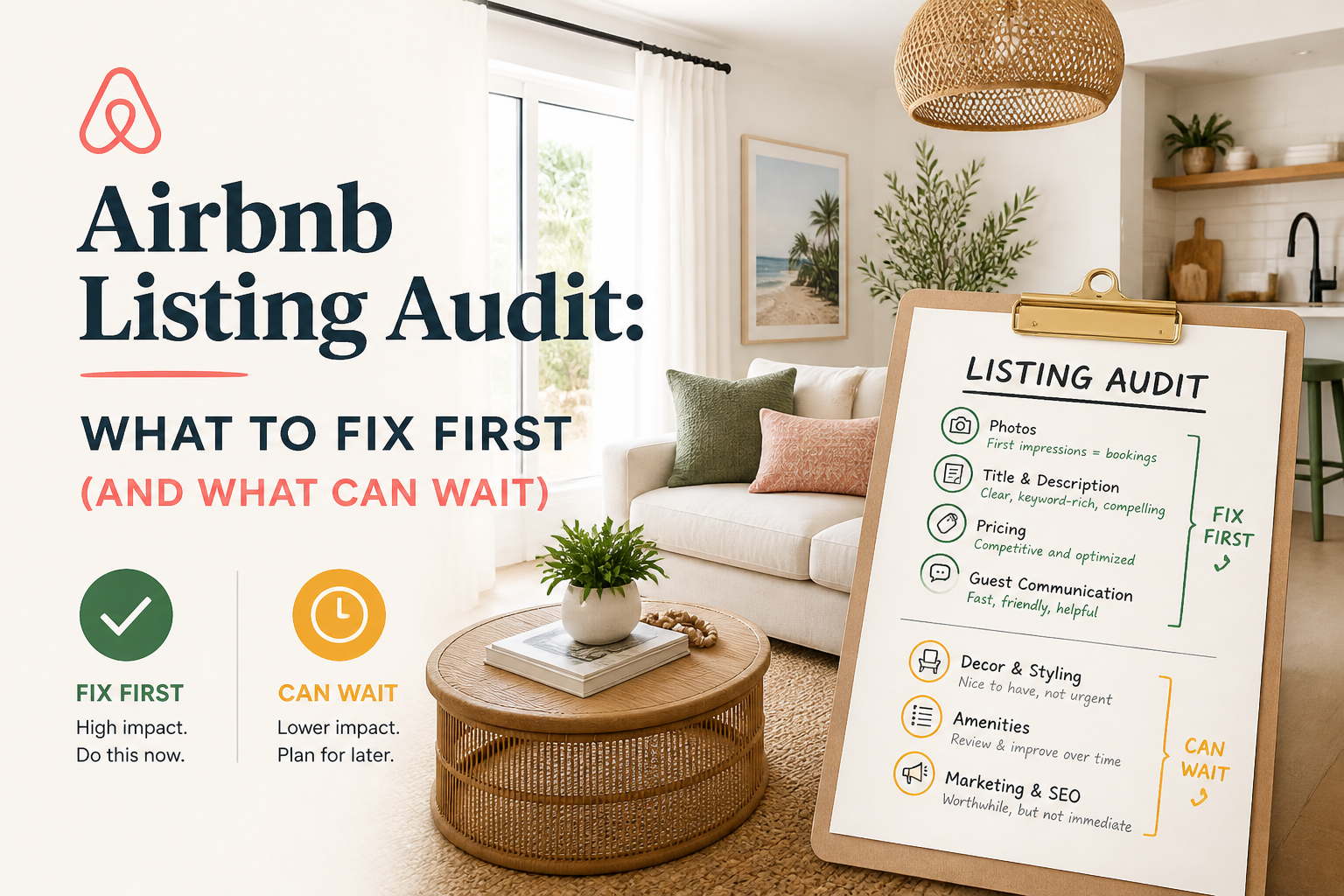 CornerstoneAirbnb Listing Audit: What to Fix First (And What Can Wait)
Not every weakness in your Airbnb listing deserves the same attention. Learn how to read an Airbnb listing audit, identify high-impact problems, and prioritize improvements that actually matter to guests.
14 min read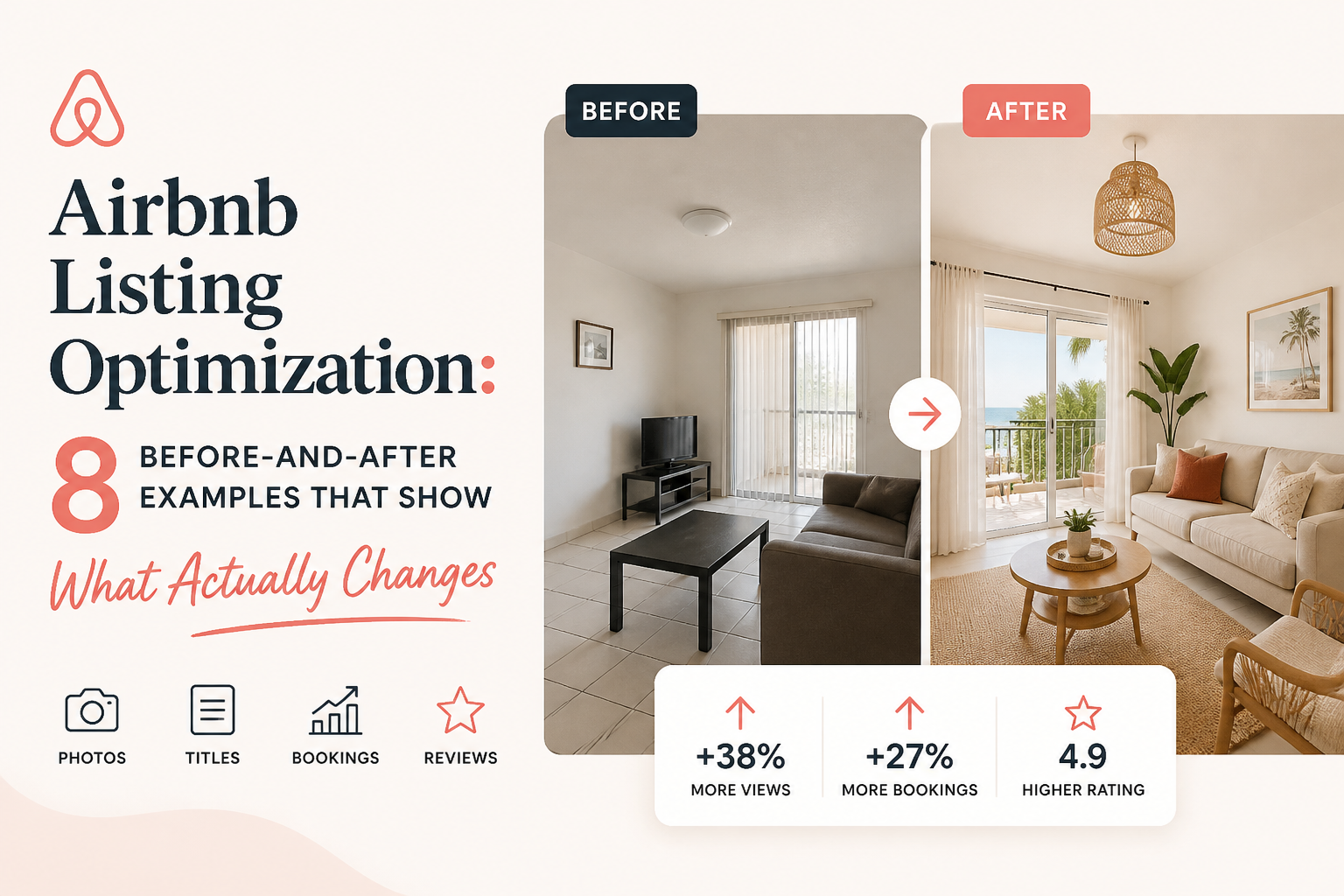 CornerstoneAirbnb Listing Optimization: 8 Before-and-After Examples That Show What Actually Changes
What does Airbnb listing optimization actually look like? Explore eight before-and-after examples covering titles, descriptions, photo order, captions, amenities, and guest expectations, plus a real SuperhostSEO listing audit.
26 min read CornerstoneAirbnb SEO Tools in 2026: Which Ones Do You Actually Need?
Not every Airbnb optimization tool solves the same problem. Learn the difference between listing audits, guest intent analysis, search rank tracking, competitor intelligence, and AI listing tools—and when to use each one.
17 min read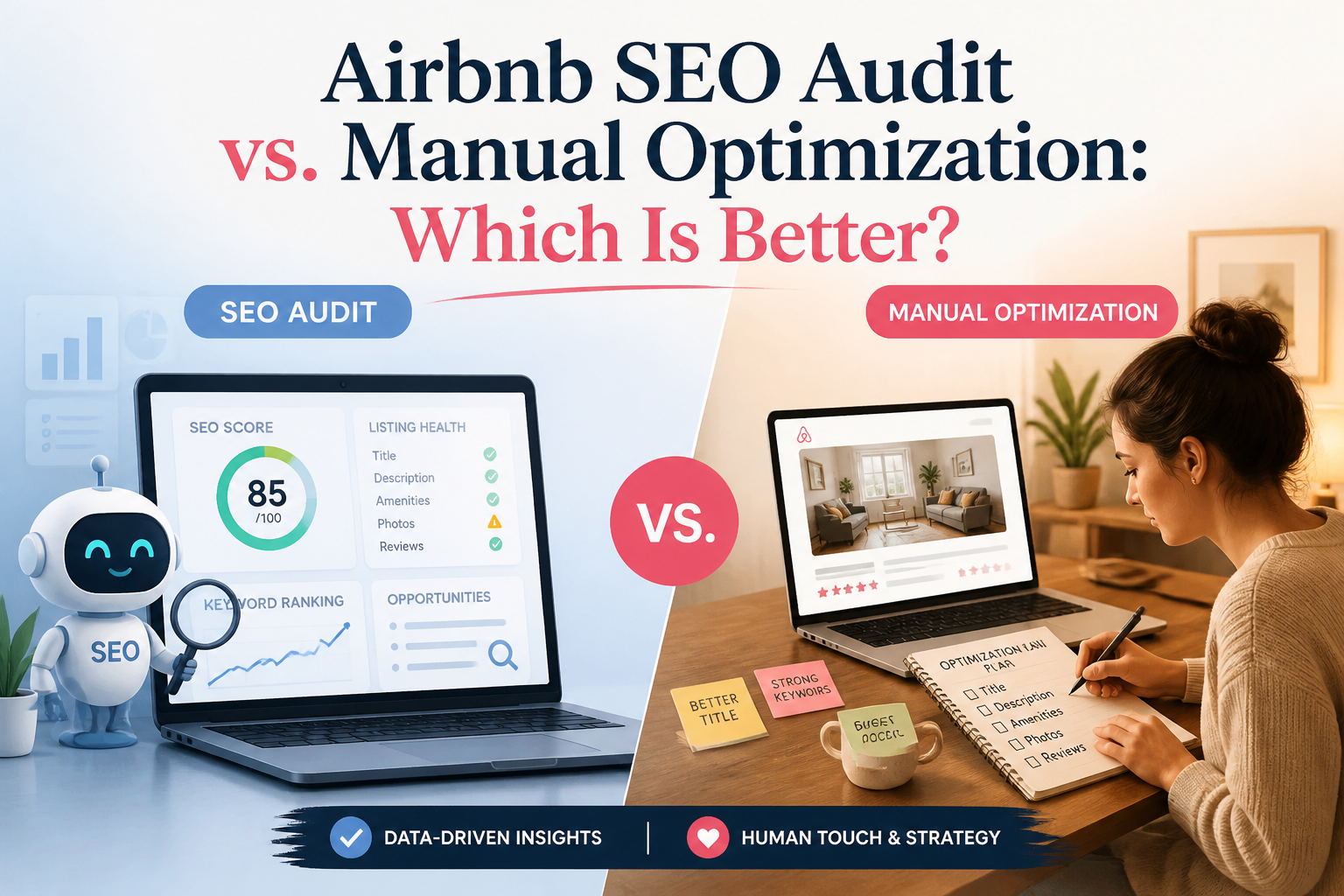 CornerstoneAirbnb SEO Audit vs. Manual Optimization: Which Is Better?
Should you optimize your Airbnb listing yourself, use an AI-powered audit, or hire a professional? Compare the benefits, limitations, costs, and practical results of each approach. Learn when a free audit is enough and when personalized help makes more sense.
23 min read CornerstoneBest Free Airbnb Listing Optimization Tools in 2026: What Actually Helps?
Looking for free tools to improve your Airbnb listing? Compare listing audits, guest intent analysis, title generators, description checkers, photo tools, and Airbnb Insights. Learn what each tool does, what it cannot do, and where to start.
21 min read