
Airbnb Guest Favorite Badge: How It Works and How to Keep It
Understanding the airbnb guest favorite criteria starts with a simple distinction: the badge reflects the experience guests have, not how cleverly a host...

Key takeaways
- Airbnb Guest Favorites recognizes listings with strong ratings, positive reviews, and dependable hosting.
- Overall ratings matter, but category ratings and low host cancellations also deserve attention.
- Guest Favorite status and top-percentage labels are related distinctions, not guarantees of search placement or bookings.
- Hosts can protect the guest experience through accurate listings, consistent cleaning, reliable check-in, and regular review monitoring.
Understanding the airbnb guest favorite criteria starts with a simple distinction: the badge reflects the experience guests have, not how cleverly a host writes a listing. Strong ratings, positive reviews, and reliable hosting all matter. Earning the badge is useful, but keeping it requires consistent work between stays.
As a host, I treat Guest Favorite status as a reason to protect the basics, not a reason to relax. A beautiful property can still disappoint if arrival instructions are confusing, the cleaning is inconsistent, or the description creates expectations the home cannot meet.
This guide explains how Guest Favorites works, what the different labels mean, and which habits help hosts maintain the underlying quality. Airbnb can change its requirements, so use your hosting dashboard and Airbnb’s current guidance to confirm the details for your listing.
What Is Airbnb Guest Favorites?
Airbnb introduced Guest Favorites in November 2023 to help guests identify homes with a strong record of positive stays. Listings qualify based on ratings, reviews, and reliability, including low host cancellations.
The badge is shown roughly to the top 10% of eligible homes. That makes it a meaningful distinction, but not a permanent certification.
Think of it as a platform-generated signal: this listing has demonstrated the kind of experience guests tend to appreciate.
Guest Favorite is about the listing
Guest Favorite status applies to an individual listing. Superhost is a separate host-level recognition.
That distinction matters if you manage several properties. A dependable host can still have one home with weaker cleanliness feedback or recurring check-in problems. Improvements need to happen at the property level, not just across the account.
The badge is not a booking guarantee
The badge gives prospective guests another signal when comparing homes. It does not guarantee better search placement, higher occupancy, or a particular revenue result.
Guests still consider location, price, availability, amenities, photos, and whether the home fits their trip. A badge cannot make an unsuitable property the right choice.
It also cannot replace an accurate listing. If your photos and description attract guests whose needs the property cannot meet, disappointment can follow despite the badge.
Understanding the airbnb guest favorite criteria
Airbnb does not give hosts a simple formula they can calculate independently. The practical approach is to understand the main inputs and monitor the information available in your dashboard.
Ratings: overall quality and consistency
A listing generally needs high overall ratings and strong ratings across categories.
The overall average is useful, but it can hide a recurring weakness. Guests might love the design and location while repeatedly mentioning uncomfortable beds or difficult access.
Look beyond the headline score. Ask:
- Which category receives weaker feedback?
- Are guests describing the same problem in different words?
- Did feedback change after a cleaner, furnishing, or operating process changed?
- Does the listing set expectations that the stay fails to meet?
A strong average is not a reason to ignore a pattern.
Reviews: enough evidence of good stays
A listing generally needs at least five reviews in the past couple of years to be considered, alongside the other quality requirements. Check your dashboard for the current review requirements and your listing’s status.
Meeting the review minimum does not automatically qualify a home. Reviews provide evidence of guest experience, rather than acting as a box you can check independently of quality.
Invite honest feedback without pressure, incentives, or requests for a particular rating. For more context on their role, read why Airbnb reviews matter more than you think.
Reliability: reservations guests can depend on
Low host cancellations are part of the reliability picture.
Keeping the calendar accurate is therefore more than an administrative task. It protects guests from booking a stay you cannot deliver.
If you use a PMS, monitor synchronization and investigate discrepancies rather than assuming every update has reached every channel. Block maintenance periods promptly and confirm that your property is ready before accepting reservations.
These practices support dependable hosting. They are not a substitute for checking Airbnb’s current eligibility guidance.
How Category Ratings Reveal What Needs Attention
Category ratings help you turn broad feedback into specific improvements. Airbnb asks guests about cleanliness, accuracy, check-in, communication, location, and value.
Treat these categories as a diagnostic tool, not a collection of scores to argue with.
Cleanliness
Cleaning problems often come from inconsistent execution rather than a lack of effort.
Use a turnover checklist that covers easily missed areas: shower drains, kitchen drawers, appliance interiors, under furniture, and soft furnishings. Arrange inspections where possible, especially after maintenance or unusual stays.
If a guest reports a problem, document what happened and revise the process. “Be more careful” is not a repeatable instruction.
Accuracy
Accuracy means the actual stay matches the listing.
Check whether photos still represent the furniture, condition, and layout. Confirm amenity selections, sleeping arrangements, parking information, and access restrictions.
Disclose limitations clearly. Stairs, shared spaces, street noise, or a compact bathroom are easier for guests to accept when they knew about them before booking.
Check-in and communication
Arrival instructions should work for someone who is tired, unfamiliar with the area, and reading on a phone.
Explain where to arrive, how to enter, and what to do if access fails. Test the instructions against the real arrival route.
For communication, prioritize useful answers and dependable follow-through. Automated messages can cover routine information, but someone still needs to handle questions and problems.
Location and value
You cannot move the property, but you can describe its setting honestly. Avoid language that gives an unrealistic impression of convenience, quiet, or proximity.
Value is also broader than price. Guests judge whether the complete experience feels worth the total cost. Working amenities, comfortable beds, clear expectations, and thoughtful essentials all contribute.
A pricing change may help in some situations, but it will not repair an inaccurate description or broken equipment.
Guest Favorite Tiers: What the Top Labels Mean
Airbnb also displays top 1%, top 5%, and top 10% labels for highly rated homes. These give guests an additional way to distinguish listings with particularly strong records.
Do not treat the labels as a ladder with a published score you can reliably reverse-engineer.
A host may see excellent ratings without receiving the label they expected. The visible average does not necessarily explain the complete assessment. Review history and reliability also matter, and Airbnb controls how its distinctions are applied.
What hosts should check
When reviewing your status, look at:
- The badge or label shown on the live listing.
- Any eligibility information available in your hosting dashboard.
- Recent overall and category ratings.
- Recurring themes in written reviews.
- Host cancellations and calendar-management problems.
Avoid relying on screenshots from other hosts as proof of a universal threshold. Their listings may have different review histories or other circumstances you cannot see.
The useful question is not “How do I force the next tier?” It is “What would make the next guest’s stay more consistently good?”
What Hosts Control, and What They Do Not
You control the home, the promises you make about it, and the systems used to deliver the stay. You do not control Airbnb’s assessment or how every guest will rate their experience.
Keeping that boundary clear helps you spend time productively.
Focus on operational improvements
Start with problems that affect the stay directly:
- Repair unreliable amenities before advertising them.
- Replace worn items that make the property feel neglected.
- Improve instructions where guests repeatedly ask the same questions.
- Give cleaners clear standards and a way to report damage.
- Keep availability and minimum-stay settings aligned with what you can deliver.
- Establish a backup plan for access failures and urgent maintenance.
These actions address the causes of poor experiences rather than the appearance of the listing.
Use listing improvements to clarify expectations
Titles, photos, and descriptions should attract suitable guests and explain the property accurately.
A useful caption can show that a bedroom is upstairs or that a patio is shared. A useful title highlights a genuine strength without exaggeration. Neither is a shortcut to Guest Favorite status.
If you need help describing what guests actually see, the Photo Captions tool can help you draft clearer captions. Review every suggestion against the property before publishing.
I would rather set an honest expectation and meet it than write an impressive promise the home cannot keep.
A Guest Favorite Maintenance Checklist
Maintaining quality is easier when tasks have a clear place in your workflow. Use this checklist as an operating routine, not as a guarantee of badge eligibility.
Before every arrival
- Confirm the reservation dates and property availability.
- Complete the turnover checklist and address reported defects.
- Test the entry method and confirm any access instructions.
- Verify that advertised essentials and amenities are available.
- Check that guests have accurate parking and arrival information.
- Make sure someone can respond if arrival goes wrong.
During the stay
- Answer questions clearly and follow through on commitments.
- Respond to reported problems without becoming defensive.
- Give guests a realistic explanation of what can be fixed.
- Keep relevant communication documented.
- Respect guest privacy and avoid unnecessary messaging.
A problem does not always become a poor review. An ignored problem is harder to recover from.
After checkout
- Ask for honest feedback without requesting a particular score.
- Read category ratings alongside the written review.
- Separate isolated preferences from recurring operational issues.
- Assign each fix to someone and confirm completion.
- Update the listing if feedback reveals an expectation mismatch.
During regular listing reviews
- Check Guest Favorite status and dashboard guidance.
- Look for trends in recent feedback, not just the lifetime average.
- Audit photos, amenities, descriptions, and house rules for accuracy.
- Review cancellations and any calendar synchronization failures.
- Check whether pricing and property condition remain aligned.
- Revisit cleaning and maintenance standards with the people doing the work.
For a broader operating review, use the vacation rental performance checklist alongside this badge-focused routine.
What to Do After a Poor Review or Lost Badge
A disappointing review can feel personal, especially when you have worked hard on the property. Respond by diagnosing the experience, not by rushing to change everything.
First, identify what the guest actually reported. Was it a cleaning failure, an inaccurate amenity, an arrival problem, or a preference the listing could have clarified?
Then compare the feedback with previous stays. A repeated complaint deserves a process change. An isolated issue still deserves attention, but it may not justify redesigning the entire operation.
Follow a practical recovery sequence
- Verify the issue. Inspect the property and review the relevant messages.
- Fix the cause. Repair, replace, clarify, or retrain as needed.
- Respond professionally. Keep any public response factual and useful to future guests.
- Monitor subsequent stays. Look for evidence that the change solved the problem.
- Check your dashboard. Use Airbnb’s current information rather than guessing about reinstatement.
Do not assume a single review automatically removes the badge, or that one excellent stay will restore it. Avoid treating badge status as a predictable countdown.
If you need a more detailed response plan, follow the Airbnb four-star review recovery plan.
Frequently Asked Questions
Is Guest Favorite the same as Superhost?
No. Guest Favorite recognizes an individual listing based on ratings, reviews, and reliability. Superhost is a separate host-level recognition. Monitor each property’s performance rather than assuming host status makes every listing a Guest Favorite.
How many reviews does a listing need?
A listing generally needs at least five reviews in the past couple of years, along with strong ratings and reliable hosting. That minimum alone does not guarantee eligibility. Check your hosting dashboard and Airbnb’s current guidance for the requirements that apply to your listing.
Can a listing lose its Guest Favorite badge?
Yes. Treat the badge as a status that can change, not a permanent award. If it disappears, review recent ratings, recurring complaints, cancellations, and dashboard information. Focus on correcting identifiable problems rather than assuming a particular review caused the change.
Can listing optimization help me get the badge?
Clearer photos, descriptions, and instructions can help guests choose appropriately and arrive with accurate expectations. That supports a better experience, but optimization cannot guarantee the badge. Strong hosting, positive reviews, high category ratings, and reliability remain central.
Guest Favorite status is worth monitoring, but the real goal is a stay you can deliver consistently. Start with the gaps between what your listing promises and what guests experience. Use the free Airbnb audit to review your listing and identify practical opportunities to make it clearer and more accurate.
Airbnb optimization specialist, Superhost, and founder of one of the largest Airbnb host communities.
Continue Reading
Chosen for you from The Optimization Journal.
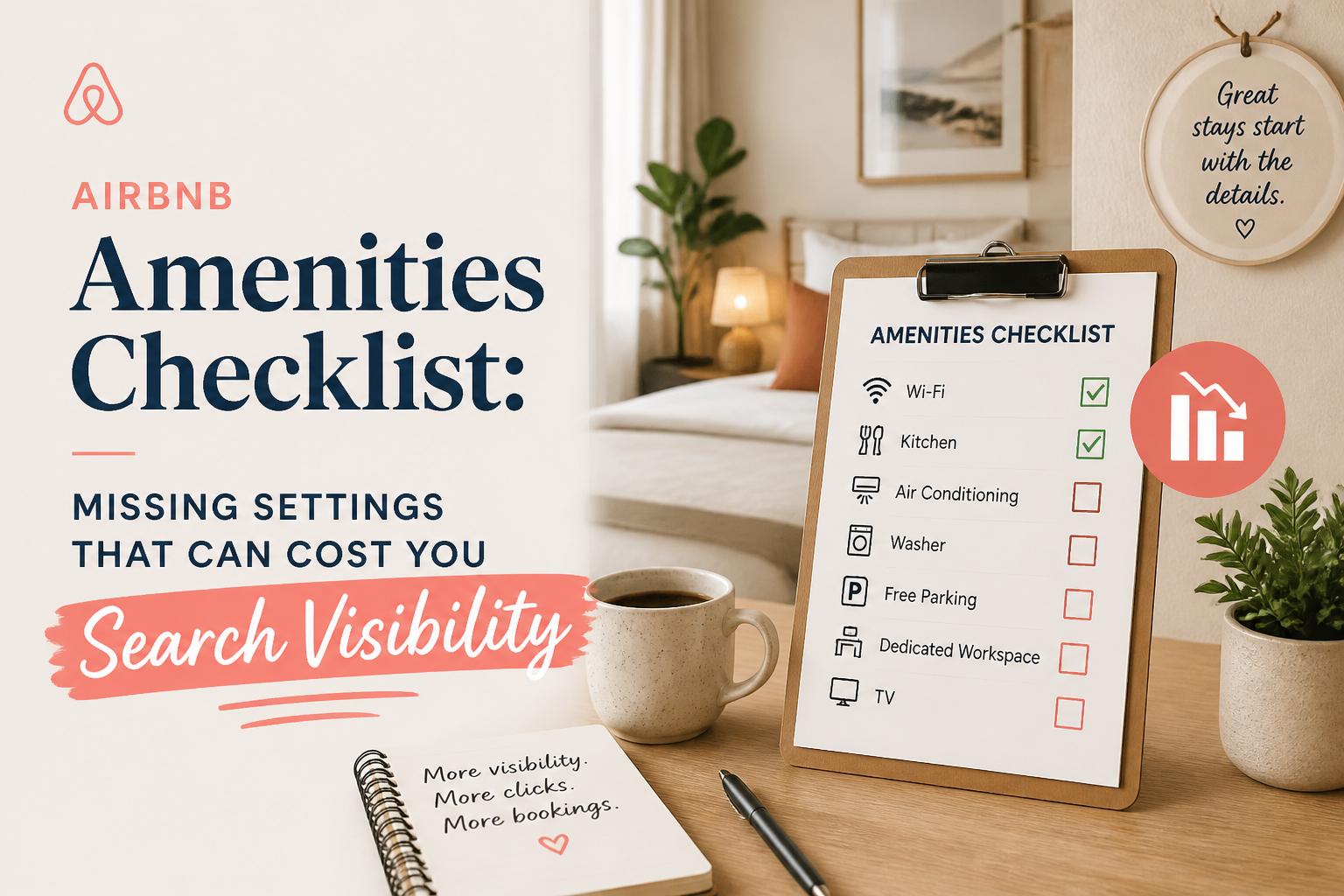 CornerstoneAirbnb Amenities Checklist: Missing Settings That Can Cost You Search Visibility
Your Airbnb may have amenities guests are searching for, but are they selected in your listing settings? Use this room-by-room checklist to find missing amenities, avoid filtered-search visibility problems, and improve your listing's accuracy.
19 min read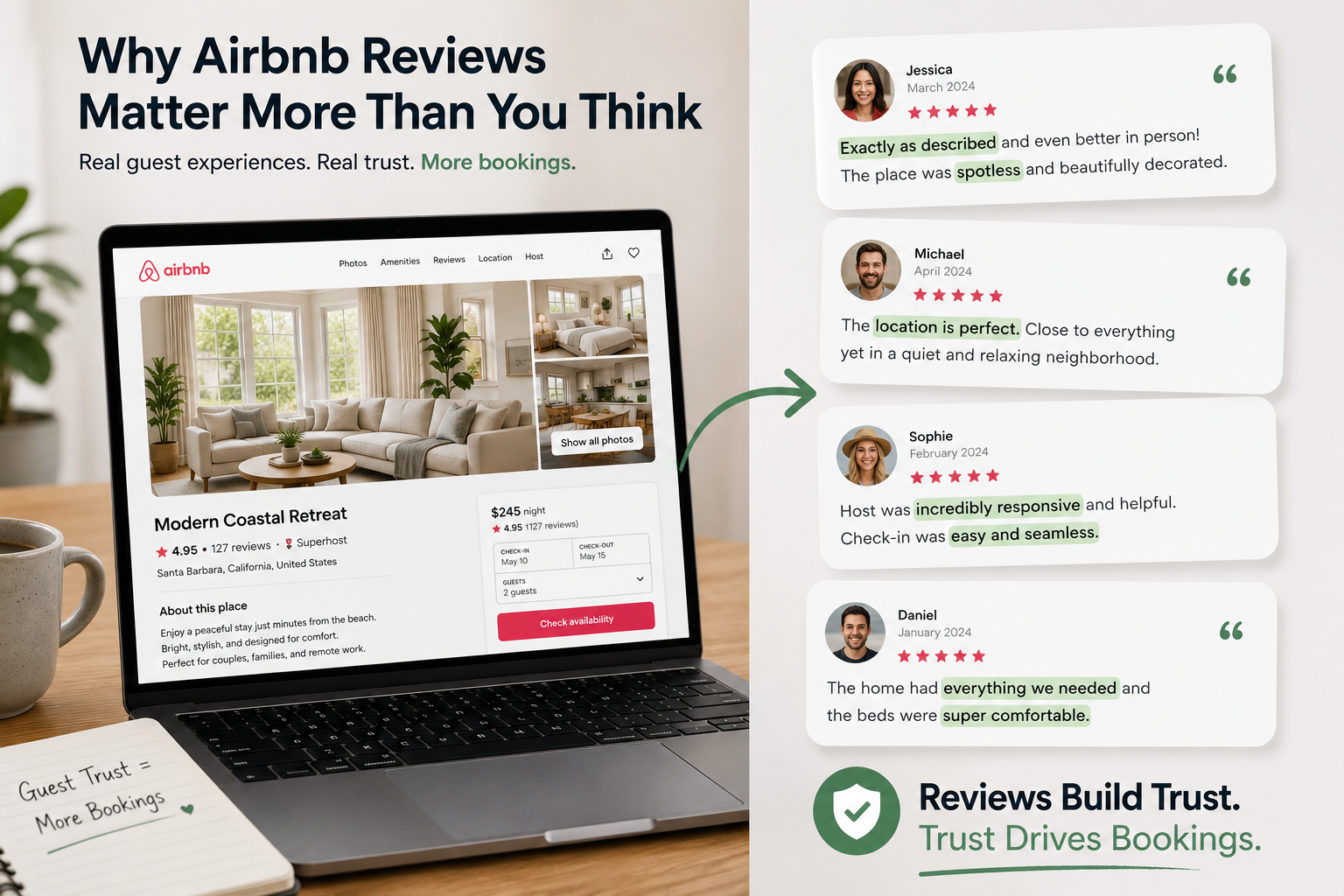 CornerstoneWhy Airbnb Reviews Matter More Than You Think
Most hosts think reviews are proof of a great stay. They're much more than that—they're one of the biggest influences on whether future guests book your property. ---
2 min read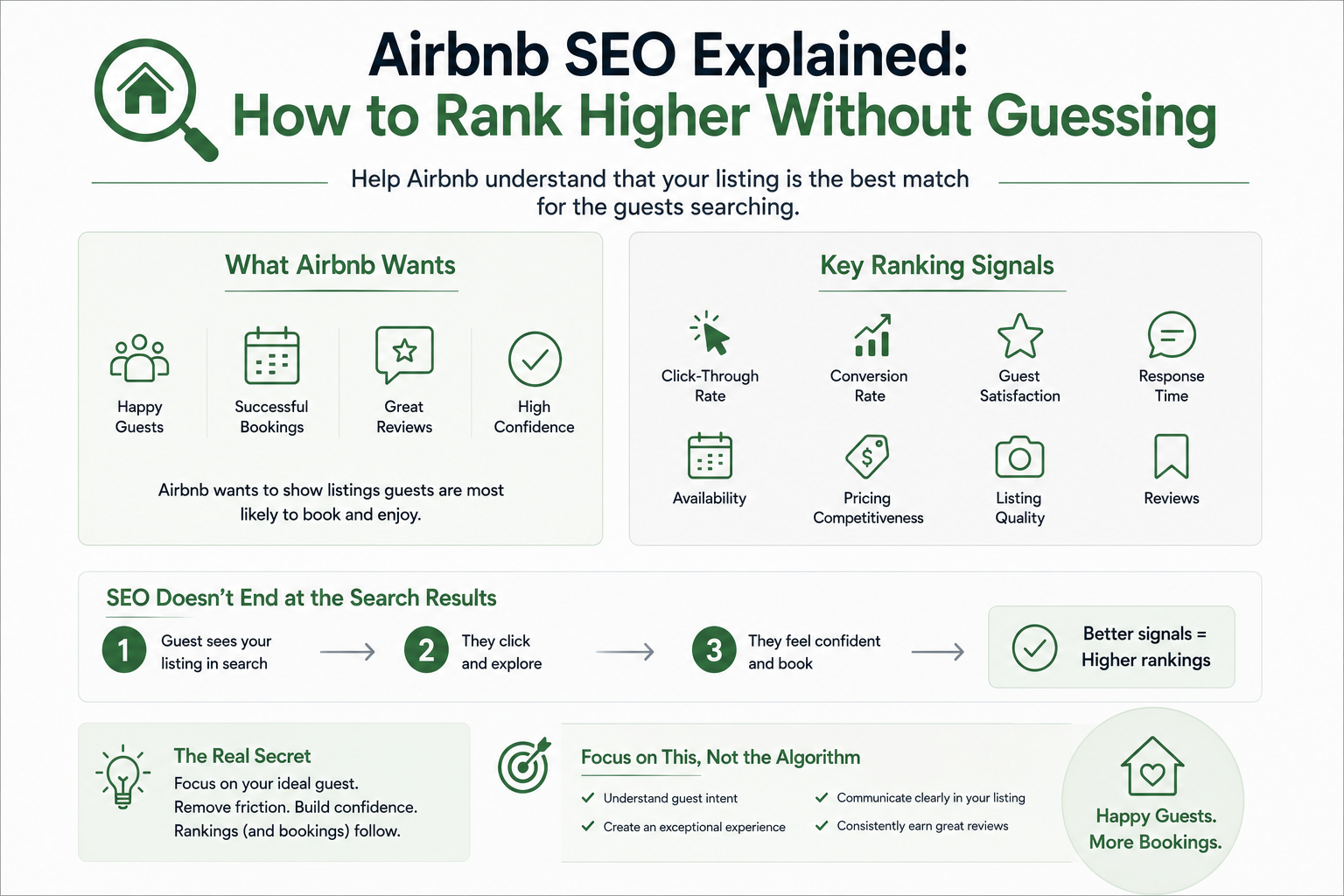 CornerstoneAirbnb SEO Explained: How to Rank Higher Without Guessing
Ranking higher on Airbnb isn't about tricks or hacks. It's about helping Airbnb understand that your listing is the best match for the guests searching.
5 min read CornerstoneWhy Is My Airbnb Listing Not Getting Bookings in 2026? How to Find the Real Problem
When Airbnb bookings slow down, lowering your price is not always the solution. Learn how to identify whether your listing has a visibility problem, a conversion problem, or a market-demand problem—and what to fix first.
12 min read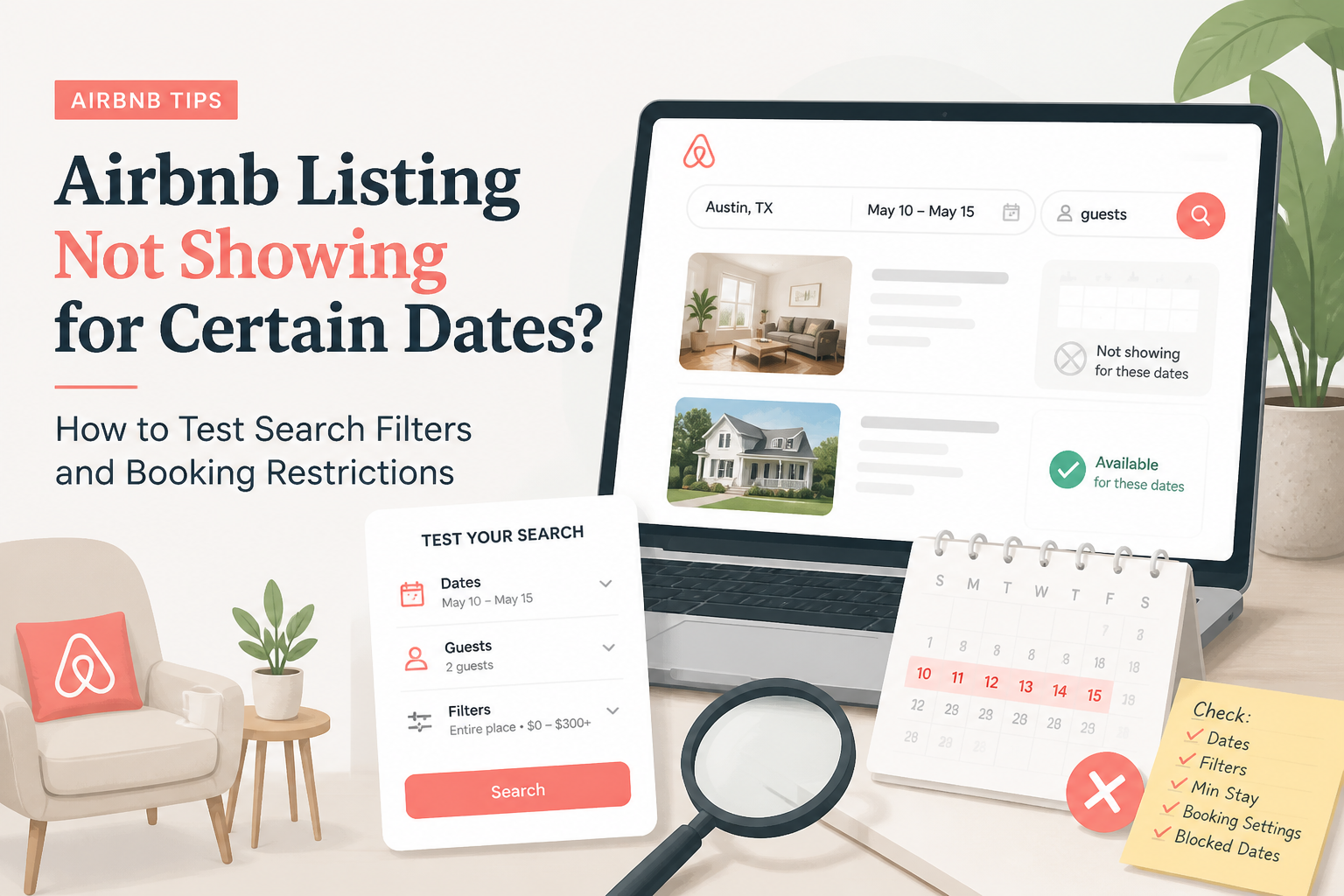 CornerstoneAirbnb Listing Not Showing for Certain Dates? How to Test Search Filters and Booking Restrictions
Your Airbnb appears for one set of dates but disappears for another. Learn how to test search criteria, minimum stays, guest counts, advance notice, booking windows, and calendar restrictions without guessing about your ranking.
22 min read