
Airbnb Views but No Bookings After a Price Increase? 9 Things to Check
Did your Airbnb bookings slow down after you raised your nightly rate? Learn how to compare listing views, conversion, total guest prices, and competing properties before deciding whether to lower your price.
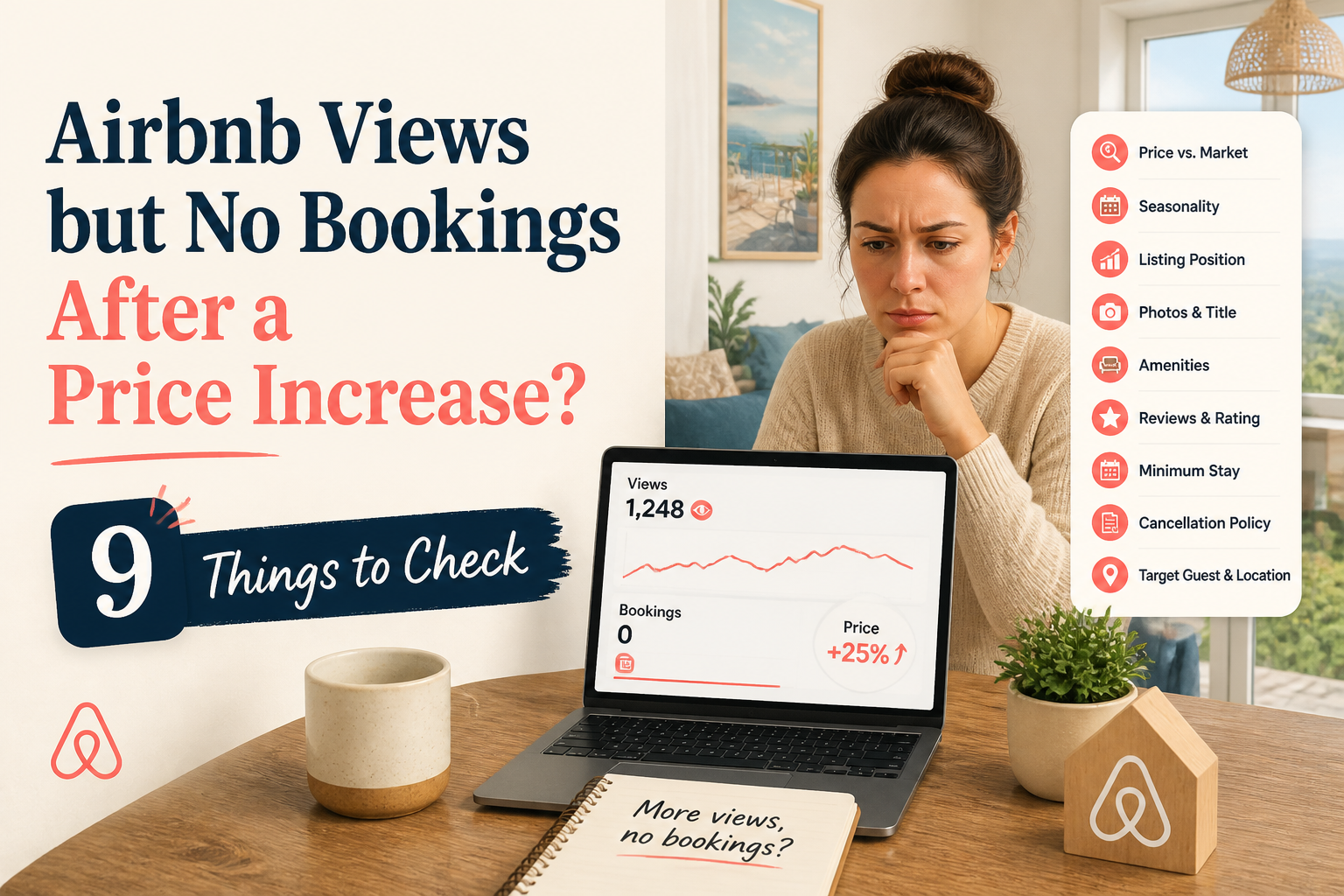
Your Airbnb listing is still getting views. Guests are opening the property, looking at your photographs, and reading the details. But since you raised your price, reservations have slowed down.
Does that mean your new price is too high? Possibly. But the booking decline alone doesn't prove it. Your total guest price may now be less competitive. A change in cleaning fees could make short stays disproportionately expensive. Or guests may be comparing your property with alternatives that communicate more value at a similar price.
There is another possibility: the timing is coincidental. Seasonal demand, booking lead times, available dates, and changes in competing properties can affect bookings even when you haven't changed anything. In The Airbnb Optimization Playbook, I explain why the first step in troubleshooting isn't to rewrite your title or lower your price.
It's to identify the actual bottleneck. I'm Elie Parienti, founder of SuperhostSEO. When I review an underperforming Airbnb listing, I want to distinguish three questions:
- Are guests finding the property?
- Are they opening the listing?
- Are they deciding to book?
If your views remain reasonably steady but bookings decline after a price increase, the most useful place to begin is the relationship between price, perceived value, and booking conversion. Here are nine checks I recommend before discounting.
1. Confirm That Your Booking Conversion Actually Declined
Start with Airbnb Insights rather than the feeling that your listing has become quieter. Airbnb's professional hosting tools provide conversion data showing how guests move through the search and booking process. According to Airbnb's official conversion reporting guide, the relevant stages include search impressions, search-to-listing conversion, and listing-to-booking conversion.
Those stages are important because they represent different questions:
- Search impressions: Is your property appearing in relevant results?
- Search-to-listing conversion: Are guests interested enough to open the listing?
- Listing-to-booking conversion: Are guests proceeding from the listing toward a reservation?
If your impressions and listing views remain steady but listing-to-booking conversion declines, the problem may involve what guests encounter after opening the property. That could include the price.
It could also involve reviews, booking conditions, or unclear information.
Use a meaningful comparison period
Suppose your listing received 300 views during one 30-day period and 290 during the next. That suggests the number of listing visits stayed relatively similar. Now imagine reservations fell from six to three.
That is worth investigating. But there are limitations. Bookings may be made after several visits, and the guests viewing your listing during one period aren't necessarily the people booking during that same period.
Airbnb's official conversion calculations use their own reporting definitions. A manually calculated bookings-to-views ratio is not necessarily identical to Airbnb's conversion metric. For this reason, I recommend using Airbnb's reported conversion data rather than treating a simple ratio as definitive proof.
What I look for first
I want to know whether the change is consistent enough to deserve attention. A few quiet days aren't enough. One fewer booking in a small sample may create a dramatic percentage change without establishing a meaningful trend.
Compare appropriate time periods, consider seasonal patterns, and look at any available similar-listing data. If conversion appears to have weakened, move to the next check.
2. Find Out What Actually Changed in Your Price
When a host says, "I raised my nightly rate," I want to know exactly what changed. Did you adjust the base price? Did you add a weekend premium?
Did you change individual dates? Did a discount expire? Did you increase the cleaning fee?
Are you using automated pricing software that may have made additional adjustments? These changes affect the guest-facing price in different ways.
Example: The nightly rate isn't the whole price
Imagine a hypothetical vacation rental. Before the change:
- Nightly rate: $180
- Two-night subtotal: $360
- Cleaning fee: $100
After the change:
- Nightly rate: $220
- Two-night subtotal: $440
- Cleaning fee: $140
Before Airbnb service fees and applicable taxes, the two-night cost has increased from $460 to $580. That's a $120 difference for the same stay. The host may be thinking about a $40 increase per night.
The guest is evaluating the total cost of the reservation. Airbnb explains that the guest's total price can include nightly rates, additional host fees, Airbnb service fees, and applicable taxes. See Airbnb's guide to how pricing works.
What to check
Open your Airbnb calendar and review the current price settings. Look for changes to:
- Base nightly price
- Weekend pricing
- Date-specific overrides
- Cleaning fees
- Extra guest fees
- Pet fees
- Weekly and monthly discounts
- Promotions
- Automated pricing settings, if applicable
Also check whether any special rules apply to the dates you're investigating. An unintended pricing change can affect competitiveness without being obvious from the standard nightly rate.
3. Compare the Total Price for the Same Dates and Guest Count
This is one of the most important checks. A host may believe their property costs $220 per night. But prospective guests don't evaluate every listing using the same length of stay.
A couple might search for two nights. A family may want five. Another guest may book an entire week.
The relative impact of fees changes depending on the reservation.
Don't compare different trips
Suppose you're evaluating a three-bedroom vacation home. You search for your property for a two-night weekend. Then you compare it with another property using a five-night weekday stay.
Those aren't equivalent comparisons. To evaluate competitiveness, use:
- The same check-in and checkout dates
- The same guest count
- A similar location
- Comparable sleeping capacity
- Similar property quality
- Relevant amenities
- The complete guest-facing price
Airbnb has a guest-price preview feature that helps hosts understand what travelers pay. Use it to examine representative reservations.
Compare more than one stay length
For example, check:
Two-night weekend stay
This reveals whether your price and fees make shorter visits expensive relative to alternatives.
Four-night stay
This may reflect a typical family or leisure booking.
Seven-night stay
This helps you assess the combined effect of nightly pricing and longer-stay discounts. You may discover that your property is competitive for week-long reservations but expensive for weekend travelers. That suggests a different adjustment than simply lowering every nightly rate.
An important distinction
A higher total price isn't automatically a problem. Your property may genuinely offer more. The question is whether the differences justify the cost to the guests you're trying to attract.
4. Check Whether Similar Properties Offer Better Perceived Value
In Chapter 12 of The Airbnb Optimization Playbook, I emphasize that pricing needs to reflect the market and the value a property communicates. A host may have an excellent reason for charging more. Perhaps the accommodation has a private pool, better furnishings, additional bathrooms, or off-street parking.
But if those features aren't obvious in the listing, prospective guests may not recognize the difference.
Example: Two similar vacation homes
Imagine two fictional homes available for the same weekend. Both sleep six guests. Both have strong reviews.
Both are located in the same general area.
Property A
- Total price: $900
- Private swimming pool
- Fenced backyard
- Three bedrooms
- Two parking spaces
Property B
- Total price: $780
- Shared swimming pool
- Three bedrooms
- Street parking
Property A costs more. But it also offers several meaningful advantages. That price difference may be justified for a family that values privacy and convenient parking.
However, imagine Property A's listing leads with photographs of decorative objects and uses the title "Beautiful Home in Great Location." The private pool and fenced yard barely appear in the opening gallery. Now the guest may struggle to understand why Property A costs more.
The price may not be the only issue. The listing may be failing to communicate the value behind the price.
What to investigate
Compare your property against several relevant alternatives. Don't focus only on the cheapest competitor. Instead, examine what each property offers and how clearly those benefits are presented.
Ask:
- What genuine advantages support my price?
- Are those advantages visible in the opening photographs?
- Does my summary explain them?
- Are important amenities selected correctly?
- Does the description help guests understand the accommodation?
If your property has distinctive benefits but fails to communicate them, a targeted listing improvement may be more appropriate than an immediate discount.
5. Review Your Cover Photo and First Five Images
This is where pricing and listing optimization overlap. When a guest is comparing properties, photographs help shape expectations about the experience. A higher price may require stronger evidence of value.
But better evidence doesn't mean exaggeration. It means showing the property's actual advantages clearly.
Example: An underrepresented outdoor area
Suppose your listing has a remarkable private terrace. Your nightly price is above the local average. But your cover photograph shows a standard living room.
The terrace appears at photo number eighteen. Guests may open your listing expecting something similar to cheaper nearby apartments. They won't necessarily recognize the terrace as a differentiator.
A better opening gallery might include:
- Private terrace
- Main living area
- Kitchen and dining
- Primary bedroom
- Outdoor seating and view
The property hasn't changed. The first impression has become more informative.
What I would avoid
I wouldn't automatically reorder the photographs every time conversion weakens. If your existing gallery already highlights the best features accurately, the problem may lie elsewhere. I also wouldn't use exaggerated or digitally misleading images to make a property appear more expensive than it is.
The objective is to communicate genuine value. For a more detailed approach, read What Should Your First Five Airbnb Photos Show?.
6. Investigate Whether Booking Restrictions Changed Too
Pricing and availability are connected. Sometimes a host raises prices for a busy period and adjusts booking rules at the same time. Later, reservations decline.
The host assumes the higher rate caused the problem. But the new minimum stay may be excluding relevant trips.
Example: A three-night minimum
Imagine your property is available from Friday through Sunday. You have two open nights. But your minimum stay is three nights.
A guest searching for that weekend cannot book those dates under the current restriction. This is an availability problem, not necessarily a price-conversion problem.
Review the complete booking setup
Check:
- Minimum and maximum nights
- Check-in and checkout restrictions
- Booking window
- Advance notice
- Preparation time
- Calendar synchronization
- Date-specific rules
You may find that the price change happened alongside a change in booking eligibility. Correcting the restriction may be more appropriate than reducing the rate. Of course, some restrictions are necessary.
A property with expensive turnovers may not be profitable for one-night stays. The objective is to match availability rules with your operating requirements and guest demand. If your calendar looks open but guests cannot reserve it, see my guide to Airbnb dates that appear available but can't be booked.
7. Look for Recent Guest Feedback That Could Affect Conversion
A price increase may make guests evaluate the property more critically. But before assuming the higher price is responsible, review your recent guest feedback. Has anything changed in the reviews?
Do guests repeatedly mention:
- Noise
- Cleanliness
- Parking
- Sleeping comfort
- Outdated furniture
- Difficult check-in
- Missing amenities
- Property accuracy
A recurring concern may influence prospective guests who are already comparing several properties. For example, imagine the property has a premium nightly rate but several reviews mention weak Wi-Fi. That could matter to guests planning to work remotely.
Or perhaps the listing emphasizes tranquility while recent reviews mention nearby construction. The right solution might involve fixing the operational issue, clarifying expectations, or both.
Don't rewrite reality
A listing rewrite cannot repair unreliable Wi-Fi. It cannot remove genuine street noise. And it shouldn't hide important limitations.
The purpose of optimization is to align what the listing communicates with what guests will actually experience.
Where Guest Intent Optimization helps
This is one reason I developed SuperhostSEO Guest Intent Optimization. The analysis examines how your photographs, descriptions, amenities, and available reviews work together. It can identify possible mismatches and recommend areas to investigate.
It cannot determine exactly why individual visitors decided not to book. But it can provide useful hypotheses when your listing appears complete and conversion remains disappointing.
8. Check Whether the Market Changed at the Same Time
Sometimes the price increase isn't the main story. Imagine you raised rates after a strong summer. Then autumn arrived.
Demand declined. Your listing continued receiving some views, but bookings slowed. You might conclude that the higher price damaged conversion.
Yet competing properties may be experiencing the same seasonal slowdown.
What to review
Compare the current period with:
- Similar dates last year, where data is available
- The previous relevant booking period
- Comparable properties
- Local event schedules
- Seasonal demand patterns
- Booking lead times
If your market typically receives reservations two months in advance, a quiet week may not tell you much about a weekend six months away. Similarly, if demand has declined across the market, lowering your rate may or may not be justified. Airbnb's pricing guidance recommends reviewing comparable properties and considering both booked and unbooked listings when evaluating competitiveness.
See Airbnb's pricing tools guide.
Don't mistake a coincidence for a cause
If bookings fell after you raised prices, the sequence is worth investigating. But timing alone doesn't establish causation. Check the surrounding conditions before deciding that the price increase failed.
9. Decide Whether to Lower the Price, Improve the Listing, or Wait
After completing the first eight checks, you'll have a better understanding of the situation. Now you need to choose an action. There are three common possibilities.
Situation A: Your Total Price Is Clearly Uncompetitive
You've compared relevant properties. Your listing is more expensive. You cannot identify enough meaningful differences to justify that premium.
And conversion has weakened over a useful observation period. A targeted pricing adjustment may be appropriate. That might mean reviewing specific dates, weekend premiums, or fees rather than lowering every night.
The objective is to remain competitive without sacrificing profitability unnecessarily.
Situation B: Your Price May Be Justified, but Your Listing Doesn't Explain Why
Your property has real advantages. But the title, photographs, or descriptions don't communicate those advantages clearly. In this case, I would investigate the listing presentation before assuming a broad discount is necessary.
You might need to:
- Highlight the best amenity earlier
- Reorganize the opening gallery
- Clarify the sleeping arrangements
- Improve the short summary
- Complete missing amenity information
- Explain private versus shared spaces
These changes should be based on actual weaknesses, not cosmetic preferences.
Situation C: The Data Is Too Limited to Draw a Conclusion
You raised the price five days ago. Your listing has received twenty views. No bookings have arrived yet.
That is not enough evidence to confidently diagnose a failed pricing strategy. Unless you've discovered an obvious error or a genuinely uncompetitive price, continuing to monitor the results may be more useful than making another major change immediately. In The Airbnb Optimization Playbook, I recommend addressing identifiable problems rather than responding emotionally to every short-term fluctuation.
This is especially important when several market factors are changing simultaneously.
A Practical 20-Minute Check Before Lowering Your Airbnb Price
Here's the process I recommend if you're concerned that a recent price increase has reduced bookings.
First Five Minutes: Review the Performance Data
Open Airbnb Insights. Compare listing views and conversion trends over appropriate periods. Confirm whether the concern is mainly fewer listing visits, weaker booking conversion, or both.
Minutes 6–10: Preview the Guest Price
Check representative dates and lengths of stay. Look at the total guest-facing cost, including relevant fees. Review any changes to discounts, cleaning fees, weekend rates, and calendar overrides.
Minutes 11–15: Compare Similar Properties
Look at several genuinely comparable accommodations. Use matching dates and guest counts. Assess both total price and the features each listing offers.
Minutes 16–20: Review Listing Value and Restrictions
Open your public listing. Ask whether the opening photographs, title, and summary clearly communicate why the accommodation is worth its price. Check minimum stays and availability settings.
Then choose the most important issue to investigate. Don't change five things at once unless you're correcting clear inaccuracies.
How SuperhostSEO Can Help You Decide What to Fix
A pricing tool can help evaluate nightly rates. But it doesn't automatically solve a weak description or unclear property presentation. This is why I separate price analysis from listing optimization.
Start With the Free Listing Audit
The SuperhostSEO Free Airbnb Listing Audit evaluates your live listing across nine weighted categories. It examines areas such as:
- Title
- Short summary
- Main property description
- Photo order
- Photos
- Amenities
- Guest Access
- Listing completeness
You'll receive an overall score and prioritized recommendations. The first audit is free. This is a structural analysis, not a guarantee of higher conversion.
It also cannot inspect every private pricing or calendar setting inside Airbnb.
Use Guest Intent Optimization for Potential Booking Hesitation
If the listing is structurally complete, but you're concerned that its presentation may be creating uncertainty, use Guest Intent Optimization. It examines the relationship between content, photographs, amenities, and guest reviews. This can help you evaluate whether the listing communicates the experience and value you're asking guests to pay for.
Prefer Personal Help?
I also offer professional Airbnb listing optimization services. If you'd rather have me personally review your listing or prepare a more complete optimization, you can explore my services at SuperhostSEO.com/services.
My recommendation remains the same regardless of which approach you choose. Diagnose the actual weakness before spending time or money fixing something else.
Frequently Asked Questions
Why did my Airbnb bookings drop after I raised my price?
A higher guest-facing price may make your property less competitive, but the decline could also reflect seasonal demand, competing listings, booking restrictions, or other changes. Compare conversion trends, total prices, and availability before deciding on the cause.
Can my Airbnb get views but no bookings because the price is too high?
Yes. Guests may open your listing but choose a comparable property offering better perceived value. However, listing views without bookings don't prove that price is the only issue.
Should I lower my Airbnb price immediately if bookings stop?
Not necessarily. Review your total guest price, comparable listings, booking conditions, and available conversion data first. A targeted price adjustment may be appropriate, but an automatic discount isn't always the best response.
Does Airbnb consider total price in search ranking?
Yes. Airbnb states that price competitiveness is one of the important factors in search results and considers total pricing relative to comparable listings for relevant dates.
Can cleaning fees hurt Airbnb booking conversion?
A cleaning fee contributes to the total guest-facing price. A high fixed fee can have a greater proportional impact on shorter reservations. Compare complete stay costs rather than only nightly rates.
How do I know whether my Airbnb price is competitive?
Compare properties with similar location, capacity, quality, amenities, and reviews using the same dates and guest count. Check the total guest-facing price and consider what genuinely differentiates your accommodation.
Could my Airbnb listing description affect whether guests accept a higher price?
Potentially. A clear description can help guests understand valuable features that justify the property's price. However, better wording cannot guarantee reservations or compensate for a genuinely uncompetitive rate.
What if my Airbnb views are stable but conversion is falling?
Review total price, recent reviews, photographs, descriptions, availability, and booking conditions. Use Airbnb's official conversion reporting when available, and avoid drawing conclusions from very small samples.
Can AI tell me whether I should lower my Airbnb price?
AI can help review available information and identify possible weaknesses, but reliable pricing decisions require market comparisons, operating costs, booking pace, and other data. A public listing audit alone cannot determine the financially optimal nightly rate.
Should I run an Airbnb audit before changing prices?
A listing audit is useful when you're not sure whether the property's presentation is communicating its real value. It won't replace pricing analysis, but it can help identify missing or unclear information before you decide that discounting is the only solution.
Final Thoughts: Don't Confuse a Booking Slowdown With a Pricing Mistake
When bookings slow down immediately after a price increase, it's natural to assume the two events are connected. Sometimes they are. But a proper diagnosis requires more than timing.
You need to understand what changed in the total guest price, how your listing compares with relevant alternatives, whether booking settings are limiting reservations, and whether the property's presentation supports its current positioning. In The Airbnb Optimization Playbook, I emphasize that a good hosting decision begins with identifying the problem.
Not guessing. Not panicking. And not changing everything at once.
If your price is genuinely uncompetitive, address it. If your listing isn't communicating its value, improve the presentation. If the evidence is inconclusive, monitor the trend until you can make a more informed decision.
Before lowering your Airbnb rate, find out whether your listing has weaknesses you can actually fix. Run Your Free Airbnb Listing Audit at SuperhostSEO. Review your score, examine the recommendations, and decide what deserves attention first.
If you prefer a personalized expert review, you can also work with me directly. The goal isn't to charge the highest possible price or achieve the highest possible occupancy. It's to build a listing that accurately communicates its value and supports sustainable bookings.
Written by Elie Parienti, founder of SuperhostSEO and author of The Airbnb Optimization Playbook, The Airbnb Tools Playbook, The Airbnb Hosting Decisions Playbook, and The Airbnb Direct Booking Playbook. This article draws primarily on the Airbnb Insights, Pricing Optimization, and Troubleshooting chapters of The Airbnb Optimization Playbook. All numerical property examples are illustrative rather than reported client results.
Further Reading
- Airbnb: Understanding Performance Data for Conversion
- Airbnb: How Search Results Work
- Airbnb: How Pricing Works for Homes
- Airbnb: Preview What Guests Pay
- Airbnb: Understanding Pricing
- Why Your Airbnb Listing Gets Views but Not Bookings
- Should You Lower Airbnb Prices When Bookings Slow Down?
- Free Airbnb Listing Audit
- Professional Airbnb Listing Optimization Services
Airbnb optimization specialist, Superhost, and founder of one of the largest Airbnb host communities.
Continue Reading
Chosen for you from The Optimization Journal.
 CornerstoneAirbnb Ranking Dropped After You Edited Your Listing: What to Check Before Reverting Changes
Did your Airbnb search visibility decline after changing your title, photos, description, or settings? Learn how to identify which edit may have mattered, distinguish lower views from lower rankings, and decide when to revert a change.
22 min read CornerstoneAirbnb Listing Not Showing for Certain Dates? How to Test Search Filters and Booking Restrictions
Your Airbnb appears for one set of dates but disappears for another. Learn how to test search criteria, minimum stays, guest counts, advance notice, booking windows, and calendar restrictions without guessing about your ranking.
22 min read CornerstoneWhy Is My Airbnb Listing Not Getting Bookings in 2026? How to Find the Real Problem
When Airbnb bookings slow down, lowering your price is not always the solution. Learn how to identify whether your listing has a visibility problem, a conversion problem, or a market-demand problem—and what to fix first.
12 min read CornerstoneAirbnb Search Ranking Dropped Suddenly? How to Find Out What Changed
Did your Airbnb listing suddenly lose views or search visibility? Learn how to diagnose ranking changes, check availability and pricing, compare market conditions, and identify what to fix before rewriting your listing.
19 min read CornerstoneWhy Is My Airbnb Listing Not Showing Up in Search? 9 Things to Check
Can't find your Airbnb listing in search results? It may not be an algorithm problem. Learn how to check listing status, blocked dates, minimum stays, booking restrictions, amenities, and visibility before making unnecessary changes.
18 min read