
Airbnb vs. Vrbo for Hosts in 2026: Which Platform Fits Your Property and Profits?
Airbnb or Vrbo—which is better for your vacation rental? Compare the October 2026 host-fee changes, property eligibility, guest fit, search visibility, calendar syncing, and real payout math before choosing one platform or both.
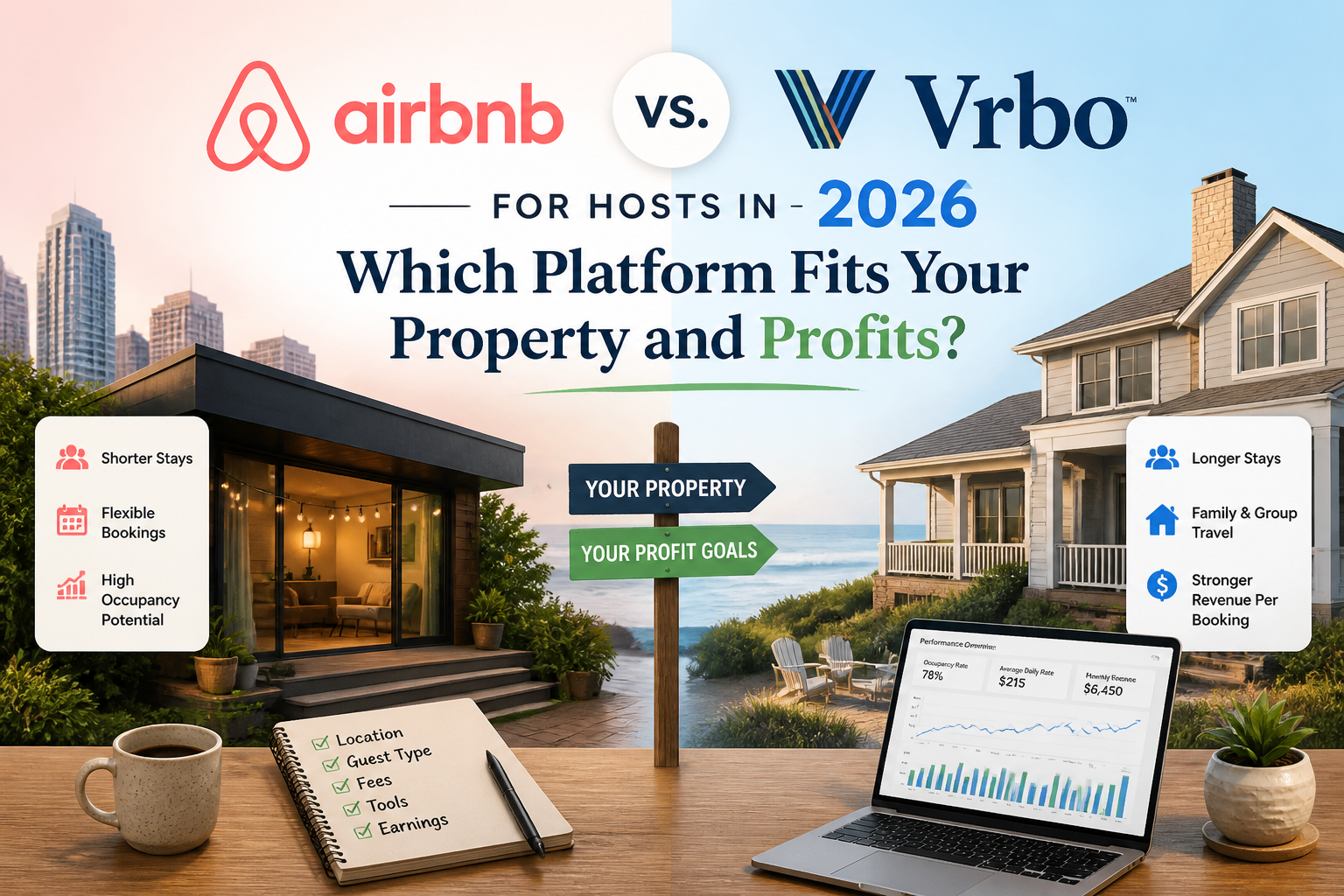
Is Airbnb or Vrbo better for hosts? For a private room or shared accommodation, Airbnb is usually the relevant choice because Vrbo focuses on private, whole-property rentals. For a cabin, beach house, vacation villa, or whole family home, both platforms may be worth testing. The best channel depends on your property, market, booking demand, total guest price, operating costs, and what you actually keep after fees.
And there is a significant pricing change hosts need to know about before comparing the two.
Beginning October 29, 2026, Vrbo is moving most hosts to a 12% commission, including payment processing for hosts paid through Vrbo. Previously, standard pay-per-booking hosts generally paid about 8% in combined commission and processing, while many software-connected hosts paid a 5% Vrbo commission plus their own payment-processing costs. Regional rates and payment arrangements differ, so check your dashboard. Vrbo explains its new fee structure here.
Airbnb, meanwhile, says most hosts are moving to a 15.5% single service fee deducted from the host payout, with regional exceptions. Its official fee guide explains the transition.
I'm Elie Parienti, founder of SuperhostSEO and author of The Airbnb Hosting Decisions Playbook and The Airbnb Direct Booking Playbook. When I asked hosts in my community whether they relied on Airbnb, Vrbo, other platforms, or their own sites, the answers were far from unanimous. Some did most of their business on Airbnb. Others relied heavily on Vrbo. Several used multiple channels deliberately to reduce dependence on any one company.
The lesson wasn't that one platform wins. It was that a host should measure what each platform contributes. Here's how I would make that decision in 2026.
1. First, Check Whether Your Property Fits Each Platform
Airbnb supports a broad range of accommodation types, including entire places and certain private or shared rooms, subject to applicable policies. Vrbo is more narrowly focused on private vacation rentals, and its shared-spaces policy generally does not allow accommodation where guests share living spaces with a host or unrelated parties.
That makes eligibility the first filter, not an afterthought.
Private Room or Shared Accommodation
If you rent a private bedroom inside your occupied home, don't assume you can simply copy the Airbnb listing onto Vrbo. Check Vrbo's private-space requirements first. Airbnb is generally the more relevant platform for that accommodation type.
Entire Apartment, Cabin, or Tiny Home
A self-contained property can potentially fit both marketplaces. But whole-property eligibility doesn't establish demand. A tiny home popular with couples may perform differently from a large vacation house, even within the same destination.
Beach House, Vacation Villa, or Large Family Home
These are natural candidates to evaluate on both platforms, provided they meet the relevant listing rules. Guests may compare whole-home accommodations for family vacations, longer weekends, and group trips. I would test actual local demand rather than promise that Vrbo always produces more family bookings.
The property type gives you a sensible starting hypothesis. Only real inquiries, booking pace, and net revenue can confirm which channel works better for your specific home.
2. Compare the New Airbnb and Vrbo Host Fees Correctly
The old shorthand—"Vrbo charges 5% plus 3%, Airbnb charges more"—is no longer suitable for a guide published in late 2026.
Airbnb's 2026 Host Fee
Airbnb says it is transitioning home hosts from a split fee to a single host-paid service fee. Most hosts pay 15.5% under that structure, while some pay a different rate; Airbnb currently identifies 16% for listings in Brazil and Mexico. Existing reservations made before a host's migration retain their original fee treatment.
The fee generally applies to the nightly price and host-added fees, excluding applicable taxes. Confirm your own rate in the earnings dashboard. See Airbnb's official explanation.
Vrbo's October 29, 2026 Fee Increase
Vrbo announced a 12% commission for most hosts beginning October 29, 2026. Its updated guidance describes that as an all-in rate including processing when Vrbo processes guest payments. It applies to rental charges and additional host fees such as cleaning and pet charges. Some regions and software arrangements have different effective costs, and hosts processing their own payments may incur separate processor fees.
For standard pay-per-booking hosts, the earlier structure was generally a 5% commission plus a 3% processing fee. Many software-connected hosts previously had a 5% commission, with their processor costs handled separately. Vrbo's fee documentation now reflects the 12% model; Skift reported the change and its October 29 effective date.
As of this article's October 2026 writing date, October 29 is still ahead. Check which bookings and dates fall under your account's transition rules and verify the rate in your owner dashboard.
A $1,000 Booking: What Does the Host Keep?
Consider a hypothetical $1,000 booking subtotal consisting of the nightly rate plus required host fees, before taxes. Assume the standard percentage applies without additional regional taxes or external payment charges.
- Airbnb at 15.5%: $155 platform fee; $845 remaining before operating expenses.
- Vrbo at the new 12%: $120 commission; $880 remaining before operating expenses.
- Difference: $35 more remains with the host on Vrbo at the same $1,000 host-set booking subtotal.
This example does not mean the traveler pays the same $1,000 on both sites. Vrbo still charges a variable traveler service fee on many reservations. Airbnb's single-fee arrangement generally incorporates its platform fee into the host-set price instead of adding a separate guest service fee under that structure. Taxes and other applicable charges also affect the traveler total.
A fair comparison therefore needs two separate numbers: the host's net payout and the guest's final checkout price.
What Changed in the Host's Economics?
Using a simplified $1,000 subtotal:
- Under Vrbo's older approximately 8% standard pay-per-booking cost, the host would retain about $920, subject to fee-base details.
- Under Vrbo's new 12% rate, the host retains about $880.
- That's about $40 less per $1,000 booking before considering other costs.
For a software-connected host whose old Vrbo commission was 5%, the commission difference is $70 per $1,000 booking, before accounting for their own processing arrangements.
To maintain the same simplified payout when moving from 8% to 12%, the host-set subtotal would need to rise about 4.55%. Moving from 5% to 12% would require about 7.95%, before any separate processing costs. That is a mathematical equivalence, not a recommendation to raise prices. A price increase may reduce competitiveness or demand.
3. Don't Forget Vrbo's Traveler Service Fee
This is where fee comparisons often become misleading.
Vrbo's traveler service fee guidance says the amount can vary by reservation. The fee is part of what travelers see in the total price, even though it isn't simply deducted from your host payout.
Suppose you set a $1,000 subtotal on both platforms. Under the simplified host-fee example, Vrbo leaves you with $35 more than Airbnb. But the guest may see a different total at checkout because Vrbo's separate traveler fee is added, while Airbnb's host-only structure works differently.
You cannot conclude which listing is more competitive from the host commission alone.
Compare the Same Stay on Both Platforms
Preview an actual booking with:
- The same arrival and departure dates
- The same number of adults, children, and pets
- The same sleeping arrangements and access
- Every mandatory fee and applicable tax
- Any discounts, promotions, or special pricing
Record final guest price, expected host payout, and net contribution after cleaning and other costs. Recheck after the October 29 change takes effect for the bookings subject to the new Vrbo rate.
4. Which Platform Fits Cabins, Beach Houses, Tiny Homes, and Large Groups?
I would not assign a universal winner to each type of property. Instead, I'd use property type to decide what to test.
Cabins
For a self-contained cabin, examine which channel delivers suitable stays at sustainable rates. Highlight genuine benefits such as a private hot tub, fireplace, outdoor access, or scenic views. Check whether guests typically book short weekends or longer holidays in your market.
Beach Houses
Beach properties can have strong seasonal booking patterns and, in some markets, guests planning well in advance. Test both channels with the same dates and total guest prices. A large beach house may benefit from broader distribution, but you should measure it rather than assume it.
Tiny Homes
A self-contained tiny home may be eligible for both platforms. Practical information is particularly important: bed dimensions, stairs or ladders, kitchen facilities, bathroom layout, parking, and privacy. Don't rely on the novelty of the property alone to overcome unanswered questions.
Homes for Eight or More Guests
Large-group properties require clarity about sleeping arrangements, bathrooms, parking, dining space, and any limits on gatherings. A guest searching for a home that sleeps twelve needs to understand where twelve people actually sleep—not just see an attractive living room photograph.
For every category, the meaningful measurement is whether a platform brings incremental, profitable bookings that fit your operating model.
5. What My Host Community Taught Me About One Platform Versus Many
Chapter 26 of The Airbnb Hosting Decisions Playbook asks whether hosts list only on Airbnb or also use Vrbo, Booking.com, and direct sites.
The responses varied substantially. One beach-house host reported that Airbnb supplied roughly 80% of bookings despite being on other channels. Another host managing multiple properties said that some homes performed almost entirely on Airbnb while others attracted bookings from more than one platform. Another participant reported receiving the overwhelming majority of bookings through Vrbo.
Those are individual host accounts, not a statistically representative survey proving average booking shares. I wouldn't use them to claim that Vrbo guests everywhere book earlier, spend more, or stay longer.
What they do demonstrate is that two properties—even under the same manager—can produce very different channel mixes.
The Real Choice Is Simplicity Versus Concentration Risk
One platform means fewer systems to manage. There is less calendar coordination and a simpler communication process. But a policy change, visibility decline, or account issue could affect most or all of your booking pipeline.
Two platforms create another potential source of demand and reduce reliance on any single marketplace. In exchange, you must manage prices, calendars, policies, messages, payouts, and guest expectations consistently.
In my Direct Booking Playbook, I make a related point: marketplaces provide discovery, while a host-owned booking presence can help build a repeat-guest relationship. These approaches can complement each other; they don't have to be treated as mutually exclusive.
6. Listing on Both Platforms? Prevent Double Bookings First
Adding Vrbo to a working Airbnb listing is not simply a matter of copying the description and opening the calendar.
If both marketplaces can sell the same dates, you need a reliable availability process before accepting live bookings.
Calendar Synchronization
Vrbo supports importing and exporting iCal calendars for eligible dashboard-managed properties. Its official calendar synchronization guide describes the setup and notes that syncing isn't necessarily instantaneous.
When you use a supported property management system, availability may instead be managed through that integration. Check its configuration and actual synchronization behavior.
Test the Process, Don't Assume It Works
Before opening the second listing fully, verify that:
- A booked night on one platform becomes blocked on the other.
- Manual owner blocks transfer as expected.
- Minimum stays and check-in restrictions are configured on both.
- Rates, cleaning fees, taxes, and discounts are correct on each platform.
- Your team knows which system is the source of truth.
A calendar feed can reduce risk, but you should not assume that it guarantees real-time prevention of every conflicting reservation.
Don't Copy Cancellation Policies Blindly
Each marketplace has its own policies, payment flow, and guest communication rules. A phrase that describes your Airbnb reservation process may be incorrect on Vrbo.
Review the actual settings on each platform and write descriptions that accurately reflect what the guest can book.
7. Airbnb SEO and Vrbo Search Optimization Aren't the Same Editor
This is where SuperhostSEO's listing work becomes relevant.
The property itself should be represented consistently, but the two listings don't need identical text.
Airbnb and Vrbo organize listing information differently. The important fields and the way they appear to guests are not always interchangeable.
Vrbo's ranking metrics guidance identifies property views, search appearances, bookings, and competing properties as useful data. It recommends accurate listing content, strong photographs, competitive rates, and relevant amenities. Airbnb publishes its own search-ranking explanation, with factors including price, quality, popularity, availability, and guest preferences.
Neither platform provides a public formula that guarantees a higher search position after changing a title.
Rewrite for the Field, Not Just the Brand
On Vrbo, I pay particular attention to the headline, property description, photographs, amenities, and the "You need to know" information that helps guests understand restrictions and practical details.
For Airbnb, I also review the short summary, The Space, Guest Access, photo order, and other structured sections. A direct copy-and-paste can leave important fields underused or information poorly organized.
For example, a large vacation home should clearly explain its six sleeping spaces, four bathrooms, parking capacity, dining arrangements, and whether the pool is private. That information matters on both platforms, but the best place to present it may differ.
Read my guide to optimizing a Vrbo listing without copying the Airbnb version.
8. Run a 60-Day Test Before Declaring a Winner
If your property is eligible for both platforms and you can manage the operational complexity, consider a measured test instead of assuming the second listing will succeed immediately.
Sixty days is an illustrative initial review window, not a universal benchmark. Seasonal properties and long-booking-lead markets may need substantially more time.
Track Five Measurements
For each platform, record:
- Inquiry and booking volume: How many suitable reservations does the channel actually generate?
- Booking lead time: How far ahead are guests booking?
- Average booked stay: Are you filling the dates you want to fill?
- Net contribution: What remains after host fees, cleaning, payment costs, and variable operating expenses?
- Incrementality: Did the second channel produce genuinely additional demand or mostly replace bookings you could have received elsewhere?
Example: More Bookings Doesn't Always Mean More Profit
Imagine Airbnb brings eight profitable reservations during a period, while Vrbo brings three. It would be premature to declare Airbnb better without examining stay length, guest price, cancellations, and the costs associated with each reservation.
A seven-night Vrbo booking may generate more contribution than several short reservations. Alternatively, those three bookings might be heavily discounted and consume peak nights that would have sold at a better rate elsewhere.
Compare net value, not just the count of reservations. And avoid drawing conclusions from an unusually small sample.
9. How to Decide: Airbnb Only, Vrbo Only, or Both
Choose Airbnb as Your Primary Channel When...
Your accommodation type fits Airbnb but not Vrbo's whole-property rules, or Airbnb is already producing most of the profitable bookings in your market and you don't yet have the capacity to manage another channel.
That doesn't mean Airbnb is universally cheaper or more effective. It means your current property and operating circumstances favor simplicity.
Test Vrbo Alongside Airbnb When...
You offer an eligible entire property, have capacity to manage synchronized availability, and want to test whether Vrbo brings additional profitable demand.
Cabins, family homes, beach houses, and vacation villas are sensible candidates for investigation. Confirm that Vrbo's new fee structure still leaves adequate margin, and compare the guest's final price before making pricing changes.
Consider a Direct Booking Channel When...
You have repeat guests, referrals, recognizable branding, or other demand you create yourself. A website or booking engine comes with its own operational, marketing, payment, and compliance responsibilities, so platform commission alone isn't the full calculation.
I explore that transition in The Airbnb Direct Booking Playbook. You don't have to abandon Airbnb or Vrbo to develop a direct-booking presence. However, a guest who discovers your property through Vrbo must complete their Vrbo-sourced reservation through Vrbo under its off-platform booking policy. Don't use platform messages to divert those bookings to your own checkout.
Start With a Separate Listing Audit for Each Platform
If you've decided to use both platforms, don't assume that a good Airbnb listing is automatically a good Vrbo listing.
At SuperhostSEO, I built a free Airbnb and Vrbo Listing Audit that accepts a listing link and evaluates the relevant platform's public content. For Vrbo, the audit focuses on areas such as headline, description, photos, amenities, and practical guest information. For Airbnb, it evaluates the fields and structure appropriate to Airbnb.
The score is an independent content and presentation assessment. It is not an official platform ranking score, and it cannot tell you which marketplace will generate more revenue.
When to Use the Audit
Run separate audits if:
- Your Airbnb listing performs well but the Vrbo version receives little attention.
- You copied the Airbnb description directly into Vrbo.
- Your photographs, amenities, or capacity details disagree between channels.
- You are considering paid listing optimization and want to identify the biggest weaknesses first.
The audit can help you improve what guests see. It doesn't replace comparing fees, calendars, and net payouts.
If you'd rather have me personally review your listing strategy or prepare optimization work, you can contact me through SuperhostSEO's services page.
Frequently Asked Questions
Is Vrbo cheaper for hosts than Airbnb in 2026?
Under the common new fee structures, Vrbo's 12% host commission beginning October 29 is lower than Airbnb's 15.5% host-paid single fee. But some hosts have different rates, external processing costs may apply, and Vrbo's separate traveler service fee changes the total price comparison. Check both your payout and the guest's checkout total.
Did Vrbo raise its commission to 12%?
Yes. Vrbo announced a shift to a 12% commission for most hosts effective October 29, 2026. The updated Vrbo fee guide says payment processing is included for hosts paid through Vrbo. Regional exceptions apply.
Does Vrbo still charge guests a service fee?
Yes. Vrbo's official documentation describes a variable traveler service fee. The existence of that separate guest charge means a 12% host commission should not be directly compared with Airbnb's host-only fee as if guests pay the same final price.
Is Vrbo better for beach houses or large family homes?
It may be worth testing because these are private whole-property rentals, but there is no universal guarantee that Vrbo will outperform Airbnb. Compare local demand, booking lead times, net contribution, and total traveler price.
Can I list a private room on Vrbo?
Vrbo focuses on private, whole-property accommodation and generally prohibits shared-space rentals. Review its current eligibility and shared-spaces policy before attempting to list a room or shared accommodation.
Should I list the same vacation home on Airbnb and Vrbo?
It can reduce reliance on a single booking channel and expose the property to additional demand. However, you must manage availability, pricing, policies, and communication consistently. Test whether the second channel delivers incremental profitable reservations.
Can I copy my Airbnb description into Vrbo?
You can reuse accurate property facts, but I recommend adapting the wording and structure to Vrbo's fields. The headline, description, guest-information sections, and photo organization may need different treatment.
Does SuperhostSEO have a Vrbo listing audit?
Yes. You can submit a public Vrbo listing through the SuperhostSEO listing audit. It assesses the Vrbo-specific content it can read and recommends priority fixes. It does not predict bookings or replace a fee analysis.
Final Thoughts: Choose the Channel That Works for Your Property
Airbnb and Vrbo both provide access to travelers, but the economics and operational tradeoffs are not identical. With Vrbo's host commission increasing to 12% on October 29, 2026, old comparisons based on an 8% standard cost are no longer sufficient.
For some hosts, Airbnb remains the simplest and most productive channel. For others, Vrbo may contribute valuable reservations. For eligible whole-property rentals, using both can be a sensible experiment if availability and pricing are managed carefully.
In The Airbnb Hosting Decisions Playbook, the hosts who contributed to the platform discussion didn't agree on one winner. They described different businesses, different markets, and different levels of tolerance for operational complexity.
That's the right way to think about this decision.
Don't ask which platform has the best reputation. Ask which platform brings the right guests, at the right total price, and leaves enough profit after the costs.
If you're listing on both, start by making sure each listing communicates the property accurately. Run your free Airbnb or Vrbo Listing Audit, review the recommendations, and improve the fields that matter on that platform. If you prefer direct personal help, work with me through SuperhostSEO.
Written by Elie Parienti, founder of SuperhostSEO and author of The Airbnb Optimization Playbook, The Airbnb Hosting Decisions Playbook, The Airbnb Direct Booking Playbook, and The Airbnb Tools Playbook. The host experiences described above are qualitative accounts from The Airbnb Hosting Decisions Playbook, not representative platform market-share statistics. All payout examples are hypothetical. Fee details were researched in October 2026 and may change; verify your applicable terms and rate in each platform's dashboard.
Further Reading
- Vrbo: About Pay-Per-Booking Fees
- Vrbo: About the Traveler Service Fee
- Airbnb: Service Fees for Home Hosts
- Airbnb: How Much Does Airbnb Charge Hosts?
- Vrbo: Understand Ranking Metrics
- Vrbo: Import a Calendar to Sync With Other Platforms
- SuperhostSEO: How to Optimize Your Vrbo Listing
- SuperhostSEO: Free Airbnb and Vrbo Listing Audit
Airbnb optimization specialist, Superhost, and founder of one of the largest Airbnb host communities.
Continue Reading
Chosen for you from The Optimization Journal.
 CornerstoneAirbnb Views but No Bookings After a Price Increase? 9 Things to Check
Did your Airbnb bookings slow down after you raised your nightly rate? Learn how to compare listing views, conversion, total guest prices, and competing properties before deciding whether to lower your price.
17 min read CornerstoneAirbnb Listing Not Showing for Certain Dates? How to Test Search Filters and Booking Restrictions
Your Airbnb appears for one set of dates but disappears for another. Learn how to test search criteria, minimum stays, guest counts, advance notice, booking windows, and calendar restrictions without guessing about your ranking.
22 min read CornerstoneAirbnb Ranking Dropped After You Edited Your Listing: What to Check Before Reverting Changes
Did your Airbnb search visibility decline after changing your title, photos, description, or settings? Learn how to identify which edit may have mattered, distinguish lower views from lower rankings, and decide when to revert a change.
22 min read CornerstoneAirbnb SEO Tools in 2026: Which Ones Do You Actually Need?
Not every Airbnb optimization tool solves the same problem. Learn the difference between listing audits, guest intent analysis, search rank tracking, competitor intelligence, and AI listing tools—and when to use each one.
17 min read Airbnb Smart Pricing vs. PriceLabs in 2026: Which Is Better for Hosts?
Is Airbnb Smart Pricing enough, or is PriceLabs worth paying for? Compare cost, minimum rates, event pricing, discounts, calendar gaps, and real payout calculations before choosing a pricing system for your vacation rental.
22 min read