
Why Lowering Your Short-Term Rental Prices in a Slow Season Can Backfire
She dropped her rates when the calendar slowed. The bookings came. And the quality of the guests who arrived dropped noticeably. She raised the prices back. She has not dropped them again.
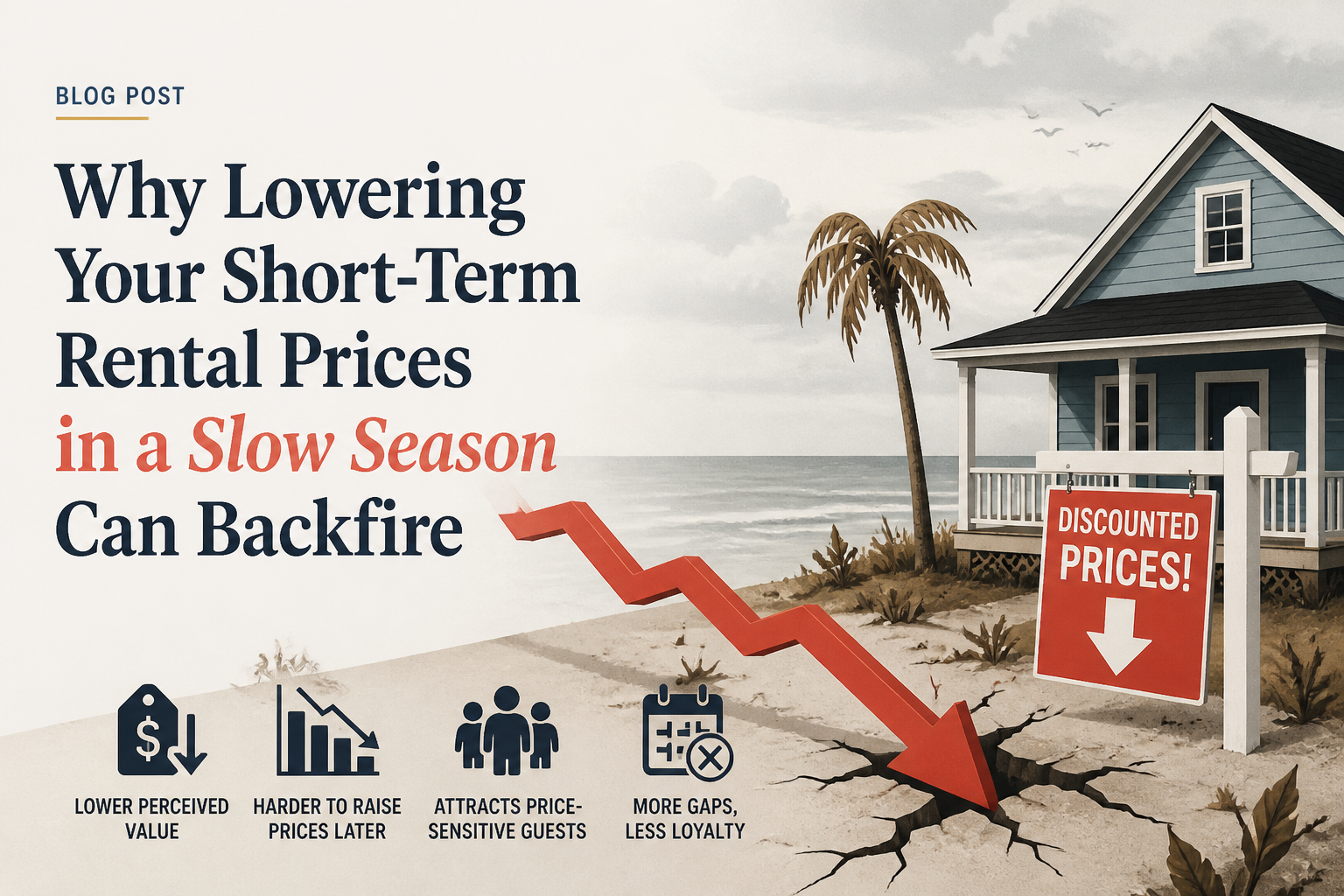
When the calendar slows and the nights sit empty, the conventional response is obvious: lower the price, attract more bookings, keep the income flowing. Most hosts who have been at this for a while have tried that approach at least once. A meaningful number of them have stopped.
The reason is not complicated once you have seen it. When the price drops significantly, the guests who arrive tend to be the guests who were choosing primarily based on price. And the guests who choose primarily based on price, in the experience of hosts who have tracked this pattern carefully, are often not the guests who take the most careful approach to the property.
The experiment most hosts run once
One host described the sequence plainly. She lowered her prices during a slow period. The bookings came in. And the quality of the guests who arrived was noticeably different from her usual calibration. She raised the prices back. The market is still slow, she said, but she is no longer making that trade-off. Eight other people in the thread responded to say they had experienced the same thing.
Another host described the same arc in more detail. In July and August, weekdays were difficult to fill. She dropped the rate slightly. The bookings arrived. The quality of guests dropped significantly in her judgment. She stopped making the rate reductions and is now considering raising the price further rather than competing on cost. She acknowledged that projecting how this plays out is genuinely uncertain. But the pattern from the experiment was clear.
The pattern is not universal. It is not a physical law of hosting. But it appears often enough in host accounts across different markets and property types to deserve serious consideration rather than dismissal.
Why price signals carry more information than hosts usually think
Price is not just a number. It is a signal that attracts a particular kind of guest and sets a particular set of expectations. A guest who books a property at a rate that signals quality arrives expecting something and treating it accordingly. A guest who found the property because it was the best deal available arrived for a different reason, and that difference shows up in subtle ways.
This is not a moral statement about budget travelers. It is an observation about what price signals relative to expectation. A guest who paid a premium expects a premium experience and tends to treat the property as something worth taking care of. A guest who booked because it was the cheapest option available on a given night may have had lower expectations to begin with and treats the property through the lens of those expectations.
One host put the philosophy bluntly: if you live by price, you will die by price. The argument is that competing primarily on rate puts you in a race with no floor, against hosts with lower costs, fewer standards, and less to lose. Once price becomes the primary selling point of a listing, it becomes very difficult to stop competing on it.
The floor rate and why it matters
Several hosts described having a rate below which they will not go, regardless of what the calendar looks like. This floor is not arbitrary. It is calculated from actual hosting costs: cleaning, utilities, supplies, the time spent managing the stay. A booking that does not cover those costs is not revenue. It is a loss that looks like a booking.
The floor rate is also a positioning decision. A property that never goes below a certain price point sends a consistent market signal. Guests who are looking for that property know what it costs. The listing does not appear in searches by guests who are filtering below that threshold, which is not a problem if those guests are not the ones you want.
One host said she would rather have the property sit empty than accept a booking below her minimum. That comment attracted more agreement than almost anything else in the discussion. She was not describing stubbornness. She was describing a deliberate minimum that protects both the economics of her listing and its positioning in the market.
When lowering the price is the right call
The argument against indiscriminate price-dropping is not an argument against ever adjusting prices in response to market conditions. There are situations where a rate reduction is the right call.
When your market has been affected by external events that genuinely reduced demand, a natural disaster, infrastructure problems, or a major local attraction closing, the appropriate response to lower demand may include some rate reduction. When you are in a market that has saturated with new supply and the competitive floor has genuinely moved, staying above it requires either differentiating significantly or accepting a new rate reality.
The distinction is between a deliberate, bounded adjustment made in response to a real market condition, and a reactive panic reduction driven by the discomfort of an empty calendar. The first is a business decision. The second tends to produce the guest quality issues that multiple hosts described.
What to do instead when the calendar is slow
The most consistently successful hosts in slow periods tend to respond not by dropping prices but by addressing the factors that are making their listing less competitive. Better photos. A stronger listing description. Additional reviews from an outreach to past guests who have not yet reviewed. Listing on additional platforms to expand the potential audience. Seasonal promotions or package offerings that add value without reducing the headline rate.
These responses take more effort than changing a pricing number. They also tend to improve the listing's long-term position rather than temporarily filling the calendar with guests who chose on the basis of price. The slow season is sometimes the right time to invest in the factors that drive performance year-round.
Airbnb optimization specialist, Superhost, and founder of one of the largest Airbnb host communities.
Continue Reading
Chosen for you from The Optimization Journal.
 CornerstoneShould You Lower Airbnb Prices When Bookings Slow Down? What Hosts Actually Say
When Airbnb bookings slow down, should you lower your nightly rate or hold firm? Discover what experienced hosts reported, why some regret discounting, and how to make smarter pricing decisions.
15 min read Do Long-Stay Discounts Actually Make Financial Sense for Your Rental?
She stopped offering discounts. Her occupancy did not change. She made more money. Another host in a different market reached the exact opposite conclusion with equal certainty. Both ran the numbers.
4 min read How to Set a Long-Stay Discount Policy That Serves Your Specific Property
A long-stay discount that makes sense for one host can cost another host money they did not know they were giving away. Here is how to figure out which situation you are in.
4 min read The Flat Rate Versus Per-Person Pricing Debate in Short-Term Rentals
When one person pays the same nightly rate as eight, is that fair? When a solo guest cannot afford a space that costs as much as it does for a full group, is that fair? The pricing question is more interesting than it first appears.
5 min read Why the Cleaning Fee Is About More Than Covering Your Cleaner
The cleaning fee question touches platform mechanics, guest psychology, dispute protection, and how guests compare your listing to the hotel down the road. The decision is worth thinking about carefully.
4 min read