
How to Choose the Right Airbnb Competitors to Watch
Competitor research is only useful if you are comparing your property with listings guests might realistically choose instead. A nearby Airbnb is not automatically a competitor. Here is how I would build a smaller, more useful competitor set.
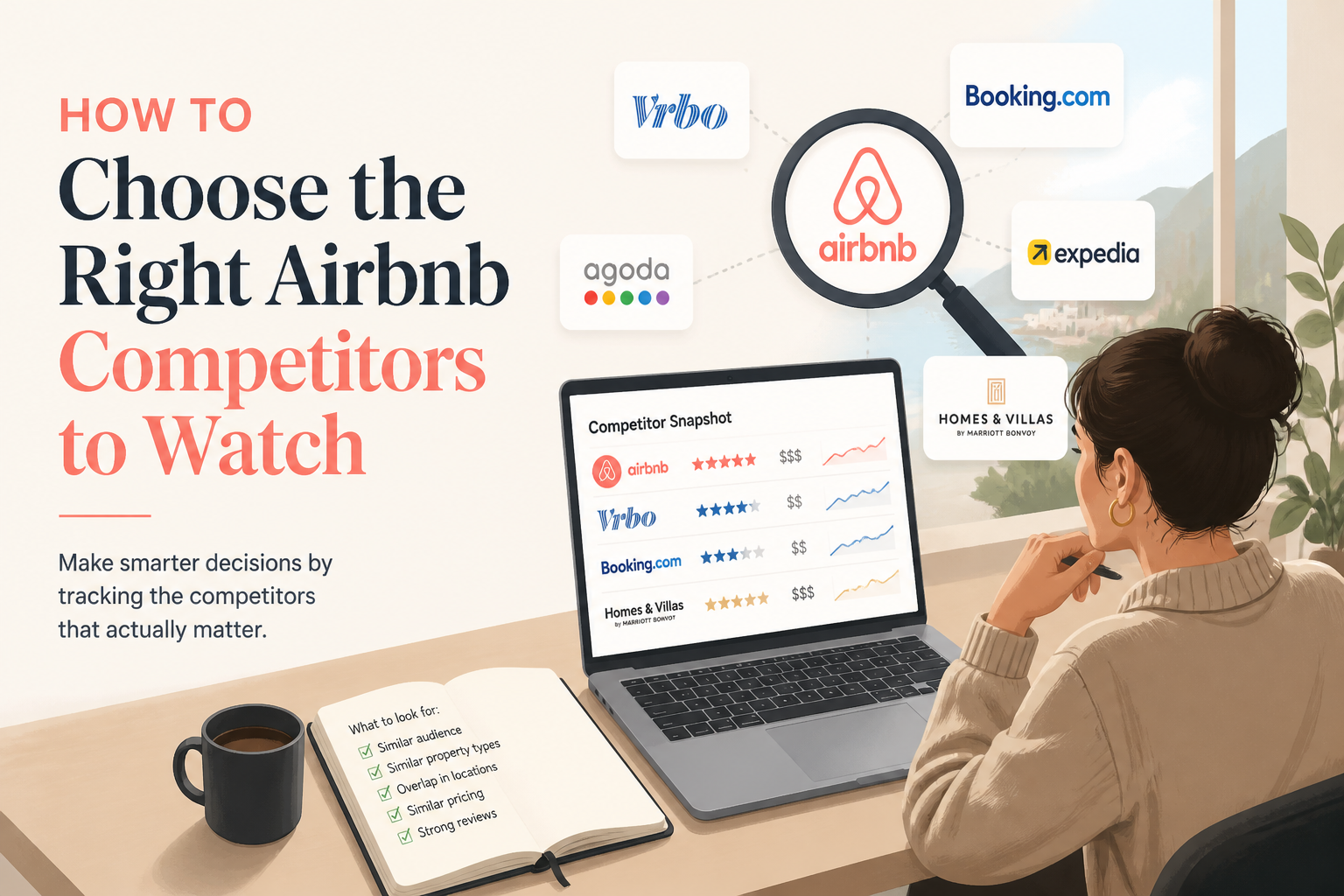
Open Airbnb, search your area, and you can probably find fifty properties within a few minutes.
That does not mean you have fifty competitors.
One of the problems with competitor research is that hosts often compare themselves with whatever happens to be nearby. A three-bedroom family home gets compared with a one-bedroom apartment. A basic rental gets compared with a newly renovated luxury property. A listing that sleeps four gets compared with one that sleeps ten.
Then the host looks at availability, minimum stays, or pricing and wonders why the numbers make no sense.
The problem is not necessarily the data. It is the comparison.
Would the Same Guest Actually Consider Both Properties?
This is the first question I would ask.
If a guest saw your property and the other listing in the same search, would they realistically be deciding between the two?
If the answer is no, I would not put much weight on the comparison.
Location matters, but it is only one factor. I would also look at bedroom count, guest capacity, property type, overall quality, major amenities, and the kind of stay the property seems designed for.
A couple looking for a downtown apartment is making a different decision from a family looking for a house with a yard. Even if the two listings are only five blocks apart, they may not be competing for the same booking.
Start With Size and Capacity
I would begin by finding properties reasonably close to your own bedroom count and guest capacity.
They do not have to be identical.
A three-bedroom home that sleeps six may still compete with a three-bedroom home that sleeps eight. But once the gap becomes too large, the guest and the economics of the stay start changing.
Larger properties often have different booking windows, group types, cleaning costs, minimum stays, and weekend demand. Smaller properties can behave very differently.
You want comparisons that help explain your own calendar, not properties running an entirely different business model.
Then Look at Property Quality
This is where the comparison becomes a little more subjective.
Two properties can have the same number of bedrooms and still sit in very different parts of the market.
One may have professional photography, a renovated interior, a pool, high-end furnishings, and hundreds of strong reviews. Another may be much more basic.
If your property sits somewhere in the middle, both listings can still teach you something, but I would not treat them as equivalent competitors.
I would rather identify properties that feel like reasonable alternatives from the guest's point of view.
Ask yourself: if my listing disappeared from Airbnb today, which nearby listings would my guest probably book instead?
Those are the competitors I care about most.
Major Amenities Can Change the Comparison
Some amenities are big enough to create a different competitive set.
A pool is a good example. So are beachfront access, a hot tub, a fenced yard, ski-in/ski-out access, parking in a difficult city market, or a property that allows pets when many nearby listings do not.
If an amenity is a major reason guests choose the property, try to compare yourself with listings offering something similar.
Otherwise you may conclude that another property is performing better when it is simply serving a different demand segment.
Do Not Automatically Choose the Most Successful-Looking Listings
There is a temptation to fill your competitor list with the nicest properties in the market.
I understand why. Those are the listings you want to learn from.
But your competitor set is not supposed to be a collection of properties you admire. It is supposed to help you understand the market you are actually competing in.
I would rather have three realistic competitors than ten impressive properties that attract a completely different guest.
You can absolutely study top listings separately for ideas about photos, positioning, amenities, and presentation. That is useful.
Just do not confuse inspiration with a true comp set.
Look at Who the Listing Seems Built For
I think guest type gets overlooked in competitor research.
Imagine two three-bedroom homes in the same neighborhood.
One has bunk beds, children's equipment, a fenced backyard, toys, and a large dining table. The other has three king bedrooms, a hot tub, a wine fridge, and a more adult-oriented design.
Technically they look similar in a spreadsheet.
In reality, they may attract very different bookings.
The first is clearly leaning toward families. The second may perform much better with couples traveling together or adult groups.
That matters when you compare booking patterns, weekends, minimum stays, and seasonal demand.
Three Good Competitors Can Be Enough
I do not think you need to monitor the entire market.
Too much data can actually make the comparison worse because you start mixing together properties that should not be grouped.
I would rather identify a small set of strong comparisons and watch them consistently.
For example:
Competitor 1: the property most similar to yours overall.
Competitor 2: a slightly stronger property that attracts the same type of guest.
Competitor 3: another close substitute with similar size and location but perhaps a slightly different strategy.
Now you have a much more useful group to watch over time.
What Should You Actually Watch?
Once you have the right competitors, I am especially interested in their availability and minimum-stay patterns.
Are their weekends disappearing earlier than yours?
Do they shorten minimum stays as dates approach?
Are they sitting open during the same slow periods you are?
Do several competitors suddenly have very little availability around a particular event or holiday?
You are looking for patterns, not trying to reverse-engineer every reservation.
Remember that an unavailable date does not prove a booking. Hosts block dates for many reasons, and reservations may also come from other channels.
What becomes useful is seeing similar behavior across several relevant listings over time.
This Is How I Use Competitor Intelligence
The Competitor Intelligence tool is built around this idea.
You choose the listings you actually want to monitor rather than having a tool decide that every nearby Airbnb is your competitor.
Then you can compare availability and minimum-stay patterns against your own property.
I intentionally keep the scope limited. The tool is not pretending to know the price a competitor received for a reservation or whether every blocked night was actually booked. That information is not visible from the outside.
Instead, it focuses on the patterns we can observe and lets the host decide what those patterns mean.
Sometimes the Comparison Tells You Not to React
This may be the most useful outcome of competitor research.
Suppose your next month looks unusually open and you are thinking about dropping your rates aggressively.
You look at your three strongest competitors and their calendars are also wide open.
That does not guarantee your pricing is correct, but it gives you important context. The market may simply be booking later or demand may be soft.
Now imagine the opposite. Your competitors have much less availability while your calendar remains open.
That is when I would investigate further. Look at pricing, minimum stays, Search Visibility, your Listing Audit, and whether guests are clicking but not converting.
The competitor data does not make the decision for you.
It tells you whether you are experiencing the same thing as the market around you.
Build a Comp Set You Actually Trust
I think competitor research becomes much more useful once you stop asking, "What are nearby Airbnbs doing?"
Ask instead:
What are the properties competing for my guest doing?
That smaller group is the one worth watching.
Choose it carefully, keep it relatively consistent, and pay attention to patterns over time. You will learn much more from three relevant properties than thirty random ones.
Airbnb optimization specialist, Superhost, and founder of one of the largest Airbnb host communities.
Continue Reading
Chosen for you from The Optimization Journal.
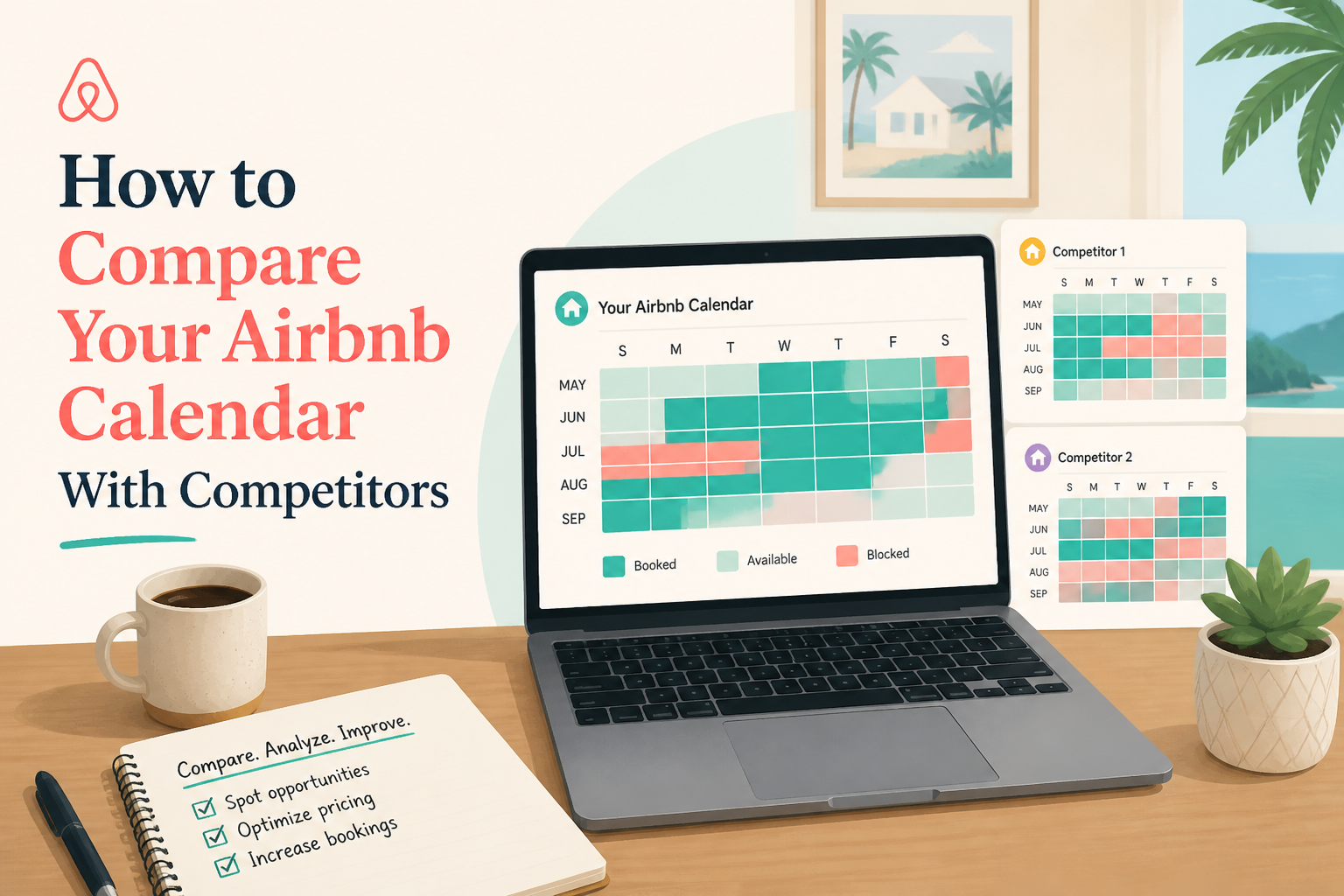 How to Compare Your Airbnb Calendar With Competitors
Looking at competitor calendars can help you understand whether a slow period is specific to your property or happening across your market. But availability does not automatically mean a property is struggling, and blocked dates do not necessarily mean bookings. Here is how I would use competitor calendar data without reading too much into it.
5 min read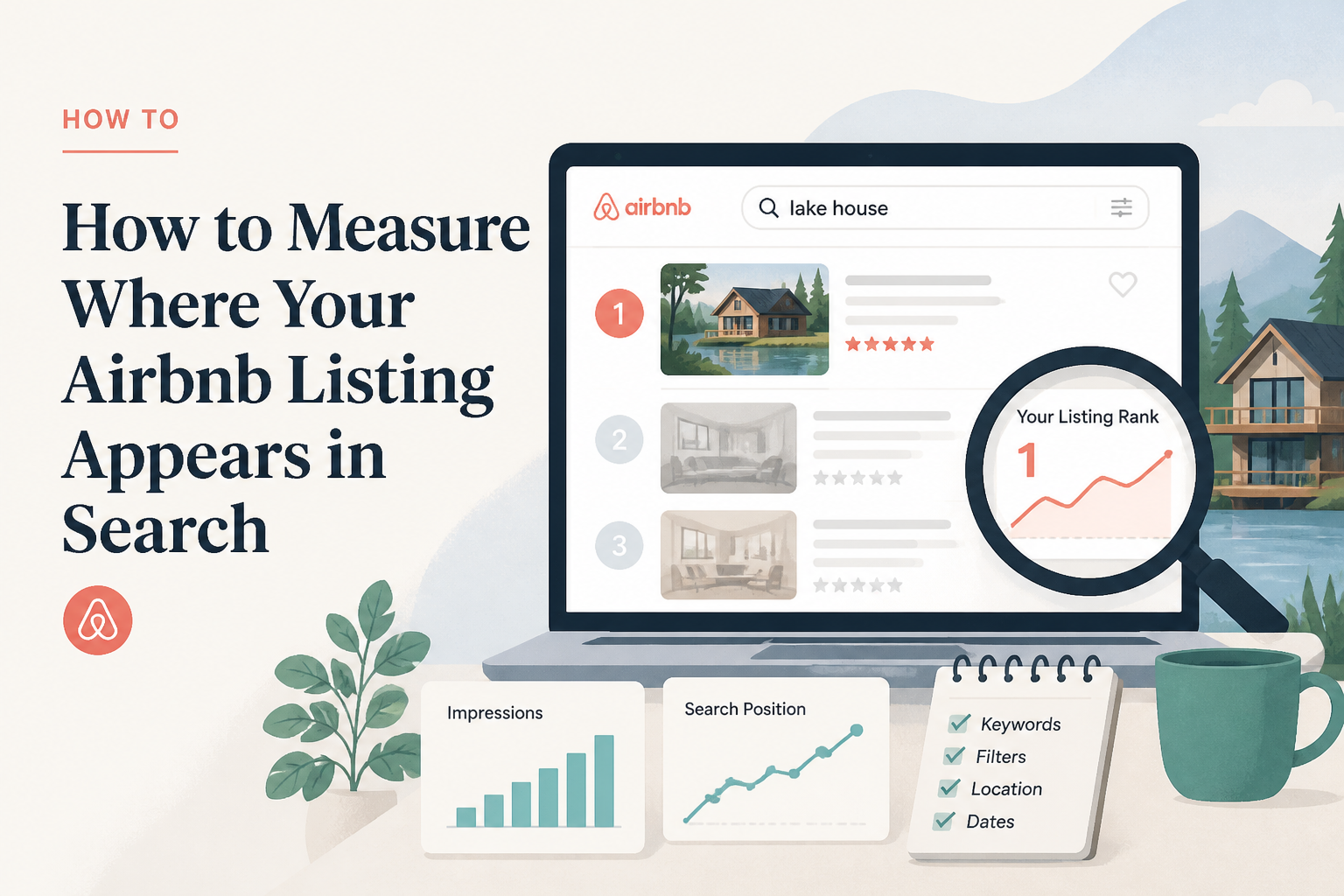 How to Measure Where Your Airbnb Listing Appears in Search
Airbnb search position is not as simple as searching your city and looking for your own property. Results can change based on dates, guest count, filters, location, and personalization. Here is a better way to think about Airbnb search visibility and how to tell whether your listing is improving over time.
5 min read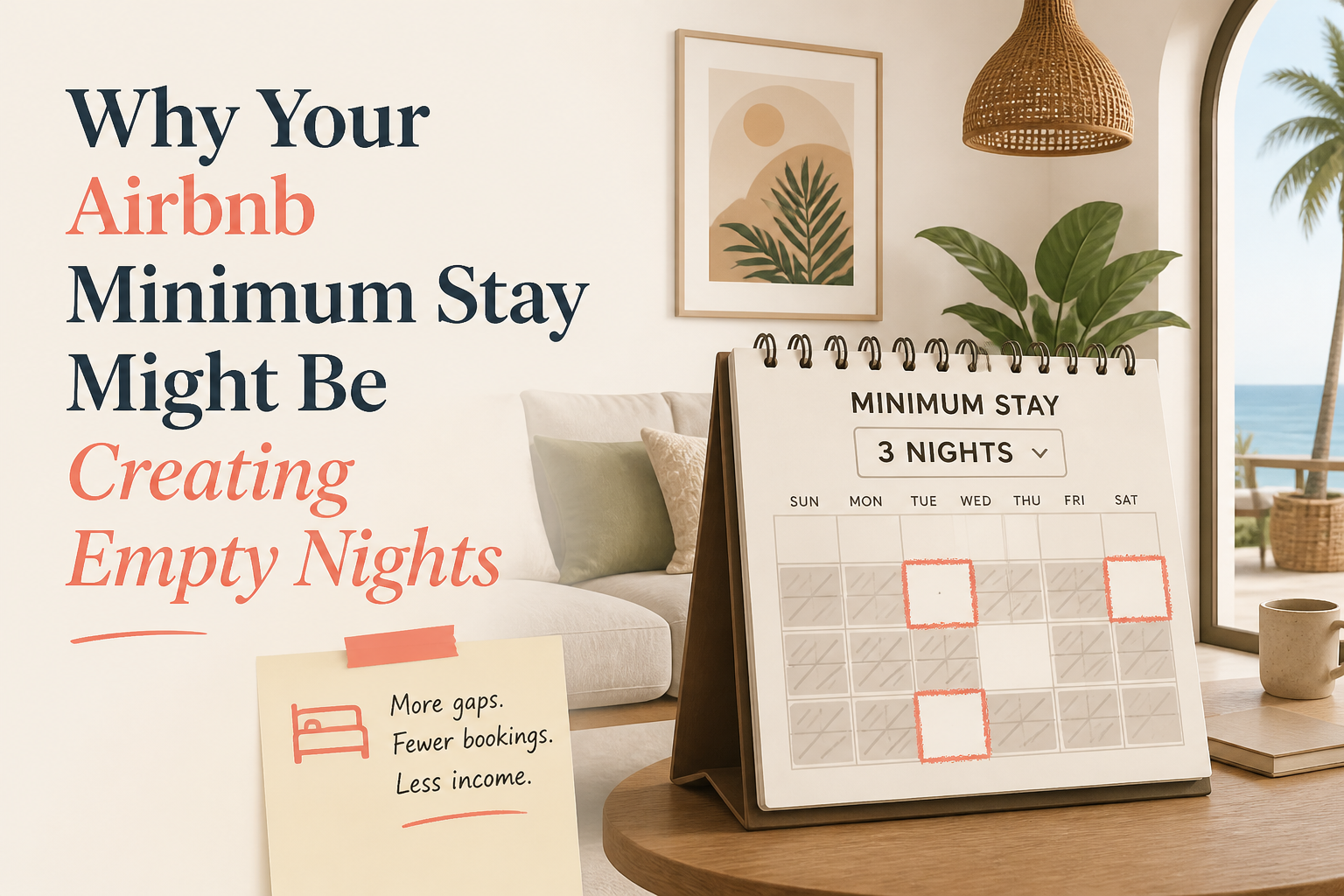 Why Your Airbnb Minimum Stay Might Be Creating Empty Nights
Minimum-stay rules can protect your calendar, reduce turnovers, and help you avoid low-value reservations. But the same rule can also create gaps that become nearly impossible to book. The trick is knowing when to hold your minimum and when the calendar is telling you to adjust it.
5 min read Why Airbnb Hosts Should Track Local Events Months in Advance
By the time a major local event is obviously driving Airbnb demand, some of the best booking opportunities may already be gone. Concerts, festivals, graduations, tournaments, and conferences are much more useful when you know about them early enough to adjust your calendar before guests start booking.
6 min read What Guests Look for Before Booking an Airbnb
Guests do not read an Airbnb listing from top to bottom like a brochure. They scan, compare, hesitate, and decide. Understanding what they look for first can help you make the listing easier to trust and easier to book.
6 min read