
How to Know If Your Airbnb Listing Is Fully Optimized: 8 Tests Every Host Should Run
Is your Airbnb listing actually optimized, or does it just look complete? Use these eight practical tests to evaluate your photos, title, descriptions, amenities, guest expectations, and booking performance before making unnecessary changes.
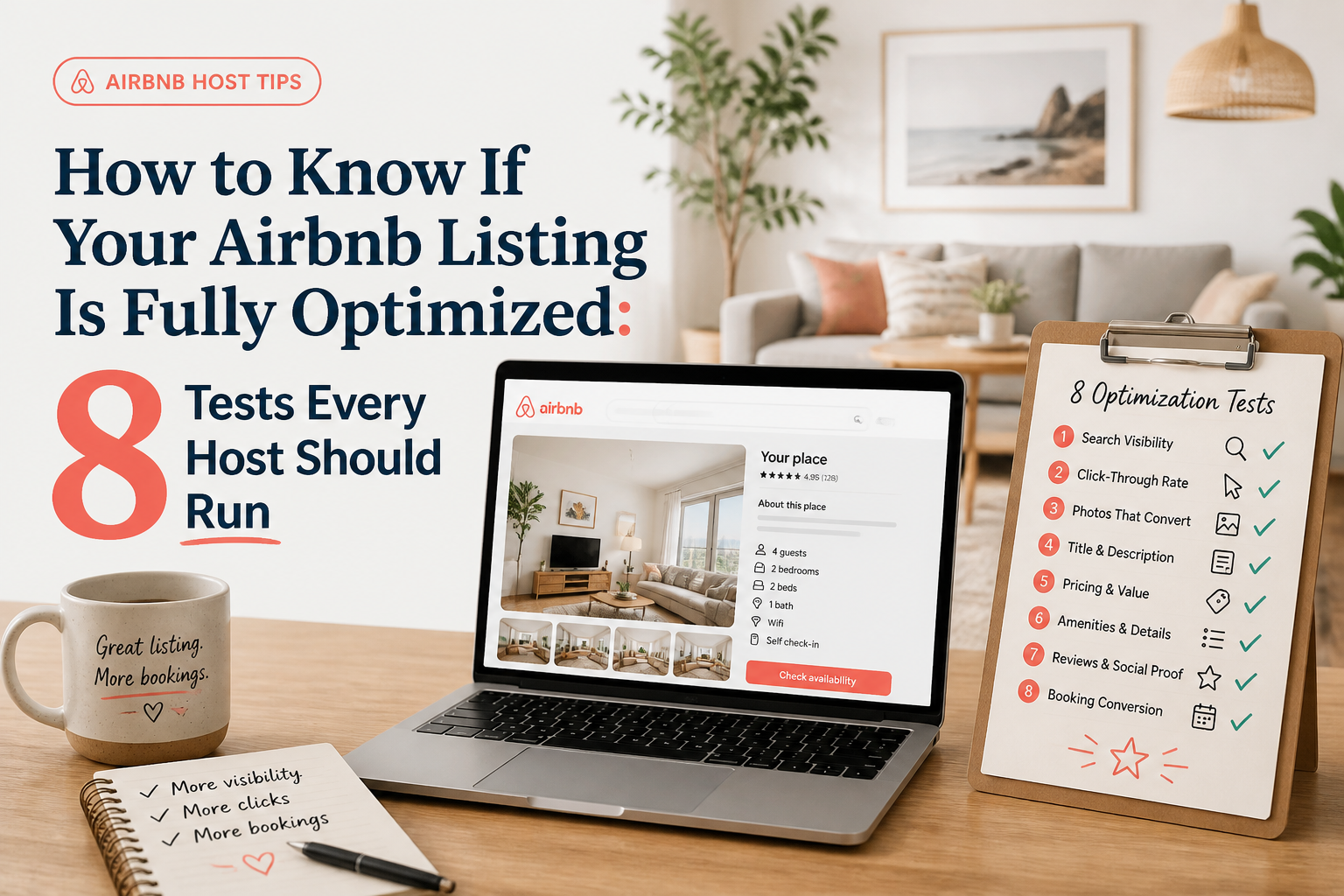
How do you know if your Airbnb listing is fully optimized?
The short answer is that a well-optimized Airbnb listing should be complete, accurate, competitive, and easy for the right guests to understand. Its photographs should communicate its strongest features, its descriptions should answer important questions, its amenities and booking settings should be correct, and its actual performance should be monitored over time.
But there is a problem.
A listing can look finished without being optimized.
You may have professional photographs, a detailed description, excellent reviews, and every important section completed.
Yet your listing could still be missing information that matters to guests.
Perhaps your strongest selling point is buried in photograph number twelve.
Perhaps your title is generic.
Maybe your property has a dedicated workspace, but you forgot to select that amenity.
Or perhaps your listing looks excellent, but your minimum-stay restrictions prevent it from appearing in searches your ideal guests are making.
In The Airbnb Optimization Playbook, I explain why optimization should be treated as an ongoing system rather than a one-time editing project.
After working on hundreds of Airbnb listings, I've found that the most useful question isn't, "Have I completed my listing?"
It's:
"Can I demonstrate that my listing is communicating the right information, qualifying for relevant searches, and giving guests confidence to book?"
Here are eight practical tests I recommend every Airbnb host run.
Test 1: Can You Identify Your Listing's Three Strongest Selling Points?
Before reviewing titles, photographs, or descriptions, start with your property's positioning.
Ask yourself:
Why would the right guest choose this property instead of another available at a similar price?
If you cannot answer that question clearly, your listing may lack a meaningful focus.
Every property has different strengths.
A downtown apartment may offer walkability, convenient parking, and a dedicated workspace.
A mountain cabin may offer privacy, views, and a hot tub.
A family vacation home may provide a fenced backyard, several bedrooms, and a private pool.
Those properties should not be marketed in exactly the same way.
The three-feature exercise
Write down your property's three most important advantages.
For example, imagine a fictional three-bedroom vacation home.
Its strengths might be:
- Private heated pool
- Spacious outdoor dining area
- Three bedrooms suitable for families
Now open your Airbnb listing.
Can a prospective guest discover those three features quickly?
Are they visible in the opening photographs?
Does the title highlight one of them?
Does the short summary explain their value?
Does the main description provide the necessary details?
If those strengths are scattered throughout the listing or barely mentioned, your presentation may not communicate what makes the property attractive.
What passing this test looks like
Your listing has a clear identity.
You know which guests are most likely to appreciate it.
And its photographs, title, descriptions, and amenities reinforce the same genuine advantages.
The goal isn't to make your property appeal to everyone.
It's to communicate its strengths clearly to the people most likely to book it.
Test 2: Does Your Listing Pass the Five-Second First-Impression Test?
Open your Airbnb listing on a mobile phone.
Look only at the information a guest can see immediately.
Pay attention to the opening photograph, title, price, rating, and visible property details.
Now ask:
Would someone unfamiliar with this property understand why it deserves attention within five seconds?
This isn't an official Airbnb measurement.
It's a practical way to evaluate whether your first impression communicates value quickly.
Start with the cover photo
Your strongest photograph isn't necessarily the one you personally like best.
It should help a guest recognize something genuinely appealing about the property.
Consider a vacation home with a remarkable private pool.
If the cover image shows an ordinary hallway, it may fail to communicate one of the property's biggest benefits.
A well-composed pool photograph might be more effective.
But every property is different.
For a stylish city apartment, the living area may be the strongest opening image.
For a mountain retreat, the view could be the most important visual.
The question is whether your opening image represents a real reason to consider booking.
Check the first five photographs
In The Airbnb Optimization Playbook, I recommend treating the first five photographs as a coordinated introduction to the property.
They should demonstrate your strongest features without becoming repetitive.
For example, a family vacation home could lead with:
- Private pool
- Living room
- Kitchen and dining area
- Primary bedroom
- Outdoor entertaining space
The exact order should reflect the property.
After those opening images, the gallery should provide a logical walkthrough of the accommodation.
Evaluate your title
Now read the title.
Consider these fictional examples.
Generic:
"Beautiful Cozy Home in Great Location"
More specific:
"Private Pool | Spacious Family Retreat"
The second version communicates a tangible property benefit rather than relying on adjectives that could describe almost any rental.
Make sure the feature is real and accurately represented elsewhere in the listing.
What passing this test looks like
Your opening photograph and title communicate a clear, accurate advantage.
Your first five images show meaningful variety.
And the property looks competitive when compared with genuinely similar listings.
That doesn't guarantee a click or a booking, but it helps guests evaluate the property more easily.
For additional guidance, read "What Should Your First 5 Airbnb Photos Show?" (https://www.superhostseo.com/blog/first-five-airbnb-photos).
Test 3: Can a Stranger Understand Your Property Without Asking Questions?
This may be the most revealing test of all.
You know your property extremely well.
You know which bedroom has the king bed.
You know where guests park.
You know that the outdoor area is private.
You know how the kitchen connects to the living room.
But someone reading your Airbnb listing for the first time knows none of that.
If your description leaves important questions unanswered, the guest has to guess or contact you.
Some guests will ask.
Others may simply keep comparing properties.
Read your listing like a stranger
Open your main property description and ask:
- How many bedrooms are there?
- What type of bed is in each room?
- Are the bedrooms on the same floor?
- How many bathrooms are available?
- Is the kitchen fully equipped for cooking?
- Is the parking private, shared, or on the street?
- Which outdoor areas can guests use?
- Are there stairs or accessibility limitations?
- Are any important amenities seasonal?
The listing should answer the questions relevant to your property clearly.
Apply the two-layer description method
In The Airbnb Optimization Playbook, I teach a two-layer method for writing the main property description.
Layer One: A skimmable overview
Organize essential details into short sections covering the rooms, sleeping arrangements, amenities, and important practical information.
Layer Two: A complete walkthrough
Follow with a more detailed description of how the property is arranged and what guests can expect.
This combination serves guests who scan quickly as well as those who want a fuller understanding before booking.
Example
Weak description:
"Beautiful three-bedroom home with modern amenities, perfect for families and groups."
More useful description:
"This single-level three-bedroom home sleeps up to six guests. The primary bedroom has a king bed and ensuite bathroom, while the other two bedrooms share a full bathroom. The open-plan living area connects to the kitchen and dining space, with sliding doors leading to the private backyard and pool."
The second example gives the guest a clearer picture of the accommodation.
It doesn't rely on exaggerated promises.
It simply explains the property.
What passing this test looks like
Your main description gives guests an accurate understanding of the layout, important features, and practical details.
Its information agrees with the photographs and room settings.
And it answers the questions guests repeatedly ask.
If you keep receiving the same questions about parking, sleeping arrangements, or private amenities, the relevant information may need to be made clearer.
Test 4: Are Your Airbnb Amenities Actually Selected?
This is one of the easiest tests to overlook.
Your property can physically offer an amenity without Airbnb having the corresponding information selected in your listing editor.
For example, you might provide:
- Free parking
- Washer and dryer
- Dedicated workspace
- Air conditioning
- Heating
- Kitchen
- Hot tub
- Children's equipment
Some of these features may be mentioned in your description.
But are they selected in the appropriate Airbnb amenity fields?
Why it matters
Guests can filter Airbnb searches by amenities and property characteristics.
If your listing doesn't meet a selected filter, it may not appear among the matching results.
Airbnb confirms that guest search criteria, listing characteristics, and amenities influence which properties appear in search.
See "Airbnb's official explanation of how search results work" (https://www.airbnb.com/help/article/39).
This means amenity accuracy affects more than the information a guest reads.
It can also affect search eligibility.
Run a room-by-room amenity check
Walk through your property and compare what exists with what Airbnb currently displays.
Check bedrooms, bathrooms, kitchen, laundry facilities, living spaces, and outdoor areas.
Pay attention to features you may have added after initially publishing the listing.
Confirm that relevant safety features and required disclosures are also accurate.
Do not select amenities that the property doesn't genuinely offer.
What passing this test looks like
Every applicable amenity is accurately selected.
Unavailable features are not advertised.
And the amenities list agrees with your descriptions, photographs, and actual guest experience.
For a deeper checklist, see "The Airbnb Amenities That Actually Influence Bookings" (https://www.superhostseo.com/blog/airbnb-amenities-that-influence-bookings).
Test 5: Does Your Listing Set Accurate Guest Expectations?
A structurally complete listing isn't necessarily a convincing one.
This distinction is at the center of my Guest Intent Optimization methodology.
Imagine a listing that includes every important section.
The amenities are selected.
The photographs are professional.
The description explains the property.
But the listing describes the location as peaceful and secluded while several recent reviews mention traffic noise.
Or perhaps the photographs suggest a private outdoor area, but guests repeatedly describe sharing that space with another unit.
The listing may be complete.
The expectations may still be wrong.
Compare three sources of information
First: Your photographs
What experience do they appear to promise?
Second: Your descriptions
How do you explain the property's strengths, limitations, and practical details?
Third: Your guest reviews
What do guests repeatedly praise or complain about after staying?
Look for agreement and disagreement among these sources.
Example: A strength you're not promoting
Imagine several guests mention that the property's private backyard is their favorite feature.
But the backyard barely appears in your photographs or description.
That may be an opportunity to strengthen your positioning.
You don't need to invent a new benefit.
You can highlight something guests already value.
Example: A limitation guests weren't expecting
Now imagine multiple reviews mention narrow stairs.
If the listing never clearly explains that the bedrooms are upstairs, consider updating the description and photographs.
You may not be able to change the physical layout.
But you can improve how accurately guests understand it before booking.
What passing this test looks like
Your photographs and descriptions create expectations that are consistent with the actual stay.
Reviews generally reinforce the property's strengths.
And recurring guest concerns are either addressed operationally or explained accurately in the listing.
This is one area where structural checklists alone may not identify every problem.
Test 6: Can Guests Actually Book the Dates They Want?
An excellent listing can still struggle if its booking settings exclude too many relevant searches.
Imagine your property is available for Friday and Saturday nights.
But your minimum stay is three nights.
A guest searching for that two-night weekend may not be able to book your listing.
The calendar looks open.
The stay doesn't meet your rules.
Check the booking settings
Review:
- Minimum and maximum nights
- Available dates
- Advance notice
- Preparation time
- Booking window
- Check-in and checkout restrictions
- Calendar synchronization
- Date-specific rule-sets, if applicable
Not every restriction is a mistake.
A larger vacation home may need longer minimum stays during peak season.
A remotely managed property may require more preparation time between reservations.
The important question is whether your rules are intentional and appropriate for the guests you're trying to attract.
Compare your total price
Booking conditions are only one part of the competitiveness test.
Review your property's total price for relevant dates and compare it with similar properties.
Account for differences in size, location, quality, amenities, and reviews.
Don't assume that being cheaper automatically means being better optimized.
A listing needs to communicate why its price makes sense.
What passing this test looks like
Your calendar is accurate.
Your restrictions match your operating requirements and market.
And your total pricing is deliberately positioned against relevant alternatives.
The goal isn't to accept every possible reservation.
It's to remain available and competitive for stays that are financially and operationally worthwhile.
Test 7: Do Your Airbnb Performance Numbers Support Your Assumptions?
This is where many hosts skip an important step.
They decide the listing looks good and assume the optimization is finished.
But a listing that looks good isn't necessarily producing the results you expect.
In The Airbnb Optimization Playbook, I explain why performance data should guide the next decision.
Begin by checking your Airbnb performance dashboard.
Depending on your account's available reporting tools, you may be able to review listing views, booking conversion, historical trends, and comparisons with similar properties.
The four performance situations
The relationship between listing views and booking conversion can help you decide what to investigate.
These are four common situations.
Situation 1: Low Views and Low Booking Conversion
What it may indicate: Your listing may need attention at both the discovery and booking-decision stages.
First, investigate whether your property is eligible for relevant searches.
Check availability, minimum stays, amenities, pricing, and other booking settings.
Then examine your first impression and complete listing presentation.
Your opening photographs may not clearly communicate the property's strengths.
Your title may be generic.
Or important details may be missing from your description.
Where to focus: Search eligibility, first impressions, and possible booking friction.
Situation 2: Low Views but Strong Booking Conversion
What it may indicate: Guests who open your listing appear relatively interested in booking, but the property may not be attracting enough relevant visitors.
Your title, opening photographs, and other visible search-result information deserve review.
You should also investigate whether availability and booking restrictions are excluding relevant searches.
However, low views don't automatically prove a search-ranking problem.
Market demand and the dates being searched can also affect visitor volume.
Where to focus: Availability, discovery, and competitiveness in relevant searches.
Situation 3: Strong Views but Low Booking Conversion
What it may indicate: Guests are opening your listing but fewer are completing reservations.
That suggests investigating what they encounter after clicking.
Possible issues include unclear property descriptions, uncompetitive total pricing, recent guest reviews, restrictive booking conditions, or uncertainty about the stay.
The problem may not be your first impression.
It may be what guests discover when they examine the full property.
Where to focus: Guest confidence, total price, reviews, and listing presentation.
This is also a situation where "Guest Intent Optimization" (https://www.superhostseo.com/guest-intent) may provide useful additional analysis.
Situation 4: Strong Views and Strong Booking Conversion
What it may indicate: Your listing appears to be attracting relevant visitors and converting them relatively effectively.
That doesn't mean optimization is finished.
Continue reviewing the accuracy of your information, guest feedback, seasonal demand, and pricing competitiveness.
Avoid unnecessarily rewriting sections that are already working.
Where to focus: Maintenance, seasonality, and ongoing competitiveness.
Important: These are diagnostic starting points
The four situations don't prove why a listing is performing a certain way.
Views are listing-page visits, not a direct measure of every search impression.
And a strong conversion rate can be misleading when only a handful of people have viewed the property.
You need enough data to interpret the trend responsibly.
Example: A property getting fewer views
Suppose your listing received 600 views in one 30-day period and 350 in the next.
That decline deserves investigation.
But it doesn't prove the Airbnb algorithm has penalized you.
Market demand may have changed.
Availability may have become more restrictive.
Your price may be less competitive.
Or your listing may be attracting less interest than before.
The correct next step is to investigate those possibilities rather than immediately rewrite the entire listing.
Example: Views remain strong, but bookings decline
If guests are still opening your listing but fewer are booking, investigate what they encounter after clicking.
Look at the complete photo gallery, the clarity of the description, recent reviews, and the total cost of the stay.
A listing audit may identify structural gaps.
Guest Intent Optimization may help identify possible sources of hesitation.
Neither tool can prove what individual visitors were thinking.
What passing this test looks like
You understand your recent performance trends.
You compare periods that make sense for your property.
And you make changes based on identified problems rather than reacting to every slow day.
Optimization should be monitored, not assumed.
Test 8: Can Your Listing Pass an Independent Audit?
The first seven tests help you evaluate your listing manually.
But there is one final challenge.
It's difficult to objectively review a property you know extremely well.
You may read your own description and automatically fill in information that isn't actually written there.
You may overlook an unclear title because you know what you intended it to mean.
And you may consider a photograph self-explanatory because you've spent years inside the property.
This is one of the reasons I created the SuperhostSEO Airbnb Listing Audit.
What the free audit evaluates
The tool analyzes a live Airbnb listing across nine weighted categories.
These include major areas such as:
- Listing title
- Short summary
- Main property description
- Photos
- Photo order
- Amenities
- Guest access
- Other structural and completeness elements
It generates an overall optimization score out of 100, individual category assessments, and prioritized recommendations.
The title, summary, and main property description have substantial influence on the tool's methodology because their wording and completeness can be assessed directly.
The weighting is specific to SuperhostSEO.
It is not Airbnb's official search-ranking formula.
What does the audit score mean?
A higher score means the listing performs better against the criteria used in SuperhostSEO's assessment.
It does not mean Airbnb has assigned the property an equivalent score.
And it doesn't guarantee a particular ranking or booking result.
For example, two properties could receive similar scores while having very different weaknesses.
One might need a more complete property description.
Another might need clearer guest access information.
The number alone isn't the most useful part of the report.
The most useful part is knowing what to fix first.
Don't automatically fix the lowest-scoring category
In The Airbnb Tools Playbook, I explain why hosts should pay attention to the prioritized roadmap rather than simply choosing the category with the lowest score.
A smaller weakness in an important section may deserve attention before a more severe weakness in a less influential part of the assessment.
The report identifies top priorities and separates what deserves immediate attention from what can wait.
That makes the recommendations more practical than a long checklist with no order.
What the free audit cannot do
The tool does not access Airbnb's private ranking algorithm.
It cannot see every private setting inside your hosting account.
It cannot evaluate all photographic qualities the way a human would.
And it doesn't automatically publish changes to your Airbnb listing.
It provides diagnosis and recommendations.
The host remains responsible for reviewing and implementing improvements.
Run your own audit
If you want an outside assessment of your listing, start with the free tool.
"Run your free Airbnb Listing Audit at SuperhostSEO" (https://www.superhostseo.com/audit/).
Paste your Airbnb listing URL, create a free account, and receive your personalized report.
You'll get:
- An overall score out of 100
- Section-by-section assessments
- Listing strengths
- Priority improvements
- Recommendations saved to your workspace
The first audit is free and does not require a credit card.
It's designed to help you understand where to begin rather than continue guessing.
What If Your Airbnb Listing Scores Well but Bookings Are Still Weak?
This is an important question.
A high structural audit score doesn't automatically mean every part of the booking experience is working.
Your property could be well documented but overpriced for the current market.
Your calendar may be too restrictive.
Demand could be temporarily weaker.
Or your listing may be structurally complete while still creating uncertainty about the guest experience.
If the audit shows a strong foundation, but booking conversion remains disappointing, investigate the next layer.
Use Guest Intent Optimization
"SuperhostSEO Guest Intent Optimization" (https://www.superhostseo.com/guest-intent) examines how photographs, written information, and guest reviews work together.
Its purpose is to identify possible mismatches between what the listing promises and what prospective guests may expect.
For example, it may highlight recurring review concerns that deserve attention or reveal valuable property strengths that the listing isn't communicating clearly.
The analysis provides a written assessment and prioritized recommendations.
It does not guarantee bookings or determine exactly why an individual guest chose another property.
Think of it this way:
The Listing Audit asks whether your listing is built properly.
Guest Intent Optimization asks whether the complete presentation may be creating unnecessary hesitation.
Those are different questions.
And they may require different improvements.
For a detailed comparison, read "Airbnb Listing Audit vs. Guest Intent Analysis: What's the Difference?" (https://www.superhostseo.com/blog/airbnb-listing-audit-vs-guest-intent).
What Should You Do After Finding an Optimization Problem?
Once you've identified weaknesses, don't immediately change everything.
Start with the most important issue.
For example, imagine your audit identifies three opportunities:
- Your main description doesn't explain the property's layout clearly.
- Your title uses generic language instead of distinctive features.
- Your Guest Access section doesn't explain whether the outdoor space is shared.
You might prioritize correcting the description and guest access information, then improving the title.
Record what you've changed.
Confirm that the new wording is accurate.
And monitor your listing's performance over time.
If the changes are small, you may be able to implement them yourself.
If your listing needs a full content rebuild, the SuperhostSEO Listing Workshop helps you work through the title, summary, main description, and photo strategy step by step.
You can explore it through the "SuperhostSEO optimization workspace" (https://www.superhostseo.com/tools).
The purpose of the paid tools is to help implement and maintain improvements identified during diagnosis.
You don't need to purchase them to receive your first free audit.
How Often Should You Check Whether Your Airbnb Listing Is Optimized?
In The Airbnb Optimization Playbook, I recommend a monthly optimization review.
Not a complete rewrite every month.
A review.
Check that the photographs still reflect the property.
Confirm that the title and summary communicate its strongest advantages.
Make sure the description remains accurate.
Review amenities, booking settings, and important guest information.
Then look at your performance trends.
When to run a deeper review
A more comprehensive reassessment may be useful when:
- You launch a new listing
- You renovate or significantly change the property
- Your listing views decline unexpectedly
- Booking conversion weakens
- Several reviews identify the same issue
- You enter a new booking season
- Your property has accumulated many small edits over time
The objective is consistent quality.
A listing should be maintained as the property, market, and guest expectations change.
Frequently Asked Questions
How do I know if my Airbnb listing is optimized?
Review its photos, title, descriptions, amenities, guest access, pricing, and booking settings. Then compare the listing's presentation with actual performance and guest feedback. A structured listing audit can help identify weaknesses that are easy to overlook.
Is there an official Airbnb optimization score?
Airbnb does not publish a universal 0-to-100 SEO optimization score for individual listings. Third-party audit tools use their own scoring methods to evaluate presentation, completeness, and other measurable factors.
What is a good Airbnb listing audit score?
A useful score depends on the assessment criteria and the weaknesses behind the number. Rather than treating a particular score as proof of ranking potential, examine the category results and prioritized recommendations.
Does a fully optimized Airbnb listing rank higher?
Improving listing quality, clarity, availability, and competitiveness may help, but no particular checklist guarantees higher rankings. Airbnb considers quality, popularity, price, location, guest preferences, and other factors when generating search results.
Can my Airbnb listing be complete but still poorly optimized?
Yes. Every field might be filled in while the title remains generic, the photographs are poorly organized, or the content fails to communicate the property's strongest benefits.
Is an Airbnb listing audit worth doing?
A structured audit can help identify missing information, weak sections, and other opportunities for improvement. Its main value is providing an outside assessment and a clear order of priorities.
Can AI optimize my Airbnb listing automatically?
AI can assist with analysis and content drafting, but generated recommendations still need human review. Property details must remain accurate, and no AI tool can guarantee bookings or a particular Airbnb search position.
How much does the SuperhostSEO Listing Audit cost?
The first SuperhostSEO Listing Audit is free. You create a free account, provide your listing URL, and receive a scored report with prioritized recommendations. No credit card is required for that first audit.
Do I need to optimize my Airbnb listing every month?
A monthly review is a useful maintenance habit. That doesn't mean rewriting the title or description every month. Focus on accuracy, important changes, guest feedback, and performance trends.
What should I do if my audit identifies several problems?
Start with the report's highest-priority recommendations. Correct genuine inaccuracies immediately, then work through other improvements deliberately. Monitor the results rather than changing every section at once.
Final Thoughts: A Fully Optimized Airbnb Listing Is Never Really Finished
Optimization isn't a status you achieve once and forget.
Your property changes.
Guest expectations evolve.
Competitors improve.
Prices and seasons shift.
And Airbnb's search experience continues to develop.
That's why I don't believe the right goal is to make every field perfect and then stop paying attention.
The goal is to build a listing that is complete, accurate, competitive, and consistently maintained.
A strong listing should pass these eight tests:
- Its three strongest selling points are clear.
- Its first impression communicates real value.
- Its description answers important guest questions.
- Its amenities are accurate and complete.
- Its photographs, descriptions, and reviews support consistent expectations.
- Its pricing and booking settings match the market and operation.
- Its performance is monitored using meaningful data.
- Its weaknesses can be identified and prioritized through an independent review.
If you can confidently answer those questions, you have a useful foundation.
If you're uncertain, you don't need to guess.
You need an outside assessment of what's working and what deserves attention.
Find out what your Airbnb listing may be missing.
"Run your free Airbnb Listing Audit at SuperhostSEO" (https://www.superhostseo.com/audit/) to get your listing score, section-by-section analysis, and personalized improvement priorities.
Start with diagnosis.
Fix what matters.
And continue improving based on what your guests and performance data actually tell you.
Written by Elie Parienti, founder of SuperhostSEO and author of The Airbnb Optimization Playbook and The Airbnb Tools Playbook. The eight-test framework is adapted from the Master Airbnb Listing Checklist, Monthly Optimization Checklist, and performance-diagnosis chapters of The Airbnb Optimization Playbook, together with the audit methodology in The Airbnb Tools Playbook.
Further Reading
- "Airbnb: How Search Results Work" (https://www.airbnb.com/help/article/39)
- "Airbnb Listing Audit vs. Guest Intent Analysis" (https://www.superhostseo.com/blog/airbnb-listing-audit-vs-guest-intent)
- "How to Optimize an Airbnb Listing: A Complete Step-by-Step Guide" (https://www.superhostseo.com/blog/how-to-optimize-an-airbnb-listing)
- "How to Measure Where Your Airbnb Listing Appears in Search" (https://www.superhostseo.com/blog/measure-airbnb-search-position)
- "Free Airbnb Listing Audit — SuperhostSEO" (https://www.superhostseo.com/audit/)
Airbnb optimization specialist, Superhost, and founder of one of the largest Airbnb host communities.
Continue Reading
Chosen for you from The Optimization Journal.
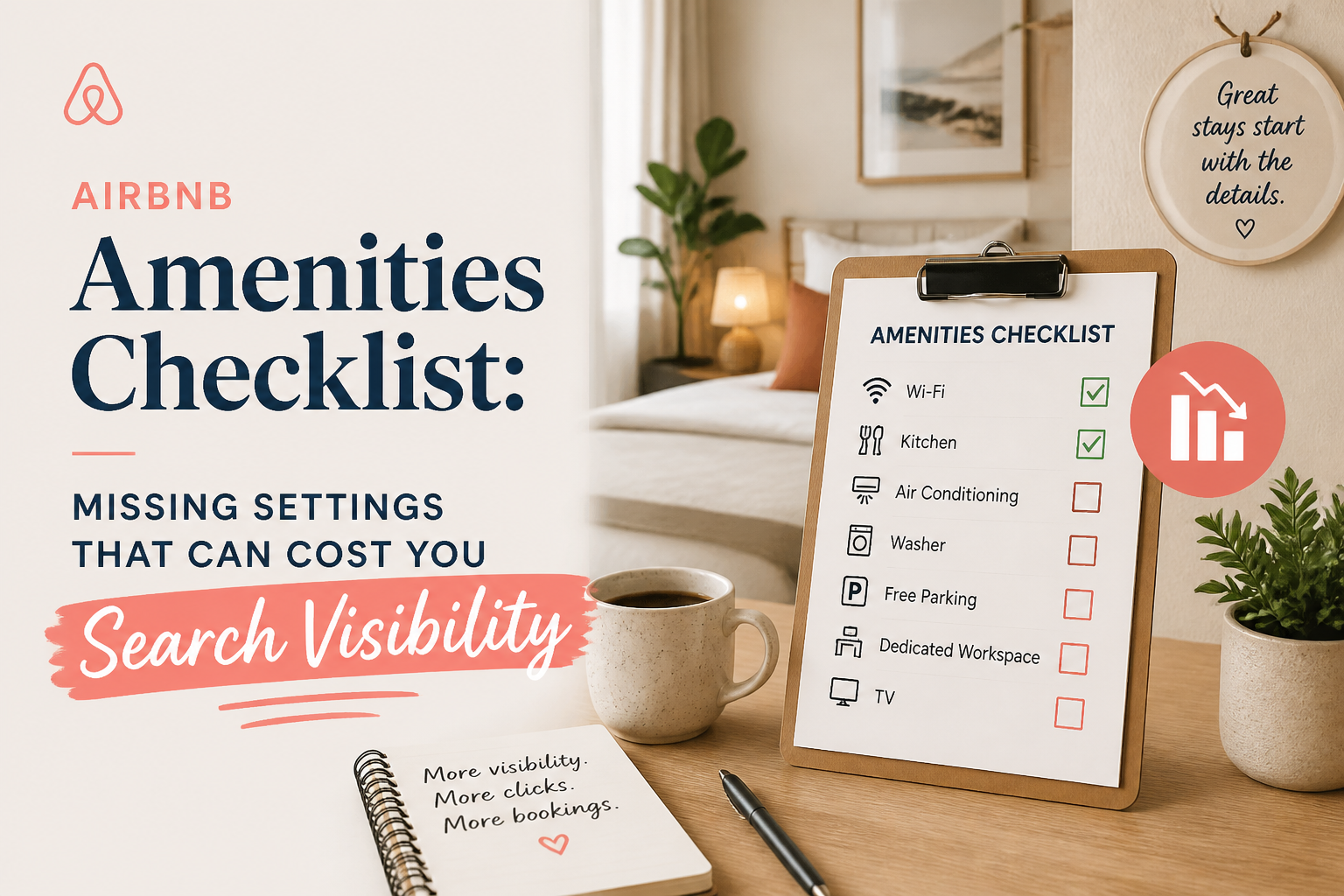 CornerstoneAirbnb Amenities Checklist: Missing Settings That Can Cost You Search Visibility
Your Airbnb may have amenities guests are searching for, but are they selected in your listing settings? Use this room-by-room checklist to find missing amenities, avoid filtered-search visibility problems, and improve your listing's accuracy.
19 min read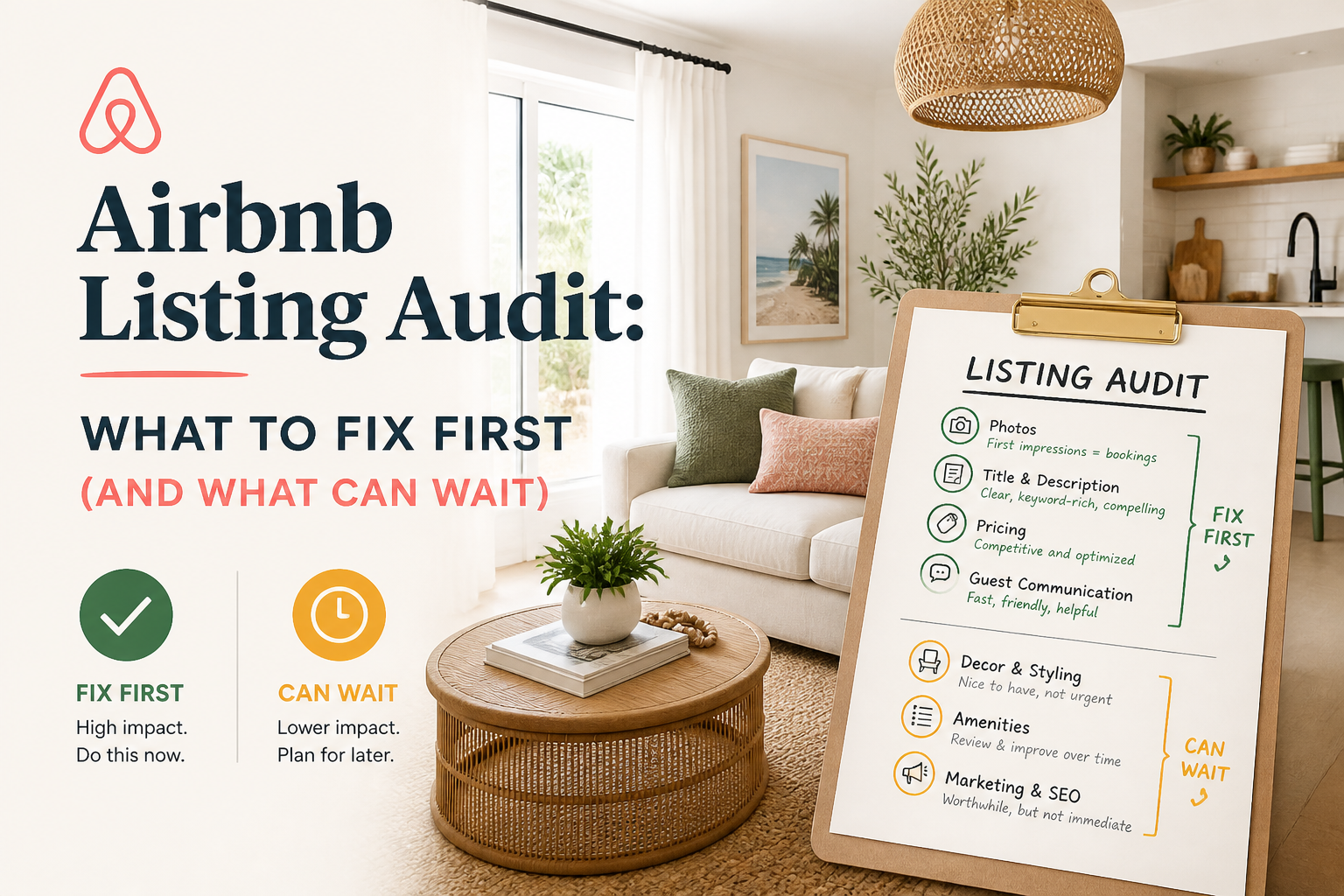 CornerstoneAirbnb Listing Audit: What to Fix First (And What Can Wait)
Not every weakness in your Airbnb listing deserves the same attention. Learn how to read an Airbnb listing audit, identify high-impact problems, and prioritize improvements that actually matter to guests.
14 min read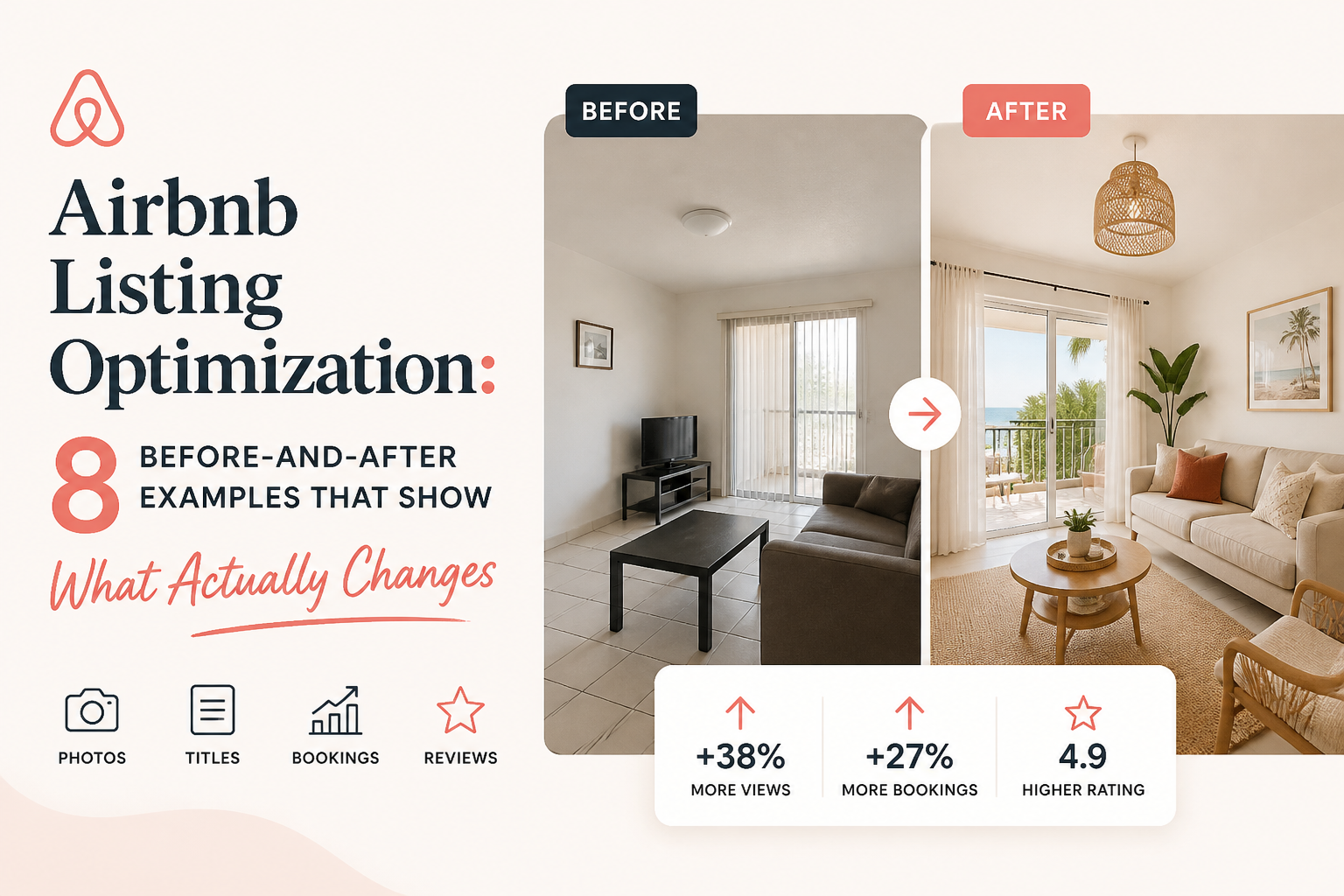 CornerstoneAirbnb Listing Optimization: 8 Before-and-After Examples That Show What Actually Changes
What does Airbnb listing optimization actually look like? Explore eight before-and-after examples covering titles, descriptions, photo order, captions, amenities, and guest expectations, plus a real SuperhostSEO listing audit.
26 min read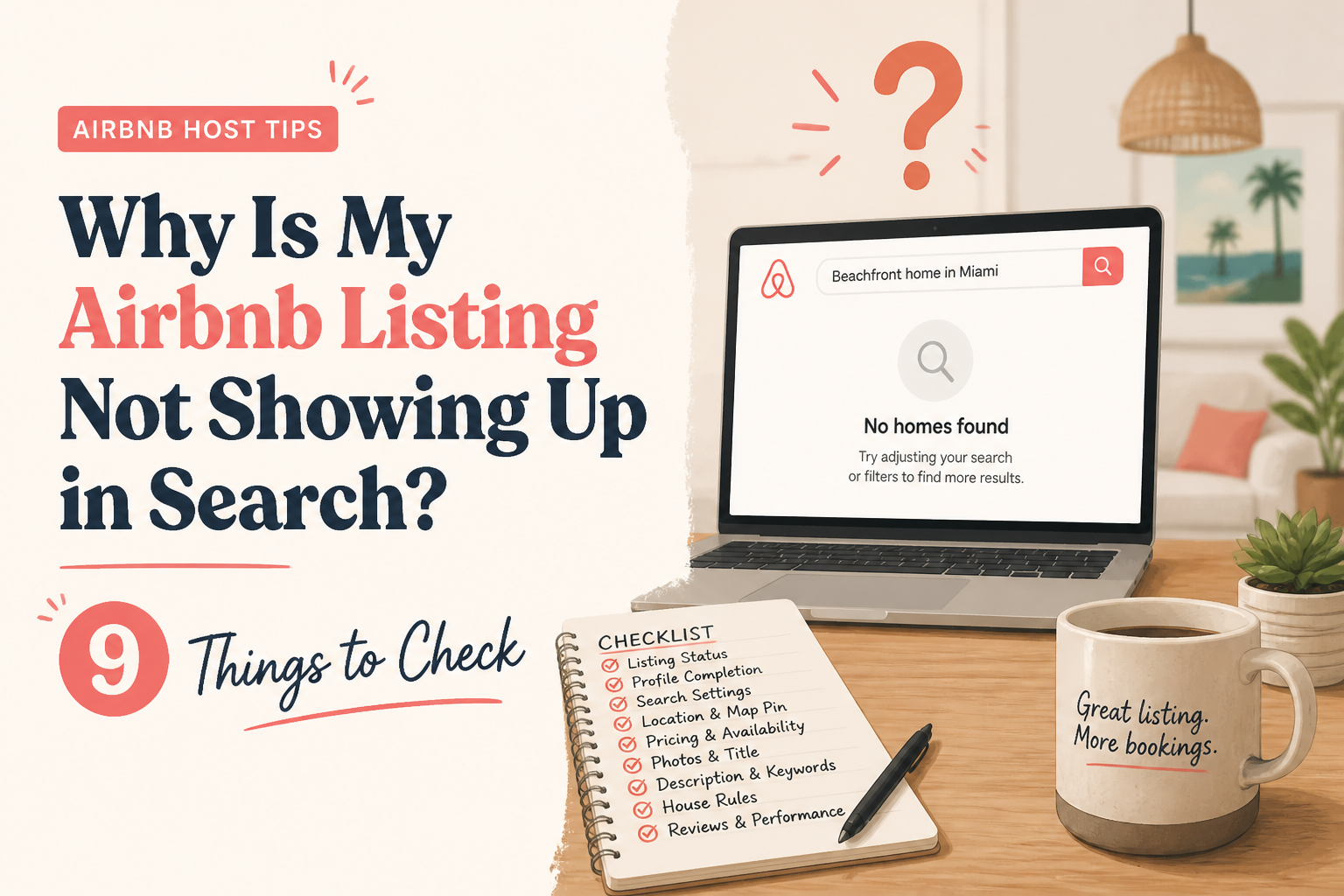 CornerstoneWhy Is My Airbnb Listing Not Showing Up in Search? 9 Things to Check
Can't find your Airbnb listing in search results? It may not be an algorithm problem. Learn how to check listing status, blocked dates, minimum stays, booking restrictions, amenities, and visibility before making unnecessary changes.
18 min read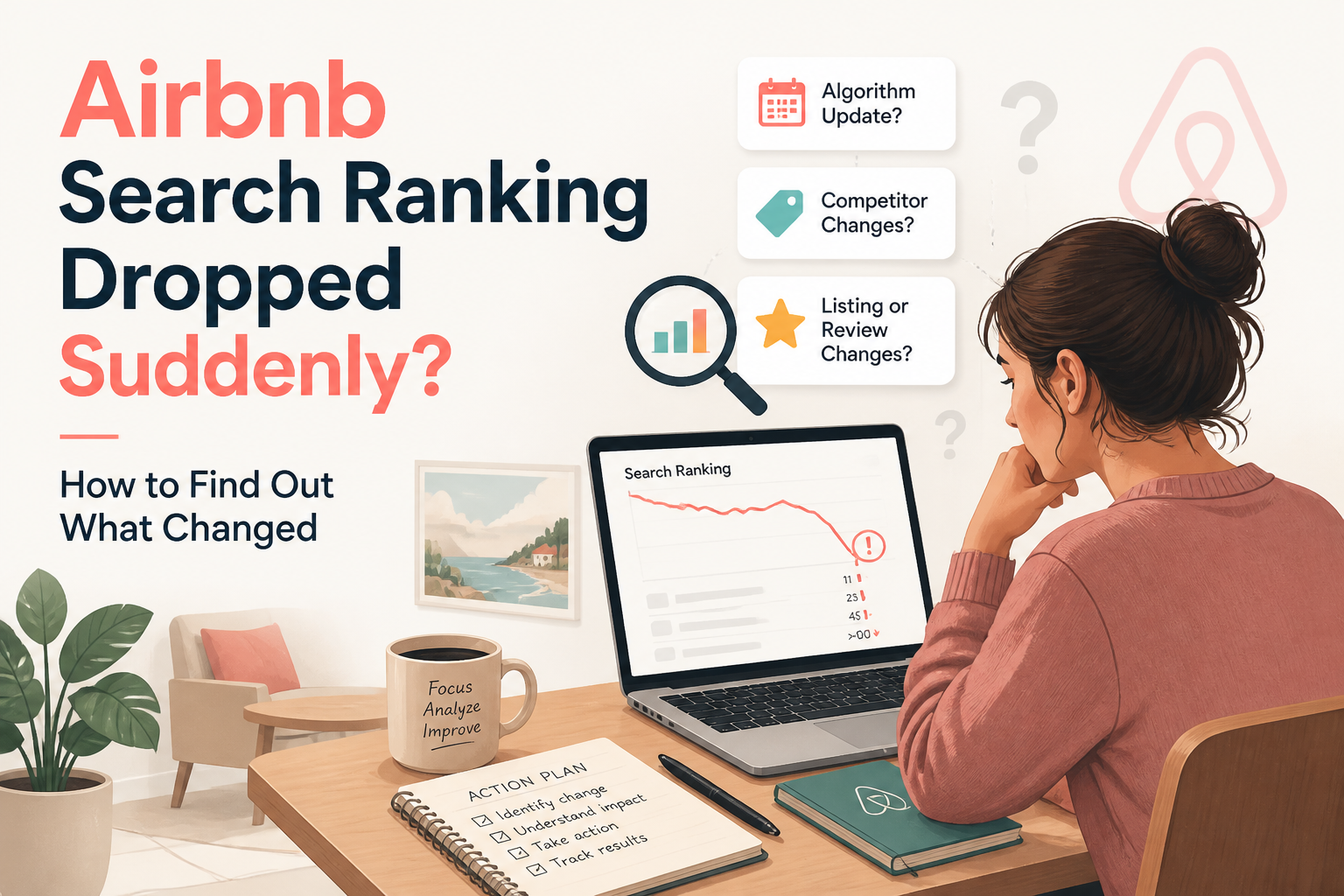 CornerstoneAirbnb Search Ranking Dropped Suddenly? How to Find Out What Changed
Did your Airbnb listing suddenly lose views or search visibility? Learn how to diagnose ranking changes, check availability and pricing, compare market conditions, and identify what to fix before rewriting your listing.
19 min read